Expense management · 11 min read · Updated:
Business expenses list 2026: deductible expenses in Türkiye and their conditions
Whether a cost counts as a tax-deductible expense depends on its conditions, not its name. In this list we've gathered the expense items businesses meet most often, with what to watch in each.
In short
- For a cost to be deducted it must relate to the business, actually have been incurred, and be backed by a proper document issued in the business's name.
- Rent, staff, energy and communication, accounting and advisory, software, advertising, shipping, bank charges, business travel and vehicle costs are the most common expense items.
- Passenger car expenses are restricted; in 2026 the part of monthly rent above 46.000 TL excluding VAT, and 30% of other costs, are non-deductible expenses.
- Tax penalties, late payment surcharges, personal spending and private costs can't be deducted; donations are treated not as expenses but as a limited deduction.
- The list gives general information; confirm with your accountant (mali müşavir) what is deductible in your own situation.
“Can we deduct this?” is the question accountants hear most. A new phone, a meal with a customer, petrol for the car, the internet bill paid while working from home. For some the answer is a clear yes, for some it's “depends on the document and how it's used”, and for some it's no.
In this article we've prepared a business expenses list: the most common expense items, the point to watch in each, and the basic conditions in force for deductible expenses as of 2026. We also cover non-deductible costs and the difference between a sole proprietorship and a limited company.
We discussed document types, the difference between a receipt and an invoice, and retention periods in detail in expense management and record keeping; here the focus is the list itself.
Part 1 · The basic rule What is a business expense, and when can it be deducted?
A business expense is spending made to earn commercial income and keep the business running. Article 40 of the Income Tax Law (GVK) and Article 8 of the Corporate Tax Law (KVK) list the deductible expenses; the logic is the same. For a cost to be deducted, three conditions apply together:
- It must relate to the business. The spending must be connected to the business's activity.
- It must actually have been incurred. The payment or debt must rest on a real purchase.
- It must be documented. There must be a proper document issued in the business's name, such as an invoice, a cash register (ÖKC) receipt, an expense voucher or a freelance receipt.
If one of these is missing, the cost doesn't count as an expense for tax, even if the money has left your pocket. The condition most often missing is the document. In 2026, purchases above 12.000 TL including taxes require an invoice; for smaller purchases an ÖKC receipt also counts.
Part 2 · The list Business expenses list: the most common expense items
The table below gathers the expense items found in almost every small and medium-sized business. The “watch out” column in each row shows the most common mistake for that item.
| Expense item | Examples | Watch out |
|---|---|---|
| Rent and service charges | Shop, office, warehouse rent; building fees | The lease should be in the business's name; withholding tax may apply |
| Energy and communication | Electricity, water, gas, internet, phone | The subscription should be in the business's name or at the business address |
| Staff | Gross wages, employer's social security share, staff meals and workwear | Must match payroll and social security filings |
| Accounting and advisory | Accountant, lawyer, consultant fees | Freelance receipt or invoice; check withholding |
| Software and subscriptions | Pre-accounting, website, domain, email, cloud storage | Services from abroad may create a VAT obligation |
| Advertising and marketing | Google and Meta ads, printed material, signage | Get an invoice for advertising spend |
| Shipping and logistics | Courier, freight, packaging | The link to sales should be visible in the documents |
| Bank and payment charges | Account fees, POS and payment provider commissions, transfer fees | Keep the bank slip and commission invoice |
| Financing | Business loan interest, credit card interest (in the business's name) | Interest on a personal loan isn't an expense |
| Vehicles | Fuel, maintenance, insurance, parking, bridge and motorway tolls | Passenger cars are restricted (Part 3) |
| Travel and accommodation | Business travel and hotels | Length and purpose must be in proportion to the business |
| Taxes, duties and fees | Taxes on business assets, notary and registration fees | Income and corporate tax themselves aren't expenses |
| Membership fees | Chamber of commerce, tradespeople's and professional chamber fees | Backed by a receipt or bank slip |
| Stationery and office | Paper, toner, cleaning supplies, small office items | Ask for an invoice on bulk purchases |
| Fixed assets and depreciation | Computers, furniture, machinery | Purchases above the threshold become expenses through depreciation, spread over years |
| Entertainment and hospitality | Business meals with customers, refreshments for visitors | Note who it was with and for what business |
| Training | Staff training, professional courses | The link to the business must be clear |
| Insurance | Premises, stock and liability insurance | The policy should be in the business's name |
There's an important distinction for fixed assets: small purchases that don't exceed the amount in Article 313 of the Tax Procedure Law (VUK) can be expensed directly, while larger ones are spread over several years through depreciation. The amount is updated every year by the revaluation rate; ask your accountant for the 2026 figure before you buy.
Part 3 · Vehicles How are vehicle and passenger car expenses deducted?
Vehicle expenses are deductible if they relate to the business, but for passenger cars the law adds a restriction. For taxpayers whose business isn't renting or operating passenger cars, 70% of passenger car expenses can be deducted and 30% is treated as non-deductible. For a rented passenger car, the part of the rent above a set amount isn't deductible.
| Expense | Rule |
|---|---|
| Fuel, maintenance, insurance, parking | 70% deductible, 30% non-deductible |
| Rented passenger car | In 2026, rent up to 46.000 TL a month excluding VAT is deductible |
| VAT on buying a passenger car | As a general rule not deductible; added to cost |
| Commercial vehicles such as vans and pickups | Not covered by the passenger car restriction |
How the vehicle is registered on its licence is the basis of this distinction. For a worked example and depreciation limits, see the passenger car section of expense management and record keeping.
Part 4 · Limits Which costs can't be deducted?
Costs that appear as expenses in the books but can't be deducted from the tax base are called non-deductible expenses (KKEG). They are paid and recorded, but added back to profit in the tax calculation. The most common are:
- Tax penalties and late payment surcharges: Tax loss penalties, irregularity penalties, late payment interest and surcharges.
- Income and corporate tax itself: Tax paid on profit isn't deductible.
- Personal and family spending: Household shopping, family holidays, clothing unrelated to the business.
- Undocumented costs: Purchases whose receipt was lost, bought in a private name, or backed only by an information slip.
- The part over the limit: The restricted share of passenger car expenses.
- Traffic fines: Not deductible even if issued to a business vehicle.
Donations are a separate matter. Donations to public-benefit associations, foundations and public bodies are not expenses but a deduction on the tax return within a limit (as a general rule 5% of declared income or corporate profit). Before donating, check whether the organisation falls within this scope.
Part 5 · Company type Is there a difference between a sole proprietorship and a limited company?
The basic conditions for deducting expenses are the same for both: business-related, real and documented spending. The difference is where the line is drawn. In a sole proprietorship the business and the owner's private life are intertwined, so the “business-related” condition is questioned more often. For example, how much of the rent and bills of an owner working from home counts as business depends on how the business premises were registered.
In a limited or joint-stock company, the company is a legal person separate from its partners. A partner's personal spending isn't a company expense; it goes to the partner's current account. We compared the tax differences between company types with numbers in sole proprietorship or limited company.
| Topic | Sole proprietorship | Limited / joint-stock company |
|---|---|---|
| Legal basis | GVK Art. 40 and 41 | KVK Art. 8 and 11 (referring to GVK rules) |
| Personal spending | Not an expense; separating it needs more care | Not an expense; recorded in the partner's current account |
| Owner's salary | A wage paid to yourself isn't deductible | A wage paid to a partner through payroll can be deductible |
| Donations | Limited deduction from declared income | Limited deduction from corporate profit |
Part 6 · In practice How do you record expenses consistently?
Knowing the expense list is half of recording expenses correctly. The other half is recording the document on the day you receive it. Receipts left until month end fade, get lost or end up in the wrong category.
In Heyşirket, on the Giderler (Expenses) screen, Gider ekle (Add expense) lets you enter the supplier, document type, due date, expense category, amount and VAT rate; the subtotal and VAT are split automatically. e-Fatura invoices from your suppliers land on the Gelen e-Faturalar (Incoming e-invoices) screen by themselves, so you don't retype them.
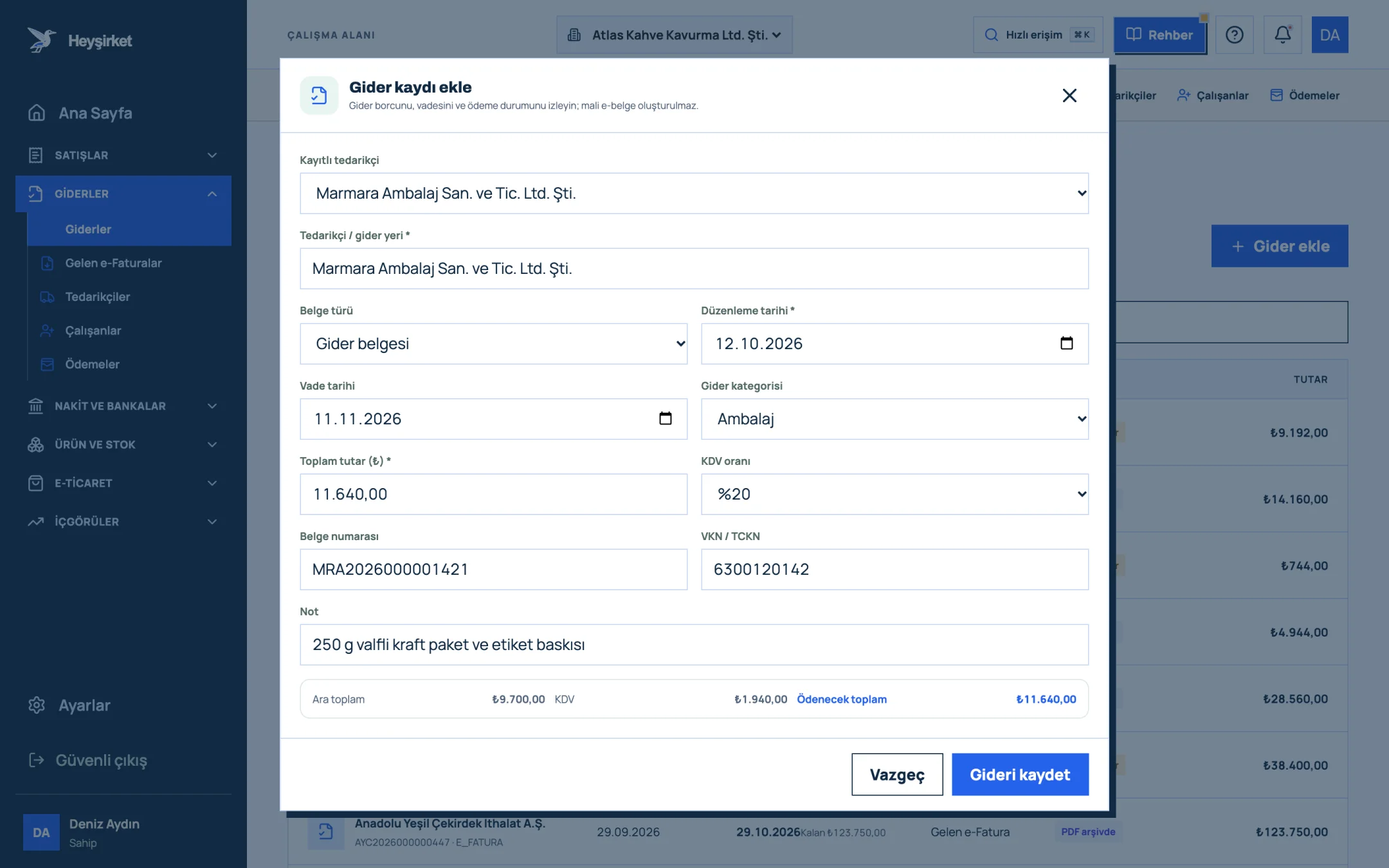
- 1. Supplier selection
- 2. Expense category
- 3. Amount and VAT rate
- 4. Subtotal, VAT and total payable
- 5. Save expense
If you set up categories based on the list in this article, you'll see month by month which item is growing in the income and expense report. For step-by-step entry see the how to enter an expense guide, and for reports the income and expenses page. If you want to tie your expenses to a monthly plan, small business budget template is the next step.
Monthly expense checklist
- Every expense document is issued in the business's name with the correct tax number.
- There's an invoice for every purchase above 12.000 TL.
- Passenger car expenses are tracked in a separate category.
- Personal spending hasn't mixed into the business records.
- Depreciation questions on fixed asset purchases have gone to the accountant.
- At month end, documents were sent to the accountant in full.
Which costs can be shown as expenses?
Costs that relate to the business, were actually incurred and are backed by a proper document issued in the business's name. Rent, staff, energy, communication, accounting, software, advertising, shipping, bank charges, business travel and vehicle costs are the most common examples.
Which costs can a sole proprietor deduct?
A sole proprietor can also deduct all business-related and documented costs. Personal and family spending and a wage the owner pays themselves aren't deductible. If you work from home, decide with your accountant how much of the home costs counts as business.
Can all passenger car expenses be deducted?
No. For taxpayers whose business isn't car rental or operation, 70% of passenger car expenses can be deducted and 30% is non-deductible. For a rented passenger car in 2026, rent above 46.000 TL a month excluding VAT isn't deductible.
Can tax penalties be deducted?
No. Tax penalties, late payment interest and surcharges, and traffic fines are non-deductible expenses; they are paid and recorded but added back to profit in the tax calculation.
Are donations deductible?
Donations are treated not as expenses but as a deduction on the tax return. For donations to public-benefit associations, foundations and public bodies, the general limit is 5% of declared income or corporate profit. For special categories of donation, ask your accountant.
Can purchases with a till receipt be deducted?
Yes, if they relate to the business and the document is valid, such as an ÖKC receipt. In 2026, purchases above 12.000 TL including taxes require an invoice. An information slip or order slip isn't an expense document.
Record your expenses by category Record each expense document on the day you get it, with supplier, category and VAT rate, and see at month end which item has grown. Open expenses
Author: Heyşirket Editorial Team