Expense management · 15 min read · Updated:
Expense management and document organization in Türkiye: which expenses can you deduct?
Every lost receipt means not getting back part of the tax you paid. Every wrongly booked expense comes back years later with an audit letter. This article shows the right path between the two.
In short
- For a purchase to be booked as an expense, it must relate to the business and be backed by a proper document (such as an invoice, ÖKC receipt, expense voucher or producer receipt).
- In 2026 the invoicing threshold is 12.000 TL; you should ask for an invoice for any purchase above this amount.
- Non-deductible expenses (KKEG) appear as expenses in the books but are added back to the tax base; 30% of passenger car expenses, tax penalties and personal spending are typical examples.
- Documents must be kept for 5 years under VUK (Tax Procedure Law) and commercial books and documents for 10 years under TTK (Turkish Commercial Code).
- Partners' personal spending should be tracked not as a company expense but through the partner current account (cari).
At the end of her first year, Deniz Hanım, founder of Atlas Kahve, handed her accountant (mali müşavir) a shoebox full of receipts. Of the 412 documents inside, 37 had faded beyond reading, 19 had been issued in her own name rather than the company's, and 8 were "information slips" left over from a dinner.
Counting the lost KDV (VAT) and the amounts that couldn't be deducted as expenses, that box cost the company the equivalent of several months' rent. And nearly all of it could have been avoided.
In this article we explain when an expense can be booked, the difference between a receipt and an invoice, non-deductible expenses and how long you need to keep documents. At the end you'll find a five-minute monthly routine that retires the shoebox for good.
Part 1 · The basic rule Under what conditions can a purchase be booked as an expense?
For a purchase to be booked as an expense for tax purposes, three conditions must all be met: it must relate to the business's activity, it must actually have been made, and it must be proven with a proper document.
If any of these three conditions is missing, the purchase is ignored in the tax calculation even though the money left your pocket. The one most often missing is the third: the document.
| Document | Who issues it? | Typical use |
|---|---|---|
| Invoice (e-Fatura, e-Arşiv) | Seller | Most purchases of goods and services; every purchase above 12.000 TL |
| ÖKC receipt (cash register receipt) | Seller | Retail purchases such as fuel, stationery and small grocery purchases |
| Expense voucher (gider pusulası) | Buyer (you) | Goods and services bought from tax-exempt tradespeople or non-taxpayers |
| Producer receipt (müstahsil makbuzu) | Buyer (you) | Buying agricultural produce from a farmer who doesn't keep books |
| Self-employment receipt (serbest meslek makbuzu) | Self-employed professional | Services from lawyers, accountants, architects and similar |
So should you get a receipt or an invoice for the same purchase? The answer depends on the amount and what you'll do with it.
Part 2 · Document type What's the difference between a receipt and an invoice?
An invoice is a commercial document that includes the buyer's company name and tax number and shows the details of the goods or services sold; an ÖKC receipt is a document printed by the cash register in retail sales, with no buyer information.
The difference isn't the form of the paper but whose name it's issued in. An invoice is issued directly to your company and proves on its own that the purchase belongs to the company. A receipt only says "someone made this purchase"; you have to establish the link to the company.
- For any purchase above 12.000 TL, ask for an invoice. A large purchase backed only by a receipt is among the first items questioned in an audit.
- From your regular suppliers, always get an invoice; even for small amounts, tracking by supplier is only possible with invoices.
- When a receipt is unavoidable (fuel, parking, small stationery), write on the back what it was for and who spent it.
- If the seller can issue e-Arşiv invoices, give your company name and VKN (tax ID) and ask for an e-Arşiv invoice; the document arrives in your email, and it doesn't fade or get lost.
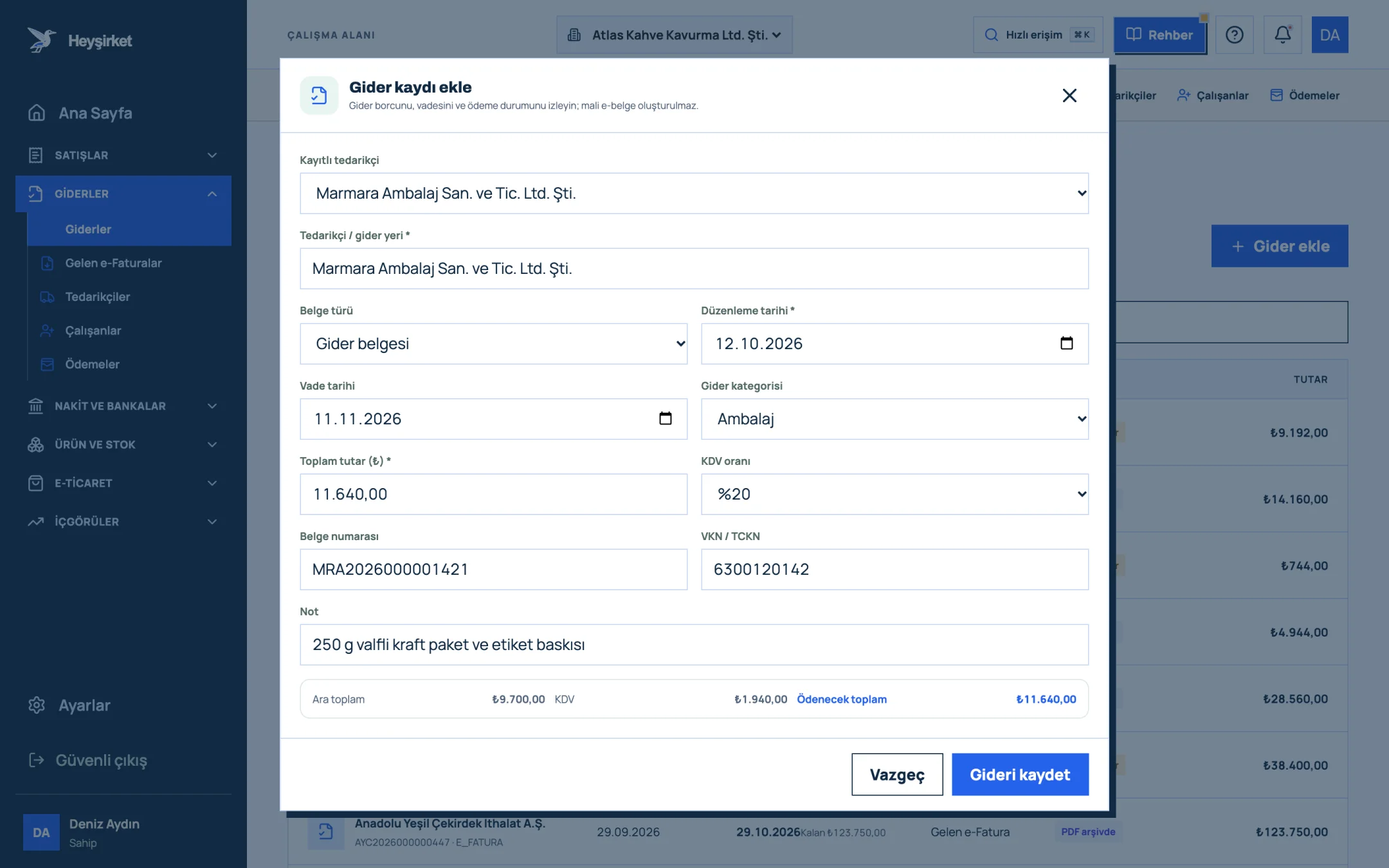
- 1. Supplier selection
- 2. Expense category
- 3. Amount and VAT rate
- 4. Subtotal, VAT and total payable
- 5. Save expense
You've got the right document. The next question is where to put it: categories.
Part 3 · Organization How should you set up expense categories?
An expense category is a label that groups your spending in ways that support management decisions. It doesn't replace the statutory chart of accounts; your accountant already posts each expense to the right account in the books. A category's job is to answer the question "where is my money going?"
A good category list is short. 8-12 categories is enough for most SMEs. A list of thirty categories won't be used consistently by anyone, and the report loses its meaning.
| Category | What does it cover? | Why separate? |
|---|---|---|
| Raw materials | Green beans, additives | Directly determines gross profit |
| Packaging | Valve bags, labels, boxes | A major part of per-product cost |
| Rent and fees | Workshop and warehouse rent, building fees | Fixed cost; open to negotiation |
| Energy | Electricity, natural gas (roasting machine) | Tracked alongside production volume |
| Logistics | Shipping, fuel, vehicle maintenance | Feeds into per-order cost |
| Marketplace and payments | Commissions, POS and payment provider fees | Essential for channel profitability |
| Professional services | Accountant, lawyer | Annual budget item |
| Software and subscriptions | Pre-accounting, e-commerce platform | An expense that grows quietly |
| Entertainment and hospitality | Customer visits, tasting events | Its limits need care |
In Heyşirket you create categories in the Categories & tags section of Settings with the "Expense category" type; this list appears both on the expense form and when creating an expense from a purchase order.
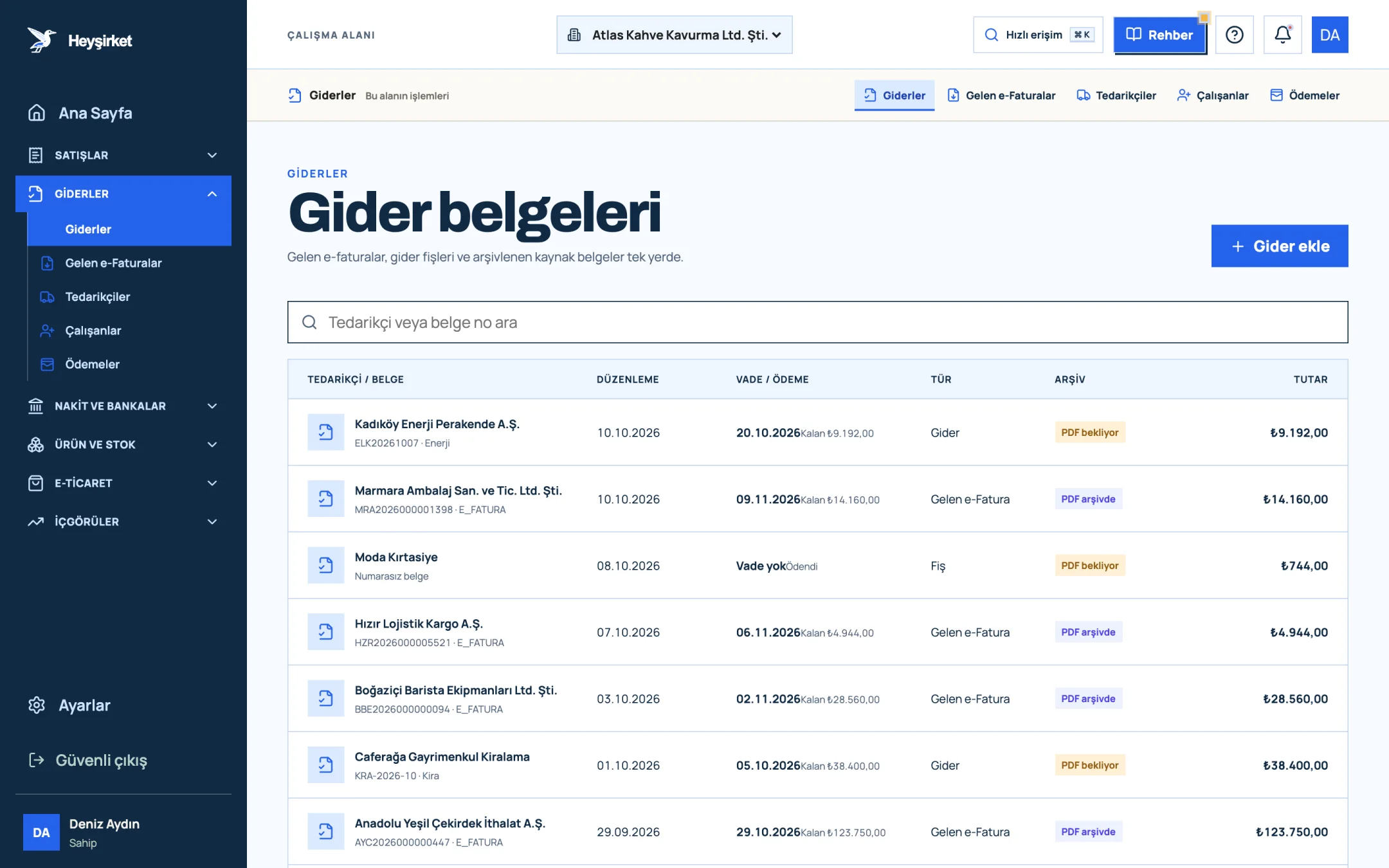
- 1. Add expense button
- 2. Due date and remaining payment
- 3. Document type (Expense, Incoming e-Fatura, Receipt)
- 4. Expense document row
Now we come to the topic that costs the most money: spending that appears as an expense in the books but not in the tax calculation.
Part 4 · KKEG What are non-deductible expenses (KKEG)?
A non-deductible expense (KKEG, kanunen kabul edilmeyen gider) is an expense that was actually incurred and recorded in the accounts but can't be deducted from the tax base because of provisions such as Article 41 of the Income Tax Law and Article 11 of the Corporate Tax Law.
KKEG isn't "forbidden spending". The company can make the purchase and record it in its books. Only at year end, when tax is calculated, is the amount added back to profit; in other words, you pay tax as if the expense had never been made.
| Expense | Why is it KKEG? | Practical note |
|---|---|---|
| Tax penalties, late payment surcharges and interest | The law explicitly prohibits deducting them | Traffic and administrative fines are treated the same way |
| Income or corporate tax paid | A tax can't be deducted from its own base | Including provisional tax |
| 30% of passenger car running costs | Expense restriction | Only 70% of costs such as fuel, maintenance and insurance can be deducted |
| The part of passenger car rent above the limit | Expense restriction | In 2026, monthly rent above 46.000 TL excluding VAT is KKEG |
| Personal spending by partners and their families | Unrelated to the business | Should be tracked through the partner current account |
| Expenses without documents or with improper documents | Can't be substantiated | Information slips, documents not issued in the company's name |
| Donations and aid above the limit | Capped at the legal rate | Check the rate with your accountant |
KKEG also has a VAT side: under Article 30 of the VAT Law, the VAT on non-deductible expenses can't be deducted either. So for a purchase that falls under KKEG, both the expense and the VAT benefit are lost. For the full logic of VAT, see our VAT guide.
| Monthly car rent (excl. VAT) | 52.000 TL |
|---|---|
| Deductible rent (2026 limit) | 46.000 TL |
| Rent left as KKEG | 6.000 TL |
| Fuel, maintenance, insurance (excl. VAT) | 10.000 TL |
| 30% of that (KKEG) | 3.000 TL |
| Total monthly KKEG | 9.000 TL |
| Corporate tax impact (at 25%, monthly) | 2.250 TL |
The annual impact means 27.000 TL in extra tax. The example is simplified; it can vary with how the car is used and the contract, so ask your accountant for an exact calculation.
Part 5 · The boundary How do you separate personal spending from the company?
Separating personal spending means keeping payments a partner or manager makes for private needs apart from company expenses. In small companies it's the most common mix-up, because the card is the same and the wallet is the same.
Doing your grocery shopping on the company card isn't a crime; booking it as a company expense is the problem. The right way is to track the amount like an advance the company gave the partner. In accounting this is usually done through the partners' current account, where it shows as the partner's debt to the company.
- Use a separate card. Reserving the company card for company spending only makes the separation automatic.
- If things get mixed, note it right away. Don't record a personal purchase made on the company card by mistake as an expense; pass it to your accountant to be posted to the partner account.
- For entertainment and hospitality, write down the purpose. A customer dinner is a company expense; a dinner with your family at the same restaurant isn't. Write on the receipt or in the record's note who it was with and for what business.
You've separated them and booked expenses correctly. One last question remains: how long do you need to keep these documents?
Part 6 · Retention How many years should expense documents be kept?
Expense documents must be kept for 5 years from the start of the calendar year following the year they relate to under Article 253 of VUK (Tax Procedure Law), and for 10 years under Article 82 of TTK (Turkish Commercial Code). In practice, following the longer period, 10 years, is the safest approach.
- 5 years VUK Art. 253 · retention for tax purposes
- 10 years TTK Art. 82 · commercial books and documents
- 12.000 TL 2026 invoicing threshold
The retention period is tied to the statute of limitations: the tax authority can audit a year's tax within 5 years from the start of the following year. An invoice you received in 2026 must be in your hands until at least the end of 2031.
e-Fatura (Turkish e-invoice) and e-Arşiv documents are stored electronically; you don't need to print them. With paper receipts, the main risk is fading. Thermal paper can become unreadable within a few years, so keeping a scanned copy of the receipt is a good habit, but don't throw away the original.
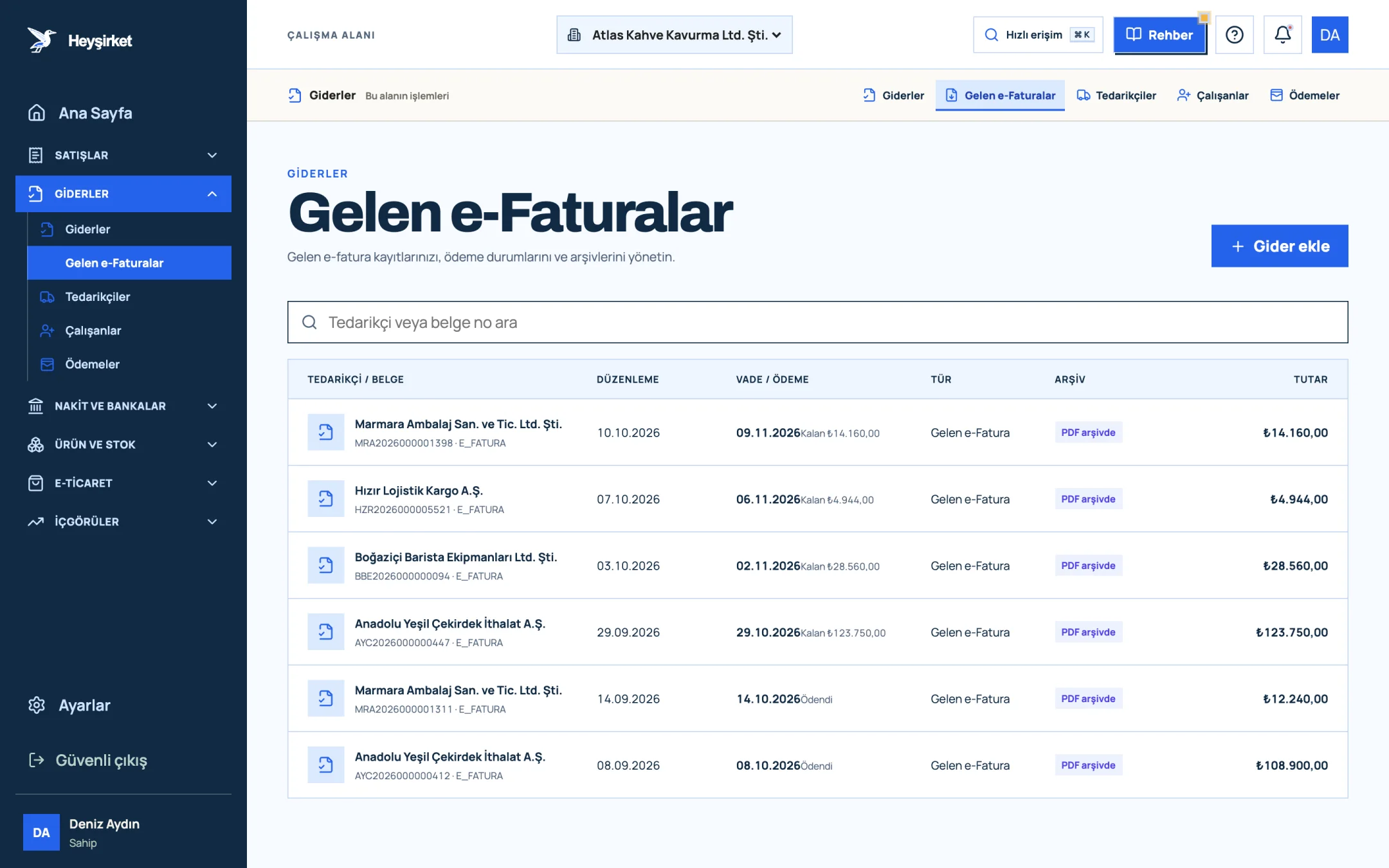
- 1. Incoming e-Faturas tab
- 2. Supplier and document number
- 3. Remaining payment amount
- 4. PDF archive status
Part 7 · Routine The monthly routine that retires the shoebox
Good document organization isn't a big clean-up at year end but small weekly habits. The flow below is the method Atlas Kahve used in its second year; almost every document handed to the accountant could be processed the first time.
- Get the document — Invoice or ÖKC receipt
- Record it the same day — Add expense
- Categorize it — Add a note and due date
- Pay and record — Add payment
- Keep the original — Monthly envelope / folder
- Hand over at month end — To your accountant
In Heyşirket, expense records are for tracking only; the statutory books are kept by your accountant. But a consistent record on your side all but eliminates your accountant's "can you find that receipt?" question. To see the recording itself step by step, check the How to record an expense guide, and for the automatic flow of e-invoices, the Incoming e-Invoices guide.
Monthly expense document checklist
- Does every purchase paid from the company card and bank account this month have a document?
- Was an invoice obtained for every purchase above 12.000 TL?
- Is the purpose and the person who spent it written on the back of each receipt?
- Has personal spending been separated from expense records?
- Are all incoming e-invoices in the list, with their payment status up to date?
- Are passenger car expenses collected in a separate category?
- Are the paper originals in an envelope or folder labeled with the month?
- Have the documents and the record list been handed to your accountant?
If you'd like to add this list to your month-end close routine, our month-end close checklist article brings all the steps together. To clarify the division of work with your accountant, see the working with your accountant guide.
Is a receipt enough for purchases under 12.000 TL?
In 2026, for purchases not exceeding 12.000 TL, the seller can issue an ÖKC receipt, and that receipt can be used as an expense document. However, proving the purchase relates to the business is your responsibility; ask for an invoice in the company's name where possible.
Can the company make a purchase that counts as KKEG?
Yes. KKEG isn't forbidden spending; the company makes the payment and records it in its books. Only when tax is calculated is the amount added back to profit, and the related VAT can't be deducted.
What can I do to replace a lost invoice?
Ask the seller for a copy of the invoice; because e-Fatura and e-Arşiv invoices are stored in the seller's system, they can be sent again. For paper invoices, request a certified copy from the seller and let your accountant know.
Do my expense categories have to match my accountant's chart of accounts?
No. Categories are for your management reports. Your accountant separately posts each expense to the right account in the uniform chart of accounts. Still, sharing your categories once makes communication easier.
What should I do with a personal purchase made on the company card?
Don't record it as an expense. Send the amount and date to your accountant and ask for it to be posted to the partner current account; close the balance by paying the company back.
Do I need to print and keep e-invoices separately?
No. Electronic documents are kept electronically. What matters is that you can access them for the legal period; the PDFs of incoming e-invoices that arrive in Heyşirket automatically are kept in the archive.
Close the shoebox today Start with this month's receipts: for each one, the amount, VAT rate, category and a short note. By month end, the list is ready. Open Expenses
Once your documents are in order, the next step is reading the VAT inside them correctly. We explain how output, input and carried-forward VAT connect in our VAT guide.
Author: Heyşirket Editorial Team