Starting a company · 17 min read · Updated:
Sole proprietorship, limited or joint-stock company in Türkiye? Choosing the right type in 2026, by the numbers
"Switch to a limited company and you'll pay less tax" is sometimes true and sometimes an expensive misconception. In this article we work out the difference in TL, using the 2026 tax rates.

In short
- In 2026, a sole proprietorship's profit is subject to progressive income tax from 15% up to 40%, while the profit of a limited or joint-stock company is subject to 25% corporate tax.
- Under the tariff for non-wage income, once annual profit exceeds roughly 1.175.000 TL a sole proprietorship's average tax burden passes 25%; that's a good starting threshold for the conversion calculation.
- A capital company's tax advantage holds as long as profit stays in the company; the portion distributed as dividends is subject to 15% withholding tax and to the partner's personal tax return.
- In a sole proprietorship the owner is liable with all their personal assets; in limited and joint-stock companies the company is liable for commercial debts, but partners and managers remain liable for public debts such as tax and SGK (social security) premiums.
- In 2026 the minimum capital is 50.000 TL for a limited company and 250.000 TL for a joint-stock company; setup and annual accounting costs are noticeably higher than for a sole proprietorship.
Atlas Kahve started life in Kadıköy as a şahıs işletmesi (sole proprietorship). For the first two years its founder, Deniz, roasted the coffee, issued the invoices himself, and his mali müşavir (accountant) prepared the tax returns. In the third year, when revenue multiplied, the accountant said just one thing: "If your profit passes 1 million this year, let's talk about switching to a limited company."
Why 1 million? Why not 500 thousand or 3 million? By the end of this article you'll be able to calculate that threshold with your own profit, and you'll also have put the three critical non-tax differences (liability, cost, partnership) into a decision table.
Part 1 · The map What's the core difference between a sole proprietorship, a limited company and a joint-stock company?
A sole proprietorship is a business in which the owner trades in their own name, with no separate legal personality; a limited şirket (Ltd. Şti.) and an anonim şirket (A.Ş., joint-stock company) are capital companies with a legal personality separate from their partners. This single difference determines your tax, your liability and how you get to the profit.
In a sole proprietorship, the business's profit is directly your income. In a capital company, the profit belongs to the company first; it only reaches you through a salary, dividends or the partners' current account. Most of the decision hinges on this "stopover".
| Topic | Sole proprietorship | Limited company | Joint-stock company |
|---|---|---|---|
| Legal personality | None, same person as the owner | Yes | Yes |
| Tax on profit | Income tax, progressive 15%-40% | Corporate tax, 25% | Corporate tax, 25% |
| Minimum capital | None | 50.000 TL | 250.000 TL |
| Can it be set up by one person? | Yes | Yes | Yes |
| Liability for commercial debts | Owner has unlimited liability | Limited to company assets | Limited to company assets |
| Liability for public debts | Owner has unlimited liability | Partners, in proportion to their capital share | Legal representatives (management) |
| Share transfer | Not possible, the business is transferred | Notarised transfer, partners' meeting approval | More flexible, by share transfer |
| Books | Single-entry or balance sheet basis, depending on thresholds | Always balance sheet basis | Always balance sheet basis |
The table shows the differences but doesn't answer the real question: which one makes you pay less tax? To answer that, we first need to put the two tax systems side by side.
Part 2 · The rates How do income tax and corporate tax compare in 2026?
Income tax is applied to a sole proprietorship's profit in brackets that rise as earnings increase; corporate tax is applied to a capital company's profit at a single rate, 25% for 2026. One is a staircase, the other a flat line.
| Income bracket | Rate | Total tax up to the end of the bracket |
|---|---|---|
| Up to 190.000 TL | 15% | 28.500 TL |
| 190.000 – 400.000 TL | 20% | 70.500 TL |
| 400.000 – 1.000.000 TL | 27% | 232.500 TL |
| 1.000.000 – 5.300.000 TL | 35% | 1.737.500 TL |
| Over 5.300.000 TL | 40% | — |
Now for the interesting part. A sole proprietorship's average tax rate climbs slowly as profit grows. On 1.000.000 TL of profit the tax paid is 232.500 TL, an average of 23,25%. Still below 25%.
The point at which the average rate equals exactly 25% is around 1.175.000 TL of profit. Below that, a sole proprietorship pays less tax; above it, the corporate tax rate becomes the better deal. That's why Atlas Kahve's accountant said "1 million".
- 25% 2026 corporate tax rate
- 15%-40% Progressive income tax on business income
- ~1,175 million TL Annual profit at which a sole proprietor's average tax reaches 25%
But this threshold is only half the story. Because if the profit doesn't stay in a capital company, it passes through a second tax before it reaches your pocket.
Part 3 · The calculation With the same profit, what's the tax burden for a sole proprietorship vs a limited company?
To compare the tax burden, the same annual profit is subjected to income tax in a sole proprietorship, and in a limited company first to corporate tax and then, if distributed, to dividend withholding tax. The two examples below use 2026 rates and simplified assumptions.
| Sole proprietorship: tax up to 400.000 TL | 70.500 TL |
|---|---|
| Sole proprietorship: remaining 200.000 TL × 27% | 54.000 TL |
| Sole proprietorship total income tax (average 20,75%) | 124.500 TL |
| Limited: 600.000 TL × 25% corporate tax | 150.000 TL |
| Sole proprietorship's advantage at this profit level | 25.500 TL |
This example is for illustration only. Bağ-Kur (self-employed social security) premiums, provisional tax timing, exemptions and deductions are not taken into account.
| Sole proprietorship: tax up to 1.000.000 TL | 232.500 TL |
|---|---|
| Sole proprietorship: remaining 1.000.000 TL × 35% | 350.000 TL |
| Sole proprietorship total income tax (average 29,1%) | 582.500 TL |
| Limited, if profit stays in the company: 2.000.000 × 25% | 500.000 TL |
| Limited, if the remaining 1.500.000 TL is fully distributed: 15% withholding | 225.000 TL |
| Limited, total with full distribution (average 36,25%) | 725.000 TL |
| Limited company's advantage if profit stays in the company | 82.500 TL |
Half of the dividend is exempt from income tax for an individual partner; dividends above a certain amount are declared on the annual return and the withholding tax is offset. So the final burden in the full-distribution scenario depends on your personal situation. Work with your accountant for an exact calculation.
The lesson from the two examples is clear: a limited company's tax advantage appears when you leave profit in the company and reinvest it. If you're going to withdraw and spend all the profit every year, changing company type for tax reasons alone may not deliver the expected benefit.
So what does the salary option change? Here's a door that simply doesn't exist in a sole proprietorship.
Part 4 · Getting to the profit Does it make sense to pay yourself a salary in a capital company?
In a capital company, the salary paid to a partner-manager is a cost the company can book as an expense; in a sole proprietorship, a salary the owner pays themselves is not accepted as an expense. This difference lets you tax part of the profit as wage income instead of corporate income.
For example, if your limited company pays you a reasonable monthly manager's salary, that amount is deducted from the company's profit and escapes the 25% corporate tax. In return, income tax, stamp duty and social security premiums arise on the salary. Because the 27% bracket on the wage tariff extends up to 1.500.000 TL, this balance can tip in your favour at some profit levels.
- Company profit — Income minus expenses
- Manager's salary — Booked as expense, wage tax
- Corporate tax — 25% on the remaining profit
- Profit kept in the company — Investment, buffer
- Dividends — 15% withholding, tax return
We've covered the tax side. Now let's move on to something that may matter more than the numbers: what you could lose if something goes wrong.
Part 5 · Risk Are you personally liable for the company's debts?
In a sole proprietorship, the business's debts are the owner's own debts, and the owner is liable with all their personal assets. In limited and joint-stock companies, commercial creditors can, as a rule, only go after the company's assets.
In other words, if your sole proprietorship can't pay a supplier, the creditor can reach your home and your personal account too. In a limited company the same debt is the company's debt. This distinction is decisive especially for businesses that take large orders, sign leases and enter long-term supply agreements.
Holding shares in a joint-stock company does not by itself create liability for public debts; liability falls on board members and legal representatives. That's why businesses planning to raise investment or transfer shares usually choose a joint-stock company.
Part 6 · Cost How big is the difference in setup and annual costs?
The cost of a company type is the sum of one-off setup expenses and the recurring yearly costs of accounting, books and corporate obligations. In a capital company, both are higher than in a sole proprietorship.
| Item | Sole proprietorship | Limited company | Joint-stock company |
|---|---|---|---|
| Capital | Not required | At least 50.000 TL | At least 250.000 TL, at least a quarter paid before registration |
| Ticaret sicili (trade registry) registration and announcement | Tradesmen's or trade registry record | Yes | Yes |
| Notary and book certification | Low | Medium | Medium to high |
| Accounting fee | Usually the lowest | Higher due to balance sheet basis | Highest |
| Corporate procedures | None | Partners' meeting resolutions | General assembly and board resolutions |
On the market, budgets of a few tens of thousands of TL excluding capital are quoted for setting up a limited company; but the real difference is in the annual accounting fee. You pay the setup cost once, the accounting difference every month. That's why a conversion that brings a 25.500 TL tax advantage can easily be wiped out by the accounting difference.
Tax, risk and cost are covered. Now let's tie them into a single decision: when does converting make sense?
Part 7 · The decision When should you switch from a sole proprietorship to a limited company?
Moving from a sole proprietorship to a capital company usually makes sense when profit rises permanently above roughly 1-1,2 million TL, when a large share of the profit will stay in the business, or when liability risk grows. A single condition is rarely enough; the decision becomes clear when you see two or three together.
Signs it's time to convert: how many apply to you?
- Profit has been above 1 million TL for the past two years and growth continues.
- You leave at least half of your profit in the business each year and reinvest it.
- You sign large supply, lease or corporate customer contracts.
- Bringing in a partner, transferring shares or talking to investors is on the agenda.
- Your corporate customers or tenders require a capital company.
- The team is growing and the business needs an identity independent of you.
Conversion has its own method too. A sole proprietorship can be transferred to a capital company together with its assets and liabilities; the legislation offers tax-advantaged transfer options under certain conditions. Details such as the timing of the transfer, valuation of stock and fixed assets, and moving your e-Fatura (Turkish e-invoice) registration to the new tax number should be planned with your accountant.
Part 8 · In practice How can you back up the decision with Heyşirket data?
The right company type decision should rest on actual figures, not estimates. The sales and expense records you keep in Heyşirket give you the raw data for the meeting with your accountant.
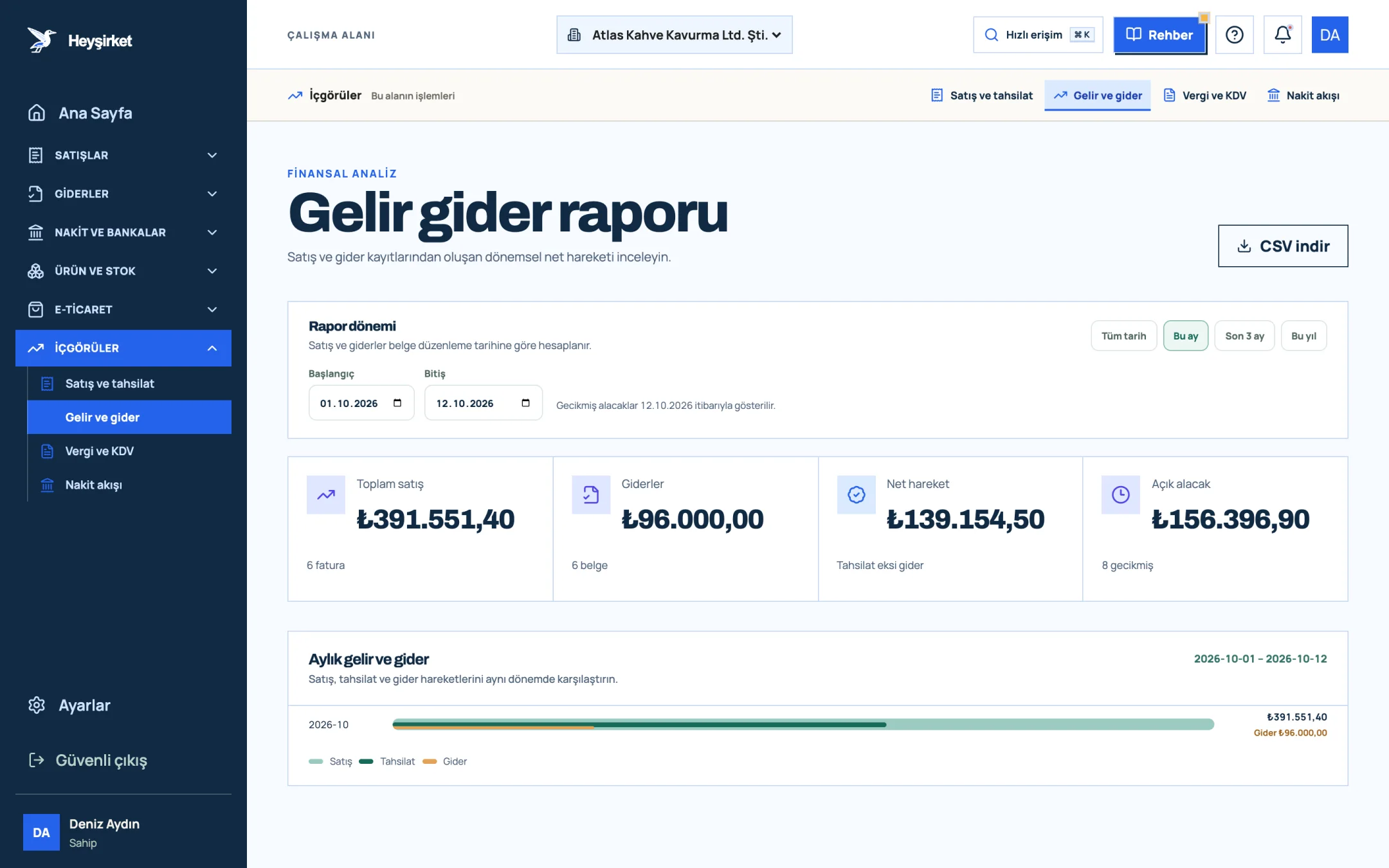
- 1. Total sales and expenses
- 2. Monthly income and expense chart
This report isn't a balance sheet or an official income statement; depreciation, stock changes and accruals live in your accountant's records. But in October it gives you a quick answer to the question "roughly how much profit are we making this year?". We explain how to read the report in the income and expense report guide.
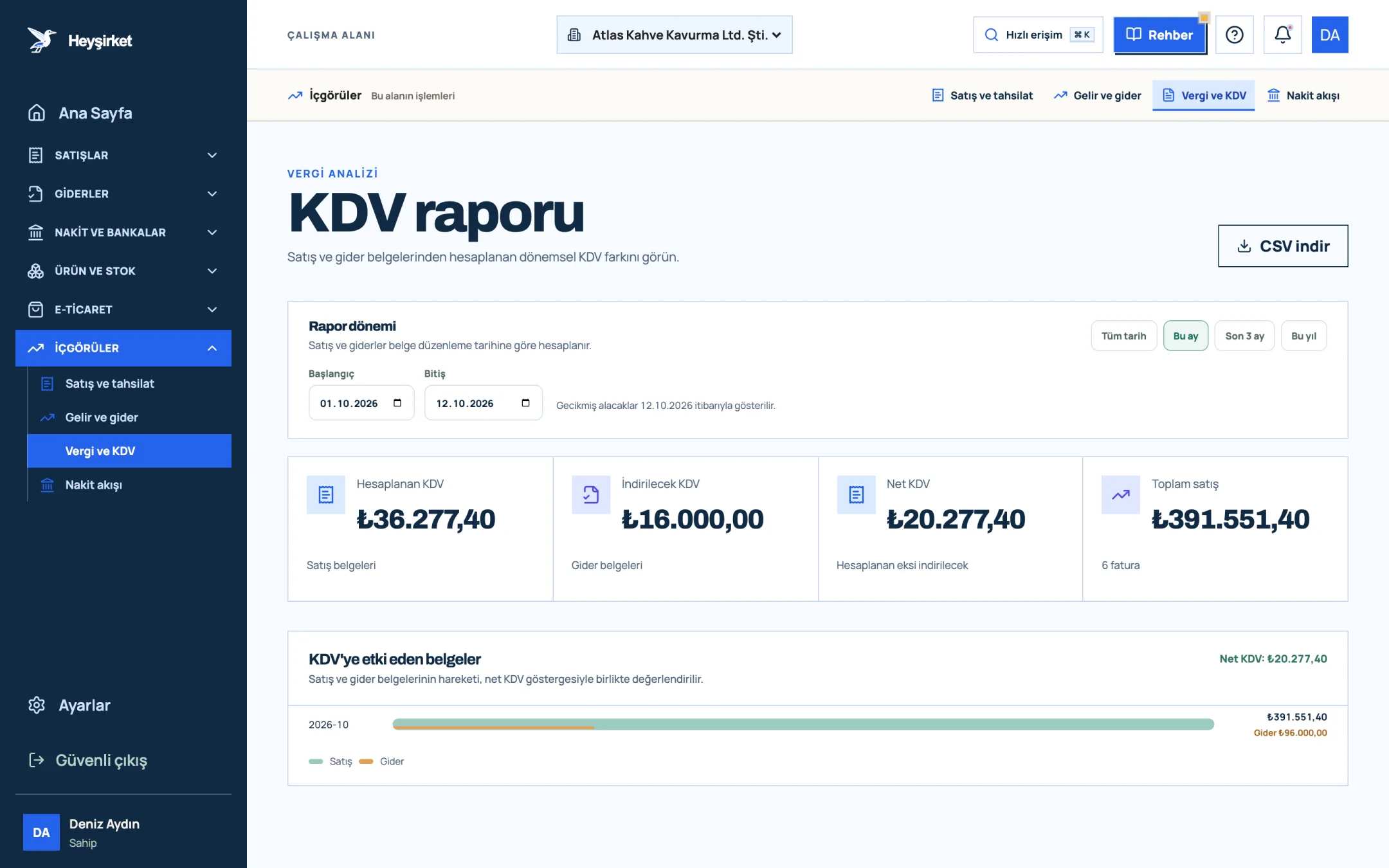
- 1. Output VAT
- 2. Deductible VAT
- 3. Net VAT
Once the conversion is done, the first thing to do is enter the new company's legal details in the system; the company name, VKN and tax office shown on invoices come from this screen.
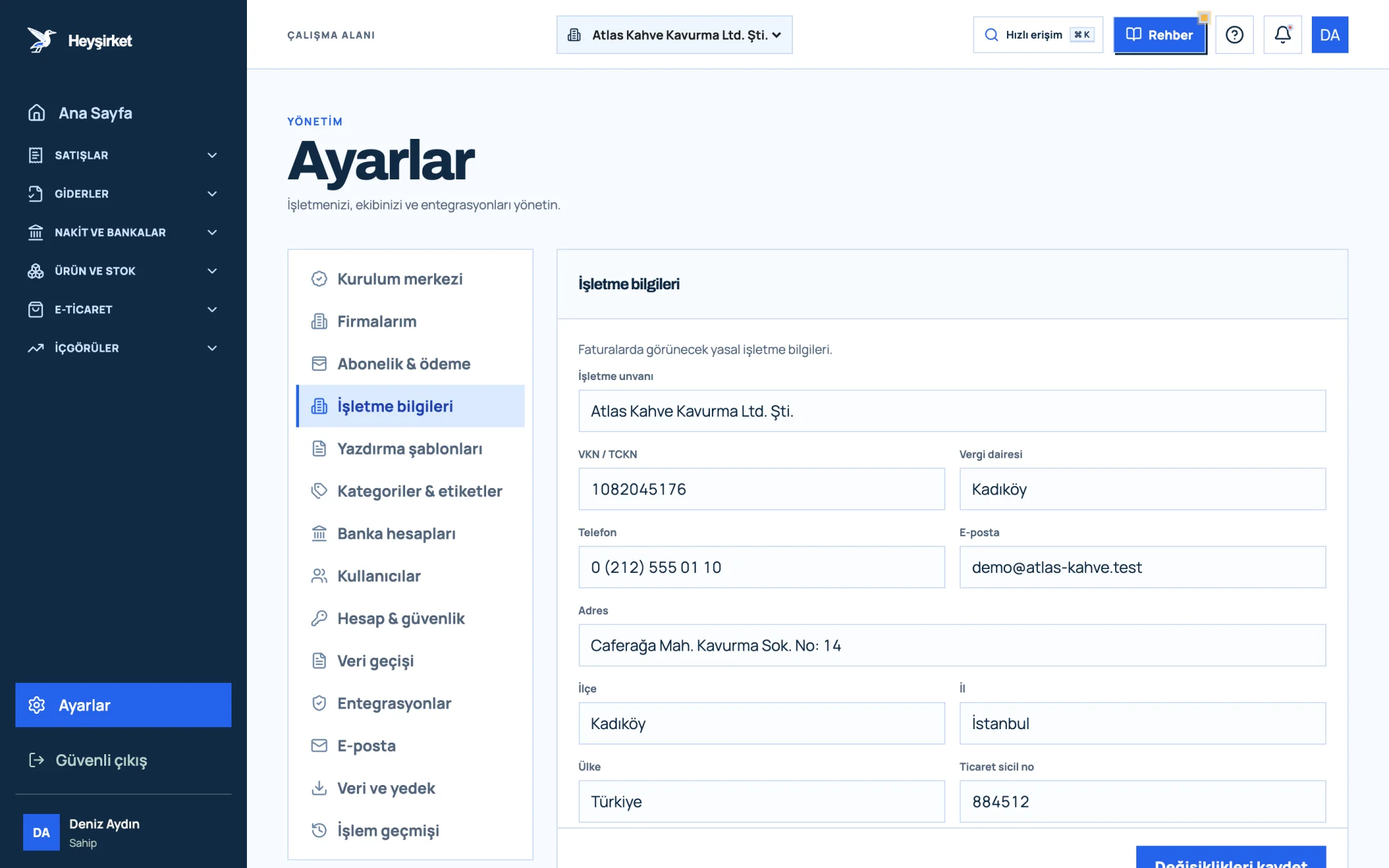
- 1. Business details tab
- 2. Company name and tax details
You'll find the other tasks for the first weeks after setting up a new company in our article on the first 30 days after starting a company, and how to split the work with your accountant in working with your accountant. The details of the business details screen are in the company settings guide.
A company type isn't a tax form; it's the skeleton of your business for the next five years. Choose it based on what you'll do with the profit, not on the rates.
Back to Atlas Kahve. Profit in the third year reached 1,4 million TL, and Deniz wanted to invest most of it in a second roasting machine and a warehouse in Ümraniye. The numbers pointed to a limited company. Today the invoices read "Atlas Kahve Kavurma Ltd. Şti.", and the profit kept in the company pays the instalments on the new machine.
Does a sole proprietorship or a limited company pay less tax?
It depends on the profit and how it's used. Under the 2026 tariff, with annual profit below roughly 1.175.000 TL a sole proprietorship's average tax stays below 25%. Above that level, and when profit is kept in the company, a limited company comes out ahead; if the profit is fully distributed, dividend withholding tax reduces that advantage.
Is there a tax difference between a limited company and a joint-stock company?
No, both are subject to 25% corporate tax. The differences are in the capital amount, how easily shares can be transferred, who bears liability for public debts and the burden of corporate procedures.
Can a sole proprietor pay themselves a salary?
No. A salary a sole proprietor pays themselves can't be booked as a business expense; money they take out of the business is a drawing from profit. In a capital company, however, a salary paid to a partner-manager can be booked as a company expense.
Will switching to a limited company free me from Bağ-Kur?
Usually not. Like sole proprietors, limited company partners are as a rule insured under 4/b (self-employed). Check your insurance status with your accountant before changing company type.
How long does it take to convert a sole proprietorship into a limited company?
Trade registry registration is usually completed within days, but preparing the transfer, valuation and moving bank and e-document accounts to the new company can take a few weeks. Planning the switch for the start of a month makes closings easier.
If I'm going to withdraw all the profit, should I set up a limited company?
For tax reasons alone, usually not; dividend withholding and the personal tax return largely cancel out the corporate tax advantage. But non-tax reasons such as limiting liability, bringing in a partner or working with corporate customers can still justify a limited company.
Estimate this year's profit now Open the income and expense report with the This year period, add a rough estimate for the remaining months and try the figure against the tariff above. Take that figure to your meeting with your accountant. Open income and expense report
Author: Heyşirket Editorial Team