Cash management · 16 min read · Updated:
Managing cheques and promissory notes in Türkiye: QR codes, endorsement, due dates and bounced-cheque risk
In Türkiye, the cheque is still the most common way to pay on deferred terms. Managed well, it strengthens your cash plan; managed badly, it becomes your biggest receivables risk.
In short
- A cheque is payable on sight; however, under Cheque Law No. 5941, a cheque bearing a future issue date cannot be presented to the bank for payment before that date.
- A cheque payable in the same place must be presented to the bank within 10 days of its issue date, and one payable in a different place within one month; if the deadline is missed, some of the holder's rights weaken.
- For every bounced cheque leaf, the drawee bank must pay the holder up to an amount set by TCMB (Central Bank of the Republic of Türkiye); for newly printed leaves in 2026, this amount is 16.350 TL.
- On the holder's complaint, a bounced cheque can lead to a judicial fine of up to 1,500 days per cheque, plus a ban on issuing cheques and opening cheque accounts.
- Checking the QR code through Findeks before accepting a cheque, and tracking your portfolio by drawer and due date, are the two most practical ways to reduce bounced-cheque risk.
It's Friday afternoon, and an envelope is being opened on Atlas Kahve's accounting desk. Inside is a cheque that was received from a hotel customer three months ago and endorsed over to a coffee supplier. On it is the bank's stamp: dishonoured.
The cheque has come back from the supplier, which means that debt is now Atlas Kahve's again. And it's too late in the day to call the hotel. By the end of this article you'll know the five checks to make before you ever take a cheque in hand, so you never open that envelope again, and how to monitor your portfolio every week.
Part 1 · The basics What are cheques and promissory notes, and how do they differ?
A cheque (çek) is a written instruction from the person who issues it to their bank to pay a stated amount to whoever presents the cheque. A promissory note (senet, or bono) is a document in which the issuer unconditionally promises to pay a specific amount to the payee on a specific due date.
The key difference is who makes the payment. With a cheque, a bank sits in between, and a cheque bouncing is subject to special sanctions. With a promissory note, you rely directly on the debtor; if it isn't paid, your route is enforcement proceedings.
| Feature | Cheque | Promissory note (bono) |
|---|---|---|
| Legal nature | A payment instruction to a bank | The issuer's promise to pay |
| Who pays | The drawee bank, from the drawer's account | The debtor directly |
| Due date | Payable on sight; can be post-dated | On the due date written on it |
| If unpaid | Bank liability amount, judicial fine and bans may apply | Enforcement proceedings specific to negotiable instruments |
| Upfront check | Findeks query using the QR code | The debtor's general credit and payment history |
Five terms you should know
- Drawer (keşideci): the person or company that issues and signs the cheque or note.
- Drawee bank (muhatap banka): the bank named on the cheque that will make the payment.
- Payee and holder (lehtar and hamil): the payee is the person the cheque was originally made out to; the holder is whoever has the cheque at that moment.
- Endorsement (ciro): transferring the cheque to someone else by signing the back. The endorser is liable to later holders if the cheque bounces.
- Issue date (keşide tarihi): the date written on the cheque. What's called a "post-dated cheque" in practice is a cheque bearing a future issue date.
Underline the endorsement point. It's exactly why the cheque in the envelope came back to Atlas Kahve: a customer cheque you pass on to your own supplier is still your risk, because you endorsed it.
Part 2 · Due dates and presentment When should a cheque be presented to the bank?
Presentment (ibraz) means submitting the cheque to the drawee bank for payment. Under the Turkish Commercial Code, a cheque payable in the same place must be presented within 10 days of its issue date, and one payable in a different place within one month; if the places of issue and payment are on different continents, the period is three months.
- Receipt — QR code check
- Portfolio — Recorded with due date
- Endorse or deposit for collection — Supplier or bank
- Presentment — From the issue date
- Paid or bounced — Money in, or follow-up
Every step of this journey carries a date, and a missed date can cost you money. So what should you check before adding a cheque to your portfolio?
Part 3 · Upfront checks What is a QR-coded cheque and how do you check it?
A QR-coded cheque (karekodlu çek) is a cheque leaf carrying a QR code that holds the drawer's bank, branch, account number and cheque number. In Türkiye, printing cheque leaves with a QR code was made mandatory by Central Bank regulation.
When the QR code is scanned with the Findeks service of the Kredi Kayıt Bürosu (Credit Bureau), you get a QR-Coded Cheque Report. This report shows whether the cheque leaf really belongs to that bank and the drawer's past cheque payment performance. To run the query you need a commercial Findeks membership and a usage package; confirm the terms with Findeks or your bank.
Five checks before you take a cheque
- Scan the QR code with Findeks; confirm that the cheque leaf is valid and see the drawer's payment history.
- Check that the amount in figures matches the amount in words, and that the issue date and place are written.
- If the drawer isn't your customer, make sure the chain of endorsements is unbroken.
- Confirm that the due date doesn't exceed the terms you agreed with the customer.
- Compare the cheque amount with the customer's open balance; note whether the cheque settles one invoice or several.
Part 4 · The law What happens if a cheque bounces?
A bounced cheque (karşılıksız çek) is a cheque that was presented to the bank on time but wasn't paid because there wasn't enough money in the drawer's account. In that case the bank notes on the back of the cheque that it's dishonoured, and the holder can start exercising their rights against the bank, the drawer and the endorsers.
Your first safeguard is the drawee bank. For every cheque leaf presented on time with no funds or insufficient funds, the bank must pay the holder up to an amount set by the Central Bank. For cheque leaves printed from 30 January 2026, this amount is 16.350 TL; a lower amount applies to leaves printed earlier.
| Cheque amount | 100.000 TL |
|---|---|
| Balance in the drawer's account | 5.000 TL |
| Bank's top-up obligation (16.350 − 5.000) | 11.350 TL |
| Total the holder receives from the bank | 16.350 TL |
| Unpaid amount to pursue | 83.650 TL |
The bank's liability is calculated for a newly printed cheque leaf using the 2026 amount. Confirm with your bank which amount applies based on your cheque's print date.
Promissory notes are different: there's no specific offence of a "bounced note". For an unpaid note, the creditor's main route is enforcement proceedings specific to negotiable instruments. That's why, when accepting a note, you should look at the debtor's overall ability to pay even more carefully than with a cheque.
What must a valid promissory note contain?
Article 776 of the Turkish Commercial Code lists the elements a promissory note must carry. If one is missing, the document may not count as a promissory note, and the fast-track enforcement route for negotiable instruments may be closed; the law also provides fallback rules for certain gaps, such as the due date and place of payment.
- The words "bono" or "emre muharrer senet" (promissory note to order) in the text of the note.
- An unconditional promise to pay a specific amount.
- The due date and place of payment.
- The name of the payee, i.e. who is to be paid.
- The date and place of issue.
- The issuer's signature.
What to do in the first week after a cheque bounces
First steps when a cheque bounces
Keep the document and the bank's annotation
Keep the original cheque and the dishonour note written on the back somewhere safe. This document is essential in any legal process; take a photocopy and file the original.
Record the amount the bank paid
If the payment the bank made up to its liability amount has reached your account, record it in Heyşirket as money in to the relevant bank account with Add transaction, and write the cheque number in the description.
Close the portfolio record
Mark the cheque record with Return and, as the reason, note that it bounced, the bank payment and the date. That way your received portfolio total reflects reality.
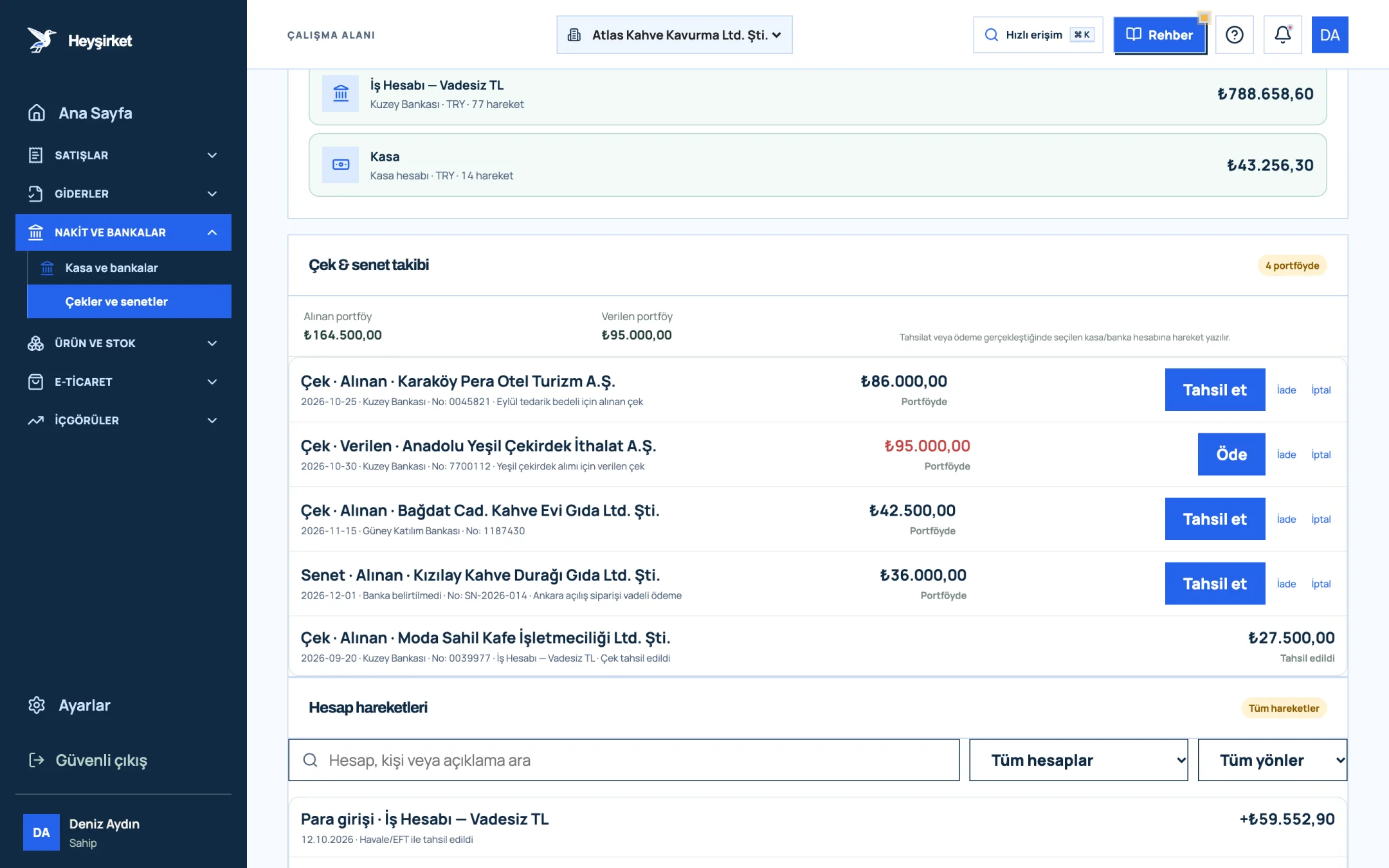
Close the portfolio record - 1. Received and issued portfolio summary
- 2. Received check in portfolio and Collect
- 3. Issued check and Pay
- 4. Collected check
Talk to the drawer, and don't miss the deadlines
First, speak to the drawer directly about payment. If that doesn't work, contact a lawyer without delay, because statutory deadlines for complaints and proceedings are running.
Update your cash plan
Remove the unpaid amount from your 13-week cash table; at best, move the chance of collecting it into your pessimistic scenario.
Part 5 · Risk tracking How do you track the risk in your cheque portfolio?
Cheque portfolio risk is the chance that some of the cheques you've received won't be paid on their due dates, and the effect that would have on your cash plan. The risk is shaped less by individual cheques than by the structure of the portfolio: how much you depend on whom, and which weeks the due dates cluster in.
- 1. Received and issued portfolio summary
- 2. Received check in portfolio and Collect
- 3. Issued check and Pay
- 4. Collected check
| Drawer | Number of cheques | Total | Share of portfolio |
|---|---|---|---|
| Karaköy Pera Otel | 3 | 180.000 TL | %50 |
| Nişantaşı Bistro | 2 | 72.000 TL | %20 |
| Moda Sahil Kafe | 2 | 54.000 TL | %15 |
| Kuzguncuk Fırın & Kahve | 3 | 54.000 TL | %15 |
| Total | 10 | 360.000 TL | %100 |
The table asks a question on its own: if half the portfolio is made up of a single hotel's cheques, any payment problem at that hotel is Atlas Kahve's problem too. In that case it makes sense to reassess the hotel's open balance and payment habits before accepting any new cheques.
- Drawer concentration: the larger a single drawer's share of the portfolio, the more the risk piles up in one place. Set yourself an upper limit.
- Due-date concentration: many cheques falling due in the same week means one bounced cheque that week can upset the whole plan.
- Issued portfolio: the cheques you've issued are your obligations. If there are no funds in your account on the due date, the sanctions apply to you.
- Endorsed cheques: even after they leave your hands, the risk remains; track them on a separate list until their due date.
When should you ask for a bank transfer instead of a cheque?
Accepting a cheque effectively means giving your customer extra time to pay and taking on some risk. It's something to negotiate, and you don't have to give every customer the same answer.
For the first orders from a new customer, for a drawer whose check comes back weak, or for a company that already has a large share of your portfolio, asking for payment by bank transfer (havale or EFT) is a sensible rule. For a customer who has paid on time for years, on the other hand, a cheque can be a flexibility that strengthens the relationship. Tying the decision to a written customer policy rather than to individual cheques makes your team's job easier and keeps you consistent with customers.
Offering a small discount to customers who pay upfront by bank transfer is another way to encourage early payment. Decide by comparing the cost of the discount with what it costs you to have that money tied up for the term of the cheque.
Part 6 · In practice How do you track cheques and notes in Heyşirket?
In Heyşirket, cheques and promissory notes are tracked in the Cheque & note tracking section of the Cash & Bank screen. With the Cheque / note button you add a record to your portfolio by entering the document type, direction, drawer or payee, due date, amount, bank and serial number; this record doesn't affect your balance yet.
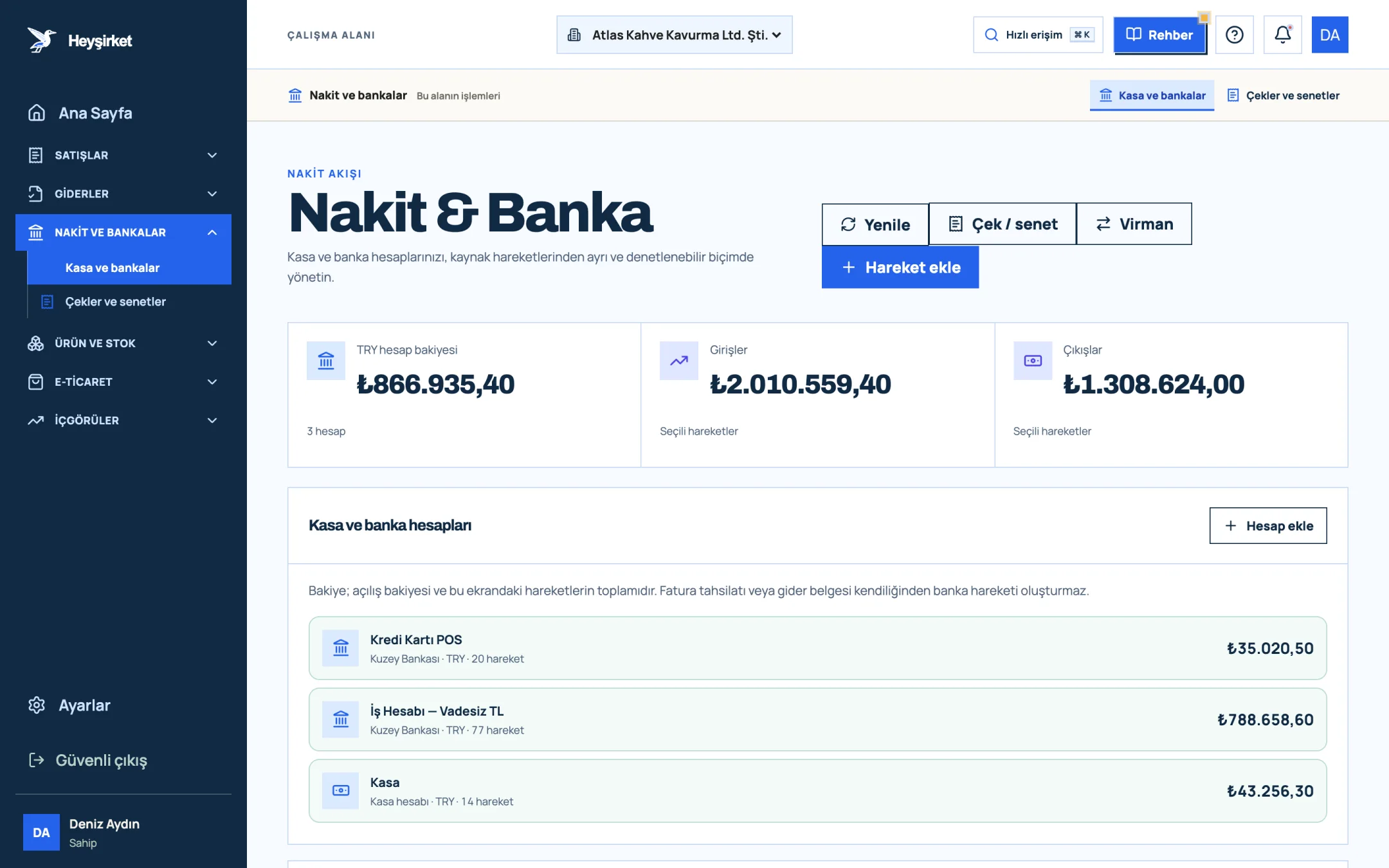
- 1. Add transaction button
- 2. Transfer between accounts
- 3. Total TRY balance
- 4. Cash and bank account list
When the due date arrives, received documents are processed with Collect and issued documents with Pay, and a transaction is written automatically to the account you choose. A document that bounced or was handed back is closed with Return, and a record that should be voided with Cancel; both ask for a reason. Heyşirket doesn't have a separate endorsement step, so you need to make a separate note of the cheques you endorse.
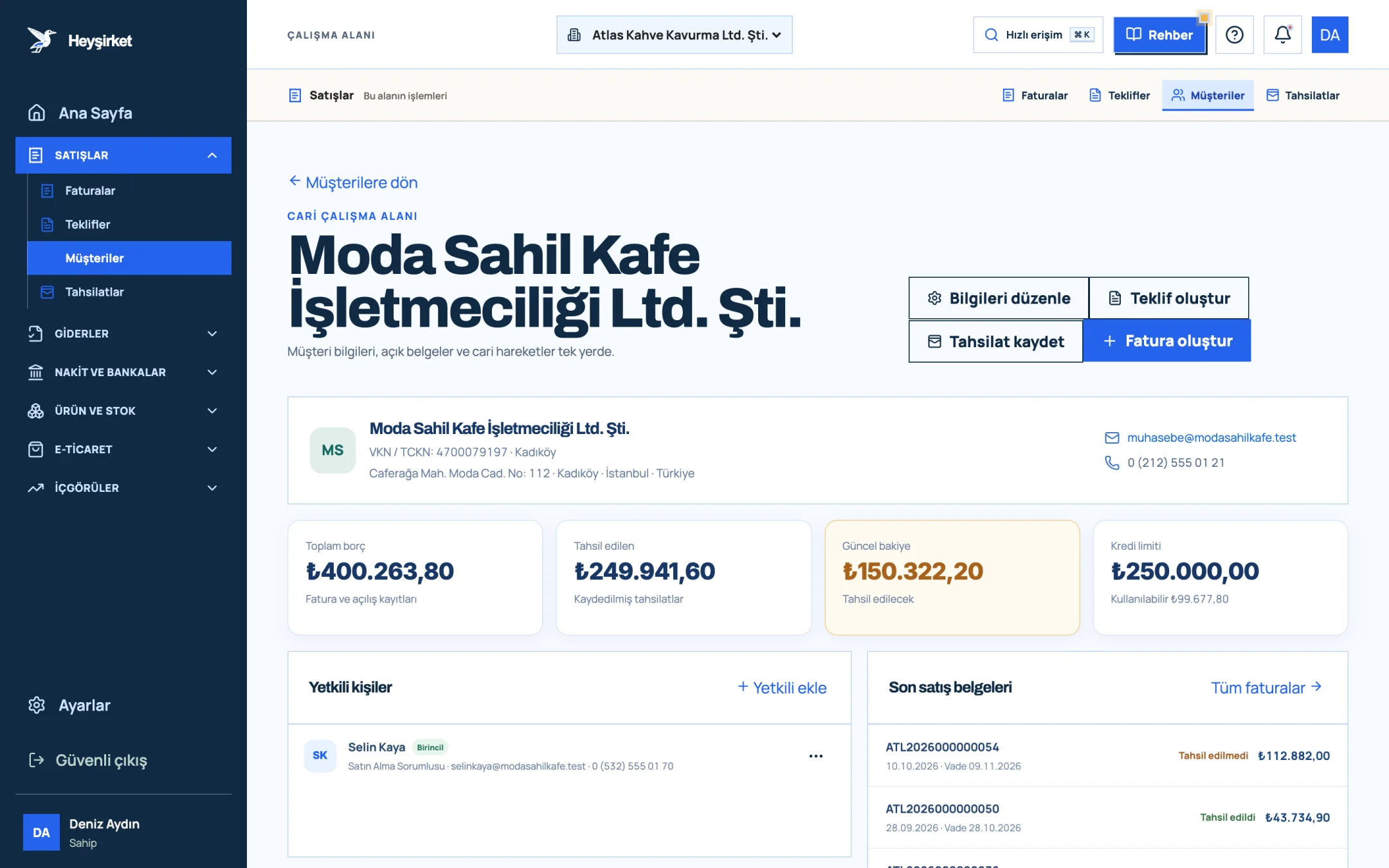
- 1. Quick actions (Create invoice, Record collection)
- 2. Current balance
- 3. Credit limit
- 4. Recent sales documents
For a screen-by-screen walkthrough, see the cheque and note tracking guide, and to regularly confirm customer balances with the other party, read our article on account reconciliation.
Back to the cheque in the envelope. From that day on, Atlas Kahve set two rules: no cheque enters the portfolio without a Findeks check, and no single drawer's share can exceed a third of the portfolio. The hotel is still a customer, but it now pays part of what it used to pay by cheque through bank transfer instead.
Can I hand a cheque to the bank before it's due?
You can hand the cheque to your bank for collection in advance, but under Cheque Law No. 5941 it cannot be presented to the drawee bank for payment before the issue date written on it. In Heyşirket, too, the collection date can't be set earlier than the due date.
How much does the bank pay for a bounced cheque in 2026?
Under the communiqué TCMB updated in January 2026, it's 16.350 TL for each cheque leaf printed from 30 January 2026. A lower amount applies to leaves printed earlier; confirm your cheque's status with your bank.
Does a bounced cheque carry a prison sentence?
The sanction set out in the Cheque Law is, on the holder's complaint, a judicial fine of up to 1,500 days per cheque, plus a ban on issuing cheques and opening cheque accounts. For details such as how the penalty is enforced and the effect of payment, consult a lawyer.
Is the Findeks cheque report paid?
A QR-coded cheque query requires a commercial Findeks membership and a query package; since package prices can change, check the current terms with Findeks or your bank.
Can I treat an invoice as closed when I'm paid by cheque?
Until the cheque is collected, the receivable isn't truly closed. So track the cheque in your portfolio and record the payment when the money reaches your account on the due date; for the collection process, see our article on speeding up receivables collection.
Move your cheque and note portfolio into Heyşirket Record the cheques in your drawer and the notes you've issued with their due dates; post the ones that fall due to your cash or bank account in a single step. Go to cheques and notes
Author: Heyşirket Editorial Team