Customer accounts · 15 min read · Updated:
Account reconciliation: how do you agree on a balance with your customer?
If the same relationship shows two different figures in two companies' books, that difference will one day turn into either a lost payment or an awkward argument. Reconciliation is how you catch it while it's still small.
In short
- Account reconciliation (cari hesap mutabakatı) is when two businesses confirm in writing the balance they owe each other as of a specific date.
- Form Ba and Form Bs notifications were abolished from the September 2024 period by VUK General Communiqué No. 565; in 2026 there is no threshold for these notifications.
- Most reconciliation differences come from invoices in transit, unrecorded collections, return and discount documents, and exchange rate and timing differences.
- A confirmation letter must always include the date, the balance, whether it's a debit or credit, the response deadline and contact details for objections.
It's the end of December. The accountant at Karaköy Pera Otel sends Atlas Kahve a short email: “Our records show we owe you 162.400 TL.” Atlas Kahve's statement, however, says 186.400 TL.
Whose mistake is the 24.000 TL difference? Maybe nobody's. Or maybe one side is right and the other will never pay that money. By the end of this article you'll have a four-step method that lets you resolve a difference like this in an hour, plus a ready-made confirmation letter outline.
Part 1 · Definition What is account reconciliation?
Account reconciliation is when two businesses that work together compare the balance they owe each other as of a specific date and confirm it in writing. The result is either a “the balance is correct” confirmation or a list explaining the difference.
Reconciliation is generally good accounting practice rather than a legal obligation. But the benefits are concrete: it finds recording errors early, shortens collection disputes and, in a disagreement, leaves you with a document the other party has confirmed.
- 1 confirmation date: usually month or year end
- 2 parties: you and your customer (or supplier)
- 4 steps: statement, letter, comparison, correction
Who should you reconcile with?
As a rule, with every cari (customer/supplier account) that doesn't have a zero balance at period end. In practice, prioritize by amount and risk:
- Large customers: The top 10-20 customers who make up a significant share of your total receivables. A difference here directly affects your cash.
- Irregular payers: With customers who often pay in part or settle several invoices with a single transfer, there's a high chance a payment gets linked to the wrong invoice.
- Main suppliers: Reconciling with the party you owe catches duplicate payments and overlooked expense invoices.
- Long-inactive accounts: An old balance is either a collection someone forgot to close or a receivable that needs following up.
So are the forms everyone used to file every month still in force? Let's settle that question first.
Part 2 · Regulation Are BA-BS forms still filed in 2026?
No. Form Ba (purchases of goods and services) and Form Bs (sales of goods and services) notifications were abolished starting with the September 2024 period. That's why there's no BA-BS threshold set for 2026 either.
This change had a practical side effect. In the BA-BS era, documents over 5.000 TL were reported by both sides every month, so mismatches came onto the tax authority's radar, and businesses treated reconciliation as a mandatory routine.
The forms are gone, but the tax authority already sees e-Fatura (Turkish e-invoice) and e-Arşiv (e-archive invoice) data. So mismatches between the two sides can still be spotted; the only difference is that the responsibility for catching them now rests entirely with you. That's why reconciliation hasn't lost its importance; it has just become voluntary.
What's more, e-Fatura and e-Arşiv documents make it easier for an invoice to be recorded on both sides with the same number, date and amount. Most of the remaining differences are no longer on the invoice side but on the collection, return and timing side. Reconciliation exists precisely to catch these differences.
Part 3 · Method How do you do an account reconciliation step by step?
Account reconciliation is done in four steps: pulling your own statement, sending a confirmation letter to the other party, comparing the two lists line by line and correcting differences with documents.
- 1. Statement — Balance as of the date
- 2. Letter — Balance and response deadline
- 3. Comparison — Line-by-line matching
- 4. Correction — Document, record, confirmation
1. Prepare your own statement
Before reconciling, make sure your own records are complete: every transfer received up to that date should be entered as a collection, and invoices that should be cancelled should be cancelled. Otherwise you'll be sending your own mistake to the other party.
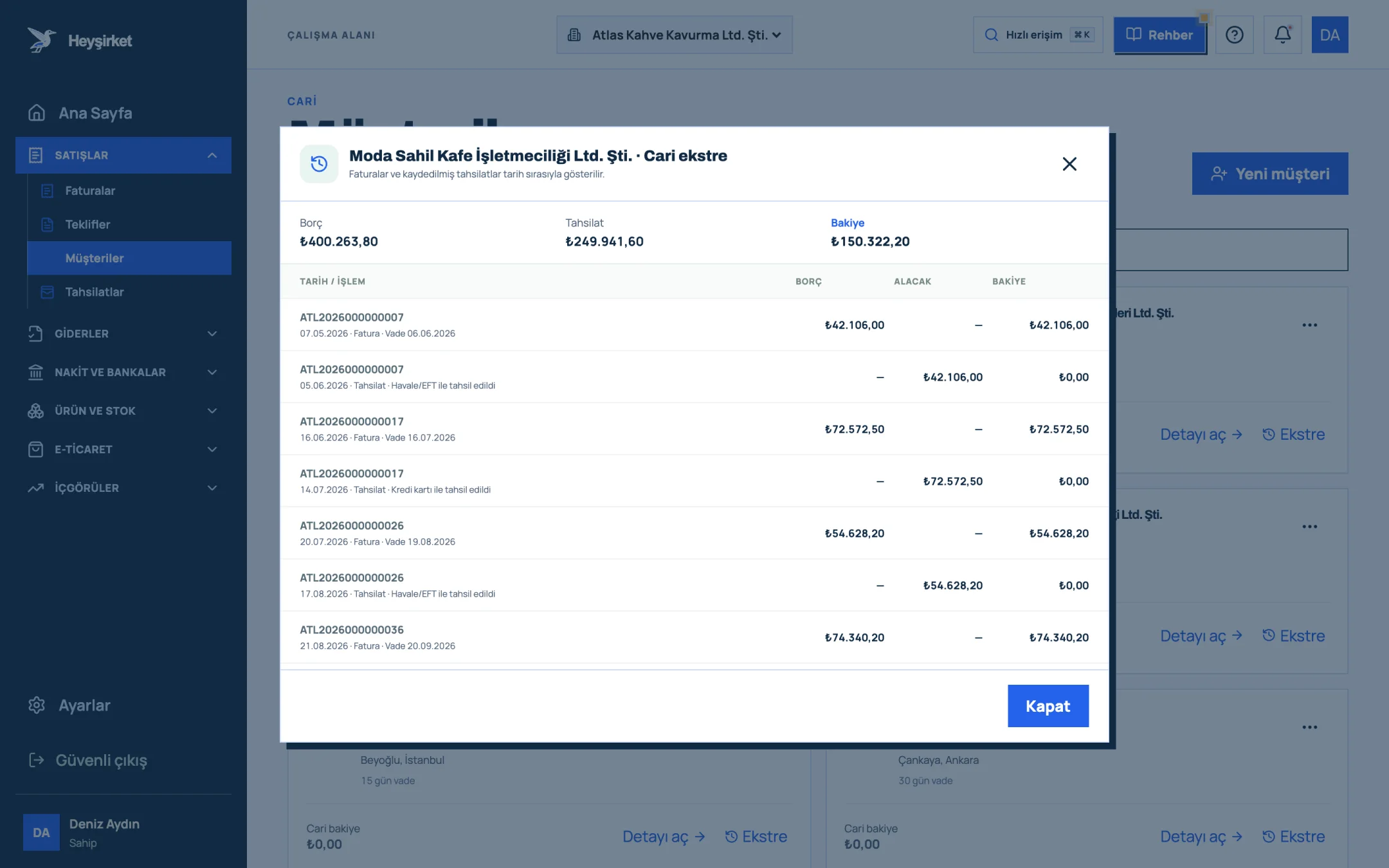
- 1. Account statement window
- 2. Statement transactions and balance
In the Heyşirket statement, invoices are on the debit side and recorded collections on the credit side; each line shows the due date, the collection note if there is one and the running balance. A balance you imported from your old software appears at the top as the “Opening balance”. We explain how to read the statement in the customer account workspace guide.
Choose the reconciliation date correctly from the start, too. The last day of the period (e.g. 31 December) is the most common choice, because both sides are already reviewing their books for the close on that date. But you should ask for the reply within the first few weeks after that date, which gives both sides time to process bank transactions and the latest invoices.
2. Send the confirmation letter
A confirmation letter is a short letter asking the other party to confirm, or object to, the balance as of a specific date. It doesn't need to be long; it needs to be complete.
| Element | Example |
|---|---|
| Sender and recipient company names, VKN (tax ID) | Atlas Kahve Kavurma Ltd. Şti. → Karaköy Pera Otel |
| Reconciliation date | As of 31.12.2026 |
| Balance and direction | Debit balance of 186.400,00 TL in our favor |
| Currency | TL |
| Response options | “We agree” / “We don't agree, the balance in our records is: …” |
| Response deadline | 15 days from the date of the letter |
| Attachment | Transaction list (statement) |
| Contact | Accounting contact, email and phone |
A sample text could read like this:
Dear Karaköy Pera Otel Accounts Department, according to our records, as of 31.12.2026 your company has a debit balance of 186.400,00 TL owed to our company. The transaction list is attached. Please compare the balance with your records and reply within 15 days with either “we agree” or “we don't agree”; if you don't agree, please share the balance in your own records along with your transaction list.
3. Compare the lists line by line
If the other party says “we don't agree”, you need to ask for their transaction list. Put the two lists side by side in date order and match each document: invoice number, date and amount. The lines that don't match are the source of the difference.
4. Correct the difference with documents
Every difference should be tied to a document: a missing collection record is entered, an incorrect invoice is cancelled or a return invoice is issued. After the correction, get a short written confirmation of the new balance; that closes the file.
Part 4 · Diagnosis What causes reconciliation differences most often?
Most reconciliation differences come from timing, not mistakes: a document has been recorded on one side but not yet on the other. Typical causes are:
| Cause | How to spot it | Fix |
|---|---|---|
| Invoice in transit | Recorded at period end on your side, in the next month on the customer's | Confirm the invoice date and delivery; note it as a timing difference |
| Unrecorded collection | The customer says they paid; you have no collection line | Find the bank transaction and enter the collection with the date the money arrived |
| Payment linked to the wrong invoice | The total matches but individual invoices don't | Cancel the collection record and re-enter it against the right invoice |
| Return or discount document | The customer deducted a discount; you have no document | Issue a return invoice or price difference document |
| Duplicate record | The same invoice appears twice on one side | Cancel the duplicate record |
| Cheque / promissory note | The customer counts it as paid on the day they handed over the cheque | Clarify whether the cheque is in the portfolio or has been collected |
| Exchange rate difference | TL amounts differ on foreign currency transactions | Consult your accountant on the exchange rate and date used |
| Balance on Atlas Kahve's statement | 186.400,00 TL |
|---|---|
| Balance reported by the hotel | 162.400,00 TL |
| Difference | 24.000,00 TL |
| 30 December invoice (the hotel recorded it in January) | 18.000,00 TL |
| 31 December transfer (not entered at Atlas Kahve) | 6.000,00 TL |
| Unexplained difference | 0,00 TL |
Atlas Kahve enters the 6.000 TL collection dated 31 December; the correct balance becomes 180.400 TL. The 18.000 TL invoice is a timing difference and appears in the hotel's January records.
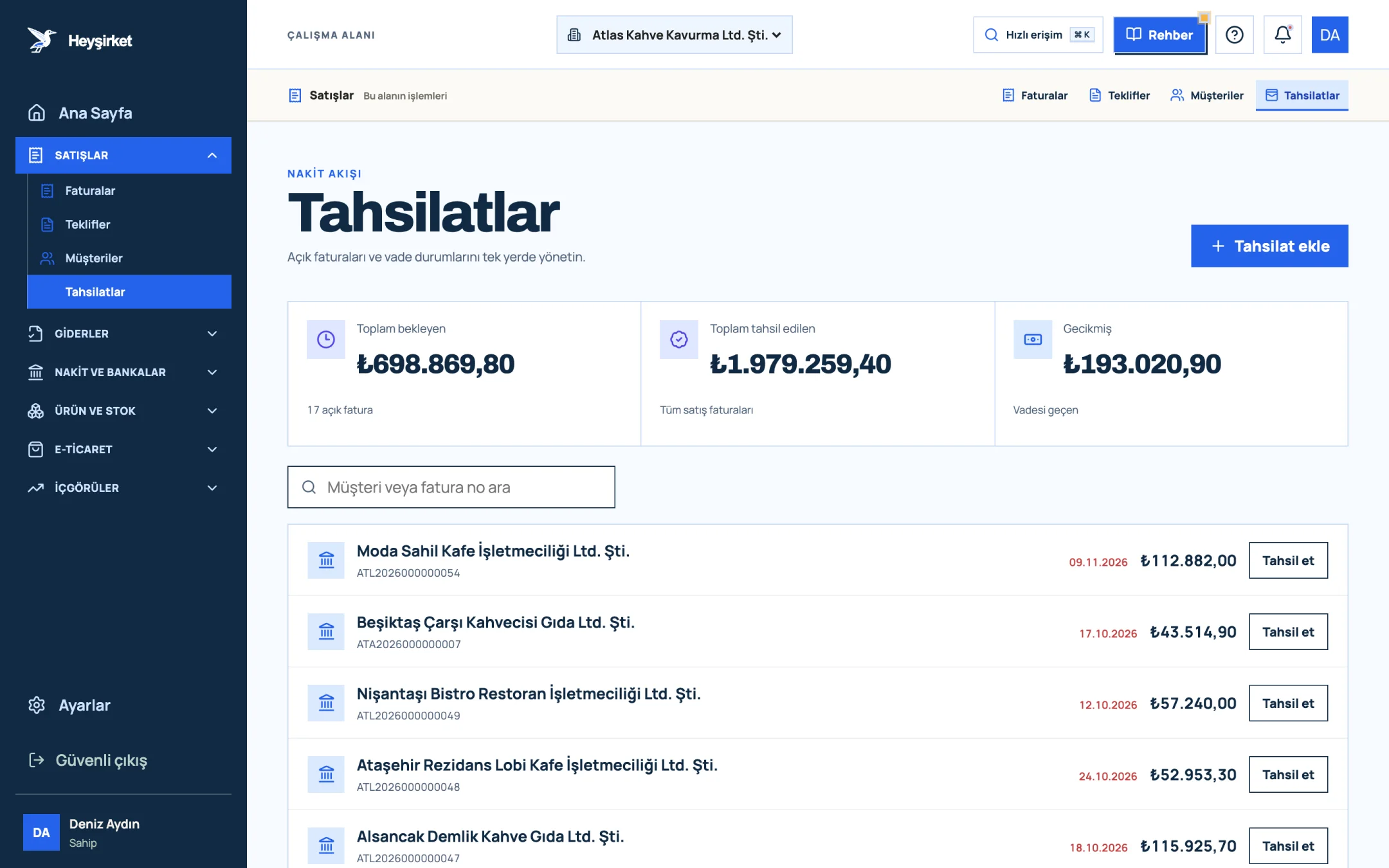
- 1. Add collection button
- 2. Total pending receivables
- 3. Total overdue receivables
- 4. Per-row Collect button
Who corrects the difference, and with what document?
The rule is simple: the side that made the mistake corrects its own record with a document. If you invoiced too much, you cancel the invoice or the customer issues a return invoice; if the customer forgot to record one of your invoices, the correction is made in their books.
- Don't touch closed periods: Corrections relating to a month for which the VAT return has been filed can also affect that return. Consult your accountant before making these entries.
- Fix collection errors at the source: Remove a collection entered with the wrong amount using Cancel record in the invoice details and enter the correct one; the statement updates automatically.
- Add a note to every correction: Writing an explanation such as “found in the 31.12 reconciliation” in the collection's Note field saves time for whoever asks the question a year later.
The value of reconciliation comes less from zeroing out the difference than from knowing the cause of every difference. A difference whose cause you know can be managed; one you don't know is next period's surprise.
Part 5 · The other side Why does supplier reconciliation matter in its own right?
Supplier reconciliation is the same confirmation done with the party you owe; this time the balance is against you. On the customer side it prevents lost collections; on the supplier side it prevents duplicate payments and missed invoices.
For Atlas Kahve, the typical example is its green coffee importer. If one of five e-invoices received during the month isn't recorded as an expense, the VAT deduction is lost and the supplier rightly asks for the shortfall. Conversely, if the same invoice was paid twice, the difference only comes to light during reconciliation.
- Check incoming e-invoices: Make sure every incoming document for the period has been recorded as an expense; details are in the incoming e-invoices guide.
- Match payment receipts: Write in the description which invoice each payment settles.
- Don't sit on the supplier's letter: Replying to an incoming confirmation letter within the deadline is part of a good payment reputation.
When the same discipline runs on both sides, the period-end close takes hours, not days. So how often should you do it?
Part 6 · Rhythm How often should you reconcile?
Reconciliation should be done at least once a year, at the year-end close. For customers with high volumes or irregular payment behavior, doing it every quarter, or even monthly, settles disputes while they're still small.
- Year end: All active customers and suppliers. It's the basis of your financial statements.
- Quarter end: The top 10 customers who make up most of your total receivables.
- Event-based: Before a relationship with a customer ends, before legal action, and during a company transfer or merger.
Before taking legal action, a signed reconciliation is one of the strongest supports for your claim. We cover the steps on the collection side in detail in our speeding up receivables collection article.
Part 7 · In practice How do you prepare for reconciliation in Heyşirket?
In Heyşirket, preparing for reconciliation starts with recording collections on time and against the right invoice; the statement is generated automatically from these records. At month end, all you need to do is open the statement and check it.
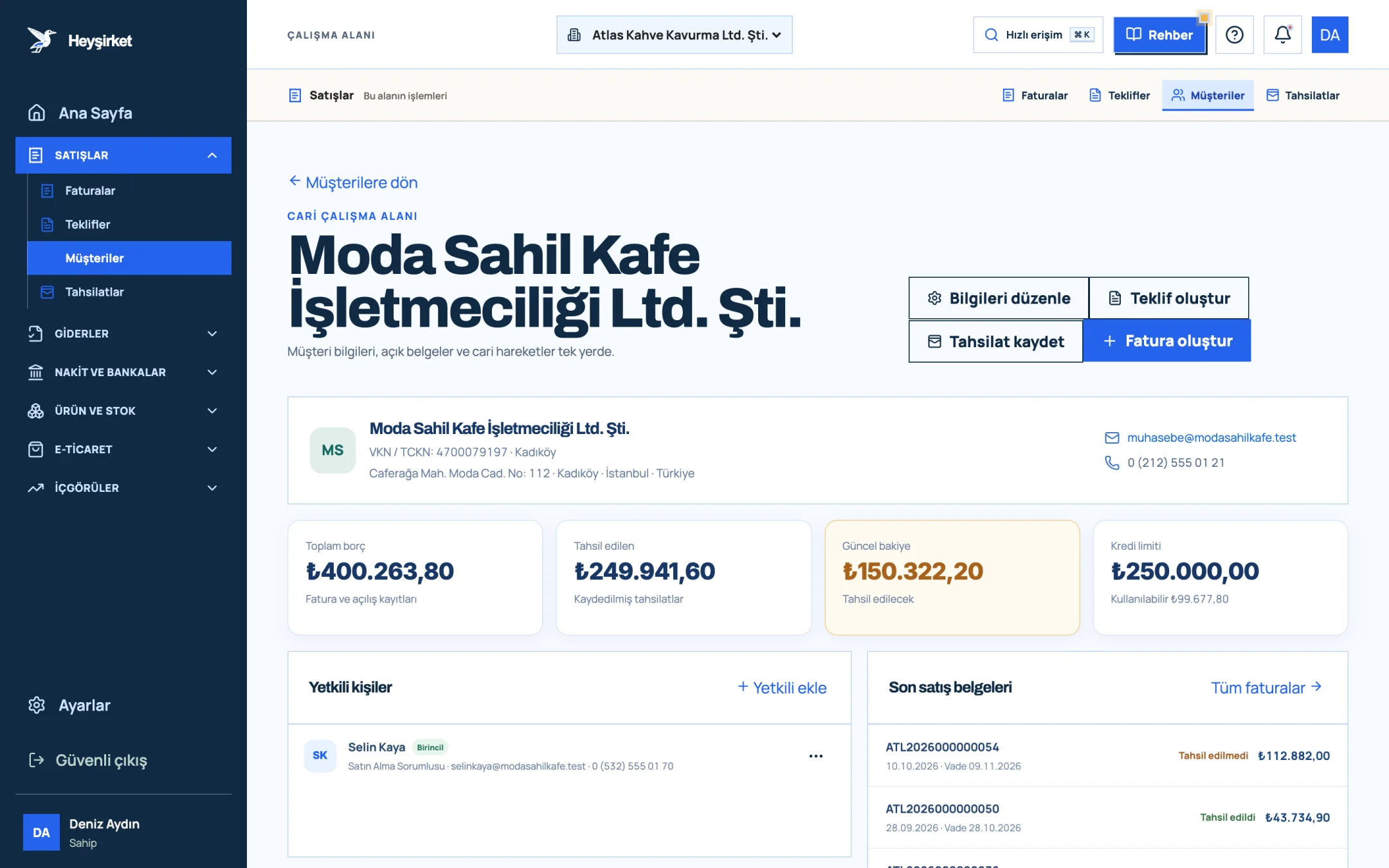
- 1. Quick actions (Create invoice, Record collection)
- 2. Current balance
- 3. Credit limit
- 4. Recent sales documents
Period-end reconciliation checklist
- Go through your bank account transactions; enter every transfer in the period as a collection.
- Check that invoices that should be cancelled have been cancelled.
- Open each customer's Statement window and note the balance.
- Send the confirmation letter with the transaction list to customers with a balance.
- Put the 15-day response deadline in your calendar; call those who don't reply.
- List the differences in a table and tie each one to a document.
- After corrections, get written confirmation of the new balance and archive it.
- Add the results to your month-end close checklist and share them with your accountant.
If you need a breakdown by invoice, search for the customer's name on the Invoices screen and export the list with Download CSV. To set up how you work with your accountant, take a look at our working with your accountant article.
Is account reconciliation mandatory?
Generally it isn't a legal requirement; it's good accounting practice. But it's recommended at least once a year to catch recording errors early, shorten collection disputes and create evidence in case of a dispute.
Have BA-BS forms been abolished?
Yes. VUK General Communiqué No. 565 ended Form Ba and Form Bs notifications from the September 2024 period. In 2026 there is no threshold for these notifications.
What happens if there's no reply to the confirmation letter?
No reply doesn't mean the balance has been accepted. Send a reminder, call the accounting contact and keep the correspondence. For significant amounts, discuss the next step with your accountant or lawyer.
When should reconciliation be done?
At least at year end for all active accounts, and at quarter ends for large customers. You should also reconcile before legal action or a company transfer.
Where do I see a customer statement in Heyşirket?
On the Customers screen, click the Statement link on the customer's card. The window lists invoices and collections in date order with Debit, Credit and Balance columns.
Prepare your first reconciliation On the Customers screen, open your largest customer's Statement window and check the period-end balance. Open customers
Author: Heyşirket Editorial Team