Cash management · 16 min read · Updated:
Cash flow management: a 13-week plan to stay profitable without running out of cash
An empty bank account while sales are rising isn't a paradox, it's a timing problem. This article shows how businesses in Türkiye can manage that timing with a 13-week table.
In short
- Profit is created the moment you issue the invoice, cash only when the customer pays; a growing business that sells on credit can be profitable and still come up short on payment day.
- A 13-week cash flow forecast starts from the opening balance, adds expected collections and subtracts payments each week, producing a closing balance for every week of the coming quarter.
- The cash conversion cycle is days sales outstanding plus days inventory outstanding minus days payable outstanding, and shows how many days your money stays tied up in the business.
- A safety buffer is cash that covers at least a few weeks of essential fixed costs; any week in the forecast where the closing balance drops below this line is an early warning.
- Preparing three scenarios (base, pessimistic and optimistic) instead of a single forecast shows in advance which week a collection delay will cause trouble.
Atlas Kahve Kavurma closed August as the best month in its history: three new hotel customers, two café chains and revenue almost double the same month last year. In the second week of September, when the founder went to pay the supplier for green beans arriving from Brazil, there wasn't enough money in the bank account.
The company was profitable. The books were flawless. The problem was where the money was: in the cafés' and hotels' accounts, on invoices with 45- and 60-day terms. By the end of this article you'll have a table you can update in fifteen minutes every Monday so you never face the same surprise.
Part 1 · The paradox Why does a profitable business run out of cash?
A profitable but cash-poor business is one that shows a profit on its income statement yet doesn't have the money to meet obligations as they fall due. Profit is a measurement, cash is an asset; the two arise at different moments.
On the day you issue an invoice, the sale and the profit exist in your books. But the money only arrives when the customer's due date comes and they actually pay. Meanwhile you've already bought the raw materials, paid salaries and covered the rent.
The ironic part is this: the faster a business grows, the wider this gap gets. Every new order means money spent today that only comes back weeks later. Growth consumes cash.
- 60 days Maximum payment term that can be agreed by contract under the TTK (Turkish Commercial Code) when the creditor is an SME
- 30 days Period after receipt of the invoice when default begins if the contract sets no term
- 13 weeks Forecast horizon that shows a full quarter in weekly detail
Granting 90- or 120-day terms without knowing this rule is one of the most common causes of cash crunches at growing SMEs. So how do you measure how many days and how many lira that gap is?
Part 2 · The measure What is the cash conversion cycle and how is it calculated?
The cash conversion cycle is the number of days between paying a supplier and that money returning to the business through sales and collections. The formula is: days sales outstanding + days inventory outstanding − days payable outstanding.
- Raw material purchase — Supplier invoice
- Time in stock — Roasting, packaging
- Sales invoice — Profit is created here
- Payment term — In the customer's account
- Collection — Cash is created here
| Component | What does it measure? | What happens if it shortens? |
|---|---|---|
| Days sales outstanding | Average days from issuing the invoice to the money arriving | Cash comes in sooner |
| Days inventory outstanding | Average days purchased goods sit in the warehouse until sold | Less money is tied up on the shelf |
| Days payable outstanding | Average days from the supplier invoice to payment | If it lengthens, the cycle shortens, but don't strain the relationship |
| Annual sales | 9.600.000 TL |
|---|---|
| Average daily sales (9.600.000 / 365) | ≈ 26.300 TL |
| Days sales outstanding | 52 days |
| Days inventory outstanding (green and roasted beans) | + 40 days |
| Days payable outstanding | − 30 days |
| Cash conversion cycle | 62 days |
| Approximate cash tied up in the business (26.300 × 62) | ≈ 1.630.000 TL |
This is a simplified calculation; computing the inventory and supplier periods using cost of sales gives a more precise result. But it doesn't change the direction: cutting days sales outstanding by 10 days frees up roughly 263.000 TL.
The figure on the last line tells you something most business owners never calculate: before looking for a bank loan to grow, know how much money is waiting in your own receivables. We cover ways to shorten collection times separately in our article on speeding up collections.
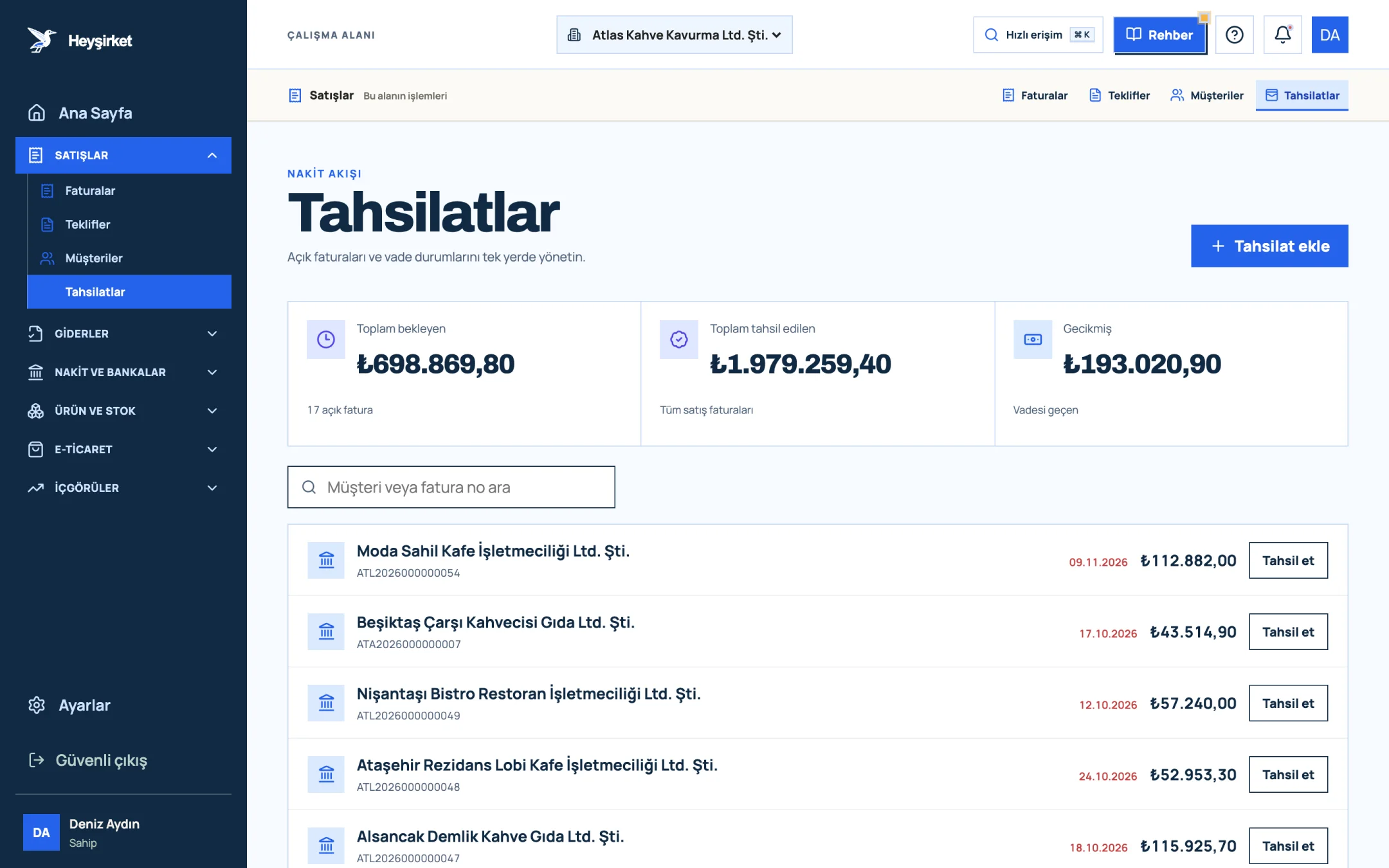
- 1. Add collection button
- 2. Total pending receivables
- 3. Total overdue receivables
- 4. Per-row Collect button
Knowing the cycle answers the question "how much". To answer "when", you need a weekly calendar.
Part 3 · The method How do you prepare a 13-week cash flow forecast?
A 13-week cash flow forecast is a table that starts from today's cash balance, lists the expected inflows and outflows for each of the next 13 weeks and projects the end-of-week balance. Thirteen weeks covers a full quarter: long enough to spot payment problems in advance, short enough to keep the estimates realistic.
The method's strength is its weekly detail. A monthly plan might look positive at the end of September while hiding that the account goes negative in the second week. Payments such as salaries, rent and taxes pile up on specific days, while collections are scattered.
Five steps to build the table
Pin down the opening balance
Take today's total across all cash and bank accounts. In Heyşirket, the TRY account balance indicator on the Cash & Bank screen gives you this figure; first make sure the balances match your bank statements.
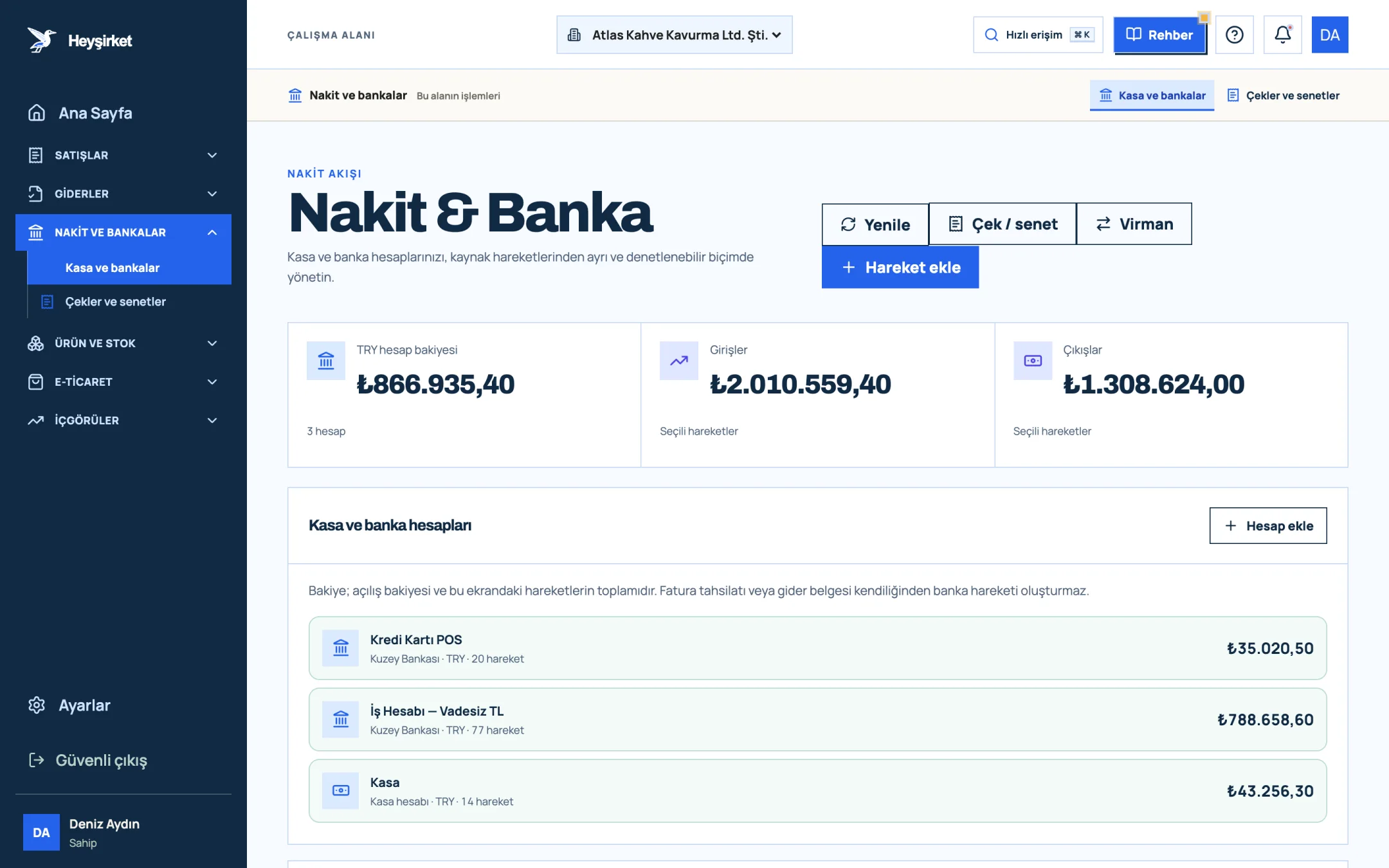
Pin down the opening balance - 1. Add transaction button
- 2. Transfer between accounts
- 3. Total TRY balance
- 4. Cash and bank account list
Enter collections by due date
Spread open invoices across the weeks according to their due dates. Use each customer's real payment habits: for a customer who pays an average of 10 days late, push the collection out by a week or two.
Enter collections by due date - 1. Add collection button
- 2. Total pending receivables
- 3. Total overdue receivables
- 4. Per-row Collect button
Add cheques and promissory notes
Enter cheques received in your portfolio as inflows in their due week, and the cheques and notes you've issued as outflows in their payment week. The Cheque & note tracking section lists them in order of due date.
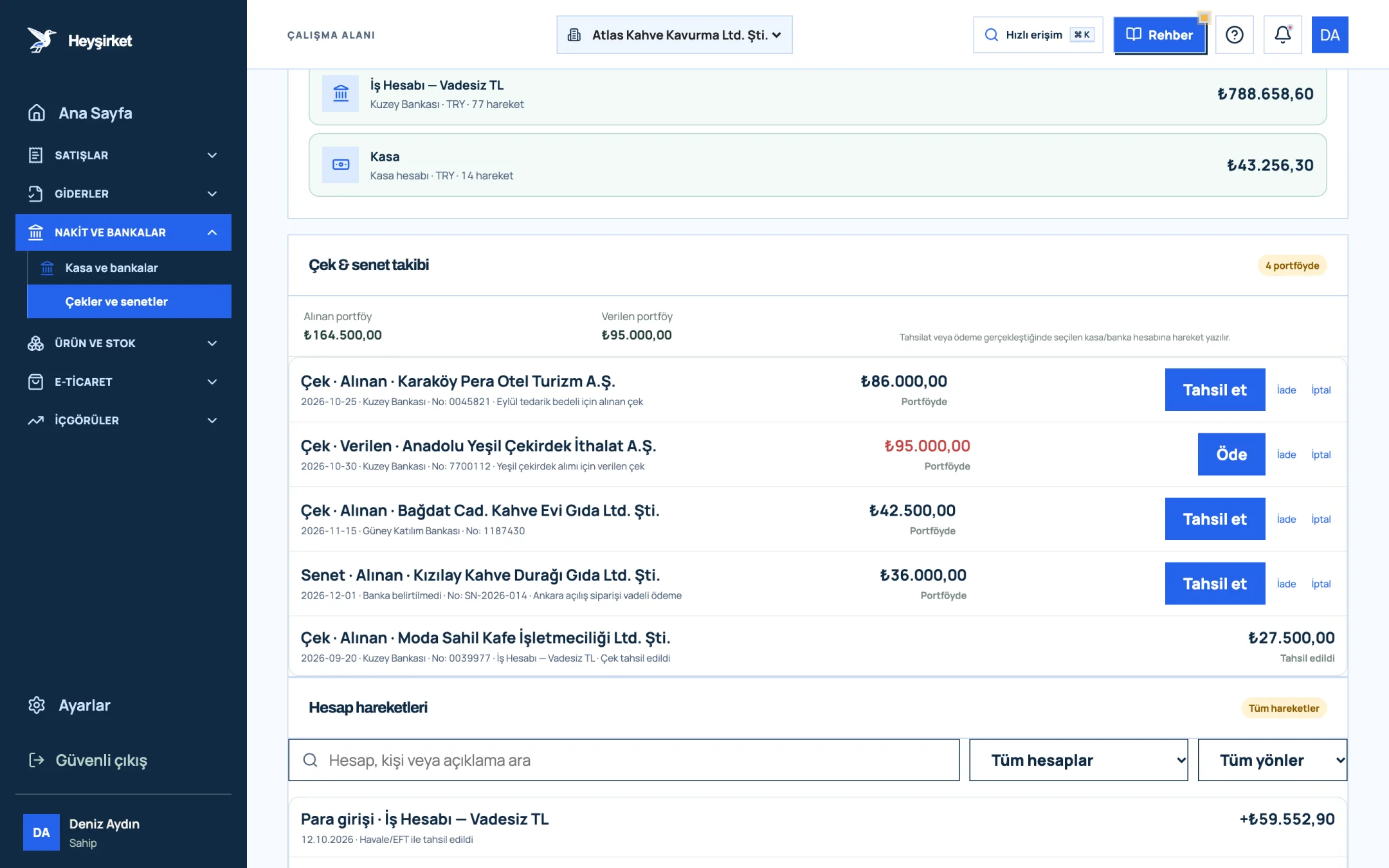
Add cheques and promissory notes - 1. Received and issued portfolio summary
- 2. Received check in portfolio and Collect
- 3. Issued check and Pay
- 4. Collected check
Put mandatory payments on the calendar
Enter salaries, SGK (social security) premiums, rent, tax payments, loan instalments and supplier due dates in the week they belong to. Confirm the tax and SGK payment dates with your accountant once and put them on the same row every month.
Update every Monday
Compare last week's actuals with the forecast, roll the table forward one week and add week 13. Noting the reasons for variances makes your forecasts more accurate every month.
How do you set your collection assumptions?
Collections are the hardest row in the table because they depend on the customer's decision, not yours. The most common mistake here is assuming every invoice will be paid on its due date. Instead, split your customers into a few groups based on past payment behaviour and give each group a delay allowance.
| Group | Example customer | Past behaviour | Week entered in the table |
|---|---|---|---|
| Punctual | Moda Sahil Kafe | Pays on or before the due date | Due week |
| Slightly late | Nişantaşı Bistro | Pays on average 7-10 days after the due date | One week after the due date |
| Unpredictable | Karaköy Pera Otel | Payment day varies month to month, pays partly by cheque | Two weeks after the due date, cheques on their own due date |
| Risky | Any cari (customer account) more than 60 days overdue | Hasn't paid despite reminders | Never entered in the base scenario |
This grouping will be rough in the first month. As you compare actuals with the forecast every Monday, it becomes clear which customer belongs in which group, and your table's accuracy improves noticeably.
| Item | Week 1 | Week 2 | Week 3 | Week 4 | Week 5 | Week 6 |
|---|---|---|---|---|---|---|
| Opening balance | 310.000 | 352.000 | 196.000 | 214.000 | 128.000 | 171.000 |
| Invoice collections | + 148.000 | + 96.000 | + 162.000 | + 104.000 | + 151.000 | + 118.000 |
| Cheque collections | + 40.000 | 0 | + 60.000 | 0 | + 35.000 | 0 |
| Supplier payments | − 86.000 | − 214.000 | − 92.000 | − 48.000 | − 88.000 | − 196.000 |
| Salaries, SGK and rent | 0 | 0 | 0 | − 112.000 | 0 | 0 |
| Tax and other | − 60.000 | − 38.000 | − 112.000 | − 30.000 | − 55.000 | − 36.000 |
| Closing balance | 352.000 | 196.000 | 214.000 | 128.000 | 171.000 | 57.000 |
Anyone reading the table spots week 6: a large green bean payment drops the closing balance to 57.000 TL. It's a problem known six weeks ahead, which means you have six weeks to solve it. But is 57.000 TL dangerous, or is it enough?
Part 4 · The buffer How big should your cash safety buffer be?
A cash safety buffer is the minimum amount of cash always kept in the account so that mandatory payments aren't disrupted even if a collection is unexpectedly delayed. There's no single ratio that fits everyone; a common starting point is an amount that covers a few weeks of essential fixed costs.
Essential fixed costs are items paid whether or not you make sales: salaries, SGK, rent, loan instalments and subscriptions you can't cancel. Leave supplier payments out of this calculation, because they rise and fall with sales.
| Monthly salaries and SGK | 84.000 TL |
|---|---|
| Roastery and shop rent | 28.000 TL |
| Loan instalment, software, insurance | 18.000 TL |
| Monthly essential fixed costs | 130.000 TL |
| Weekly equivalent (130.000 × 12 / 52) | ≈ 30.000 TL |
| Target coverage | × 4 weeks |
| Safety buffer | ≈ 120.000 TL |
Businesses with volatile collections, a dependence on a few large customers or seasonal sales may want to extend the coverage.
Now go back to week 6. The 57.000 TL closing balance is less than half the 120.000 TL buffer. The table is flashing red, and this is still a table built on an optimistic assumption.
Part 5 · Scenarios Scenario analysis: what if customers pay two weeks late?
Scenario analysis means recalculating the same cash forecast with different assumptions to see which week becomes a problem in the worst case. A single forecast gives you a number; three scenarios give you a range.
| Scenario | Assumption | Week 6 closing | Against the buffer |
|---|---|---|---|
| Base | Customers pay as they do today | 57.000 TL | 63.000 TL short |
| Pessimistic | One fifth of collections are two weeks late, and a hotel's cheque bounces | − 94.000 TL | 214.000 TL short |
| Optimistic | Two overdue invoices are collected, and the new café chain pays upfront | 168.000 TL | 48.000 TL over |
In the pessimistic scenario the account goes negative. This isn't a prophecy, it's a preparation list: you can decide today which lever you'll pull before that week arrives. You don't need to rebuild the scenarios every week; write the assumptions next to the table and update them only when a major customer or payment changes.
- Bring collections forward: reminders for overdue invoices from week 2, and an early payment discount offer to large customers.
- Reschedule payments: talk to the green bean supplier now about splitting the payment into two instalments; a request made six weeks ahead is accepted far more easily than one made two days before.
- Postpone spending: push deferrable investments, such as a new roasting machine, back by a quarter.
- Arrange financing in advance: if needed, discuss a short-term credit line with the bank before the need arises.
Part 6 · In practice How do you feed this table with Heyşirket data?
A 13-week forecast rests on three well-answered questions: how much money do I have today, who will pay me and when, and whom will I pay and when. In Heyşirket, these three answers live on three separate screens.
- 1. Add transaction button
- 2. Transfer between accounts
- 3. Total TRY balance
- 4. Cash and bank account list
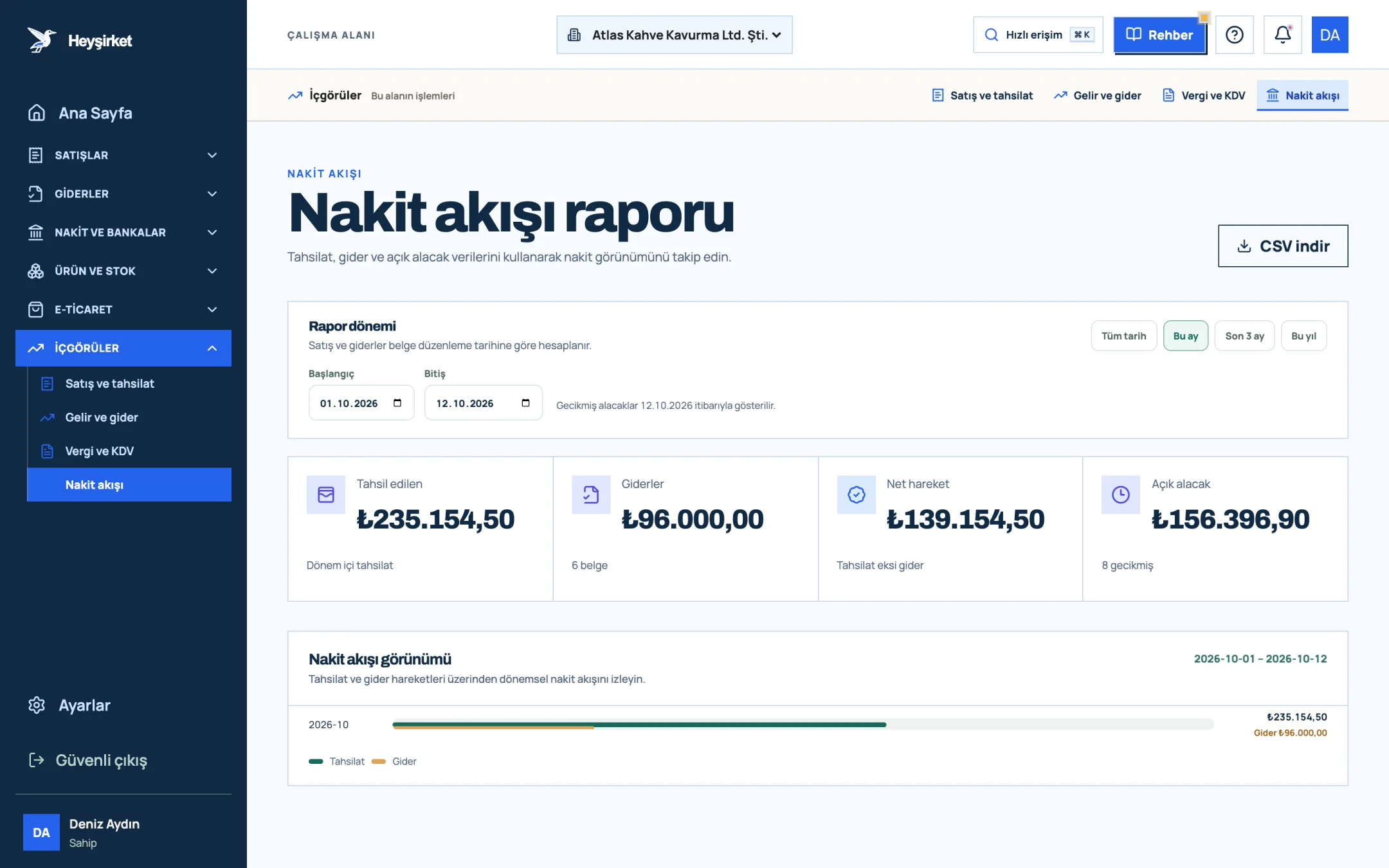
- 1. Collected and expenses
- 2. Cash flow view
We explain the report's logic and limits in the cash flow report guide. In short: the report shows the past, the 13-week table shows the future; use them side by side and your forecasts will be less wrong every month.
A 15-minute weekly cash routine
- Check that cash and bank balances match the statements.
- Compare last week's forecast with actuals and note the reason for any large variance.
- List overdue invoices and plan collection calls.
- Check cheques and promissory notes falling due in the next two weeks.
- Roll the table forward one week and add week 13.
- Mark the first week whose closing balance falls below the buffer and decide on the action.
A cash plan isn't made to know the future, but to see the surprise six weeks in advance.
Since that day in September, Atlas Kahve's founder opens this table every Monday. They discussed splitting the green bean payment into two instalments six weeks in advance, and the supplier agreed. Record sales keep coming in; they just don't empty the account anymore.
Is Excel enough for a 13-week cash flow forecast?
Yes, the table has a simple structure. What matters is the accuracy of the inputs: the current bank balance, open invoices with due dates and cheques in your portfolio. You can take this data from Heyşirket into the table and export the cash flow report with Download CSV.
How many days should the cash conversion cycle be?
It varies a lot by industry. For a retailer selling for cash it can even be negative; for a manufacturer selling on credit it can take months. Measure your own cycle every quarter and focus on keeping it moving in the shorter direction.
Why do I borrow to pay taxes even though I'm making a profit?
Because tax arises on the invoices you issue, regardless of whether they've been collected. The KDV (VAT) on a credit sale can fall into the filing period before the customer pays. Putting tax payments on their own row in the 13-week table prevents this surprise; for details, see the VAT guide.
Can I use the safety buffer instead of a credit line?
The two complement each other. The buffer is your own money and always available; a credit line depends on the bank's decision and has a cost. A credit line is easier to arrange when it's negotiated before the need arises.
How do cheque collections affect my cash flow?
Until its due date, a cheque is a promise to pay, not cash. Enter it in the forecast as an inflow in its due week and add the possibility of it bouncing to the pessimistic scenario. More detail in our article on cheque and promissory note management.
Pin down your opening balance today The first row of the 13-week table is an accurate balance. Update your cash and bank accounts in Heyşirket and add your cheques and promissory notes to the portfolio with their due dates. Go to cash and banks
Author: Heyşirket Editorial Team