Cash management · 16 min read · Updated:
Speeding up receivables: get paid sooner with payment terms, credit limits and a reminder rhythm
Making the sale is half the job; the other half is getting paid on time. We walk through the collection discipline an accountant has been teaching clients for years, with numbers and in order.
In short
- DSO (days sales outstanding) shows how many days, on average, trade receivables take to turn into cash, calculated as trade receivables ÷ period sales × days in the period.
- Under Article 1530 of the Turkish Commercial Code (TTK), in supplies of goods and services between businesses, if no due date is agreed the debtor is in default 30 days after receiving the invoice; a contractually agreed term generally can't exceed 60 days.
- The late payment default interest rate set by the TCMB (Central Bank of the Republic of Türkiye) for 2026 is 43% a year, and the minimum compensation for collection costs is 2.020 TL.
- Your reminder rhythm should move through three tones: polite, firm and formal; a formal notice and enforcement proceedings are the last step.
- An early payment discount makes sense if its annualized cost is lower than your cost of financing.
In early October, the founder of Atlas Kahve Kavurma closed a profitable quarter. Sales were up 30 percent. Even so, two days before payday she called the bank to ask about her overdraft limit.
Where was the money? In the accounts of cafés, hotels and bistros. A full 840.000 TL. She was rich on paper, but not in the bank.
This is one of the most common problems for growing SMEs. By the end of this article you'll know the five levers that can leave hundreds of thousands of lira more cash in your pocket on the same sales volume, and when to pull each one.
Part 1 · Measuring What is DSO, and how many days do your receivables take to turn into cash?
DSO (Days Sales Outstanding) is the metric that shows how many days, on average, your credit sales take to turn into cash. The formula is simple: trade receivables at period end ÷ credit sales during the period × number of days in the period.
Why does it matter? Because the feeling that "my customers pay well" can't be managed without measuring it. If your DSO is clearly longer than the average payment term you give, the problem isn't sales, it's collection.
| Trade receivables at period end | 840.000 TL |
|---|---|
| Credit sales in the last 90 days | 1.260.000 TL |
| Calculation: 840.000 ÷ 1.260.000 × 90 | 60 days |
| Average payment term given to customers | 30 days |
| Cash freed up by bringing DSO down to 45 days | 210.000 TL |
Average daily sales are 1.260.000 ÷ 90 = 14.000 TL. Every day cut from DSO is roughly one day's sales in cash: 15 days × 14.000 TL = 210.000 TL.
Atlas Kahve gives 30-day terms but collects in 60 days on average. Those extra 30 days are an interest-free loan to its customers. The good news: most of that gap closes without cutting prices, through process alone.
Look behind the average: aging
DSO is an average, and averages hide things. Receivables aging splits open invoices into buckets by how long it's been since the due date, showing where the problem is concentrated.
| Bucket | Amount | Share | Action |
|---|---|---|---|
| Not yet due | 462.000 TL | 55% | Polite advance reminder |
| 1-30 days overdue | 210.000 TL | 25% | Phone call, promised date |
| 31-60 days overdue | 126.000 TL | 15% | Hold shipments, formal letter |
| Older than 60 days | 42.000 TL | 5% | Consider a formal notice |
In this table the real risk is in the last two buckets. The older a receivable gets, the lower the chance of collecting it; so focus your energy not on the biggest amounts but on the oldest ones.
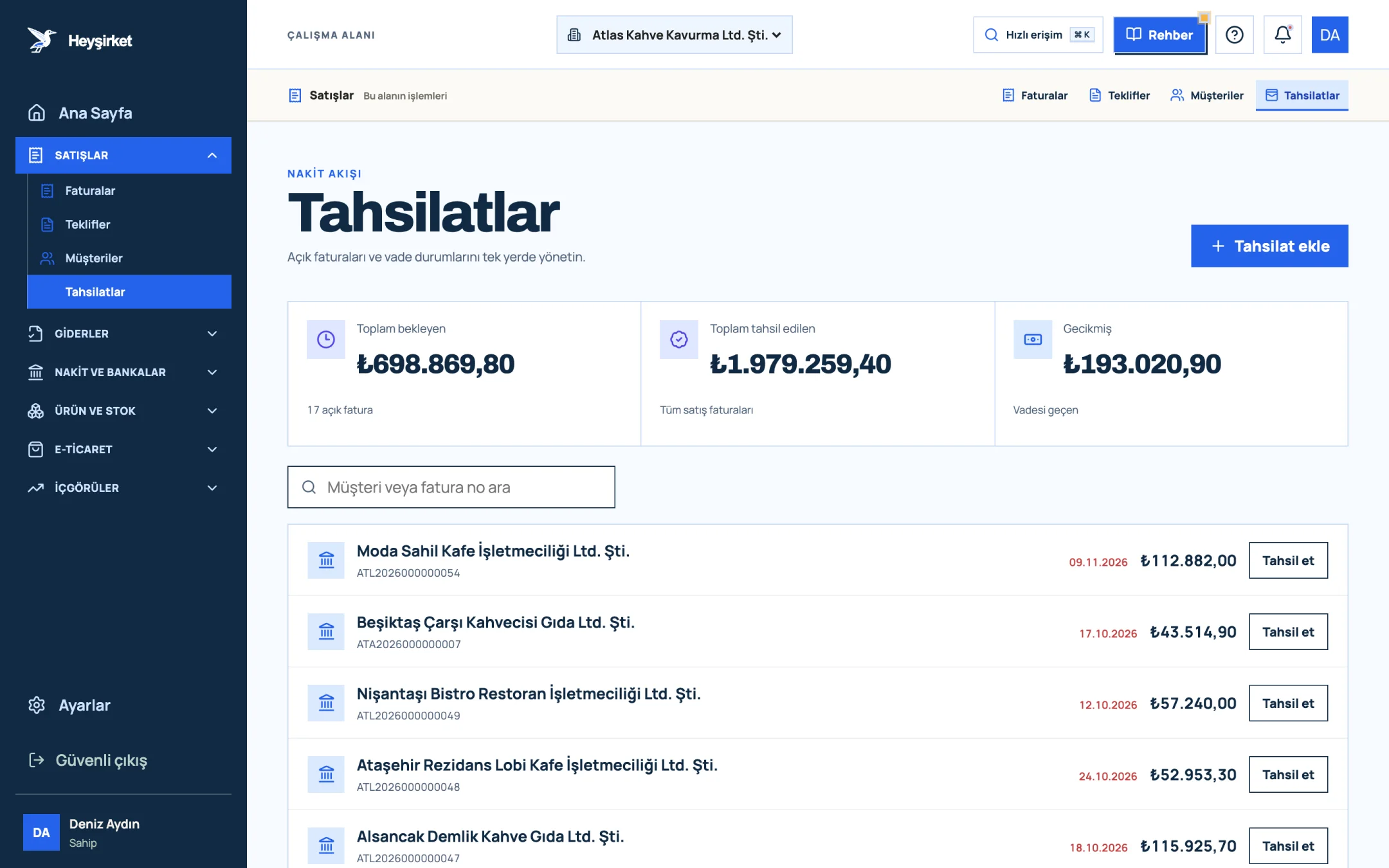
- 1. Add collection button
- 2. Total pending receivables
- 3. Total overdue receivables
- 4. Per-row Collect button
Now we know how to measure. Let's move to the first lever: the point where the problem starts, before the invoice is even issued.
Part 2 · Setting rules How do you write a payment terms policy?
A payment terms policy is a written set of rules that decides in advance which customer gets how many days to pay, and on what conditions. In a business without a policy, the customer with the most bargaining power sets the terms.
A good policy answers three questions: what terms does a new customer get, under what conditions do terms get longer, and what happens when payment is late? For Atlas Kahve, an example table could look like this:
| Customer segment | Payment term | Credit limit | Condition |
|---|---|---|---|
| New café (first 3 months) | Upfront or 15 days | 30.000 TL | Reviewed if the first two invoices are paid on time |
| Regular café | 30 days | 75.000 TL | No delays over 15 days in the last 6 months |
| Hotel, restaurant chain | 45 days | 200.000 TL | Written contract and a named contact on file |
| Barista training (individual) | Upfront | — | Payment at registration |
This rule gives you a strong argument: when a large hotel chain asks for 90-day terms, you can politely point out that, as an SME creditor, the law points to 60 days.
Writing the policy isn't enough; it has to be built into the system. In Heyşirket, the Default payment term (days) field on the customer card calculates the due date on new invoices automatically. That way your sales team doesn't renegotiate terms on every invoice. How to set up the card is in the adding a customer guide.
The invoice itself is a collection tool
A surprising share of late payments are the invoice's fault, not the customer's. An invoice with a misspelled company name, no order number or sent to the wrong person can sit in the customer's approval chain for weeks.
- Issue it the same day: An invoice issued a week after delivery effectively extends the payment term by a week.
- Send it to the right person: The invoice email should go to the accounts team that makes the payment, not the buyer.
- Make payment details visible: Add your IBAN to the invoice note, along with a request to include the invoice number in the transfer description.
- Include the customer's reference: Large customers may not send an invoice without an order number for approval.
In Heyşirket, the Automatically send to customer when an invoice is issued option in Settings sends the invoice, with the official PDF attached, to customers with a saved email address the moment it's issued. That puts an end to "we never got the invoice".
Part 3 · Limiting risk How much credit should you give a customer?
A risk (credit) limit is the maximum amount a customer can owe you at any one time. The limit makes sure that one customer going under doesn't take you down with them.
A practical starting formula: the customer's average monthly purchases × (payment term in days ÷ 30) × a 1,2 safety margin. For a café buying 50.000 TL a month on 30-day terms, that comes to 60.000 TL.
- Single-customer concentration: If one customer makes up more than 20% of your total receivables, that customer's problem is your problem.
- Limit increases are earned: Grow a limit based on payment history, not on the sales team's request.
- Hitting the limit is a signal: When a customer reaches their limit, talk about collection first, then the next shipment.
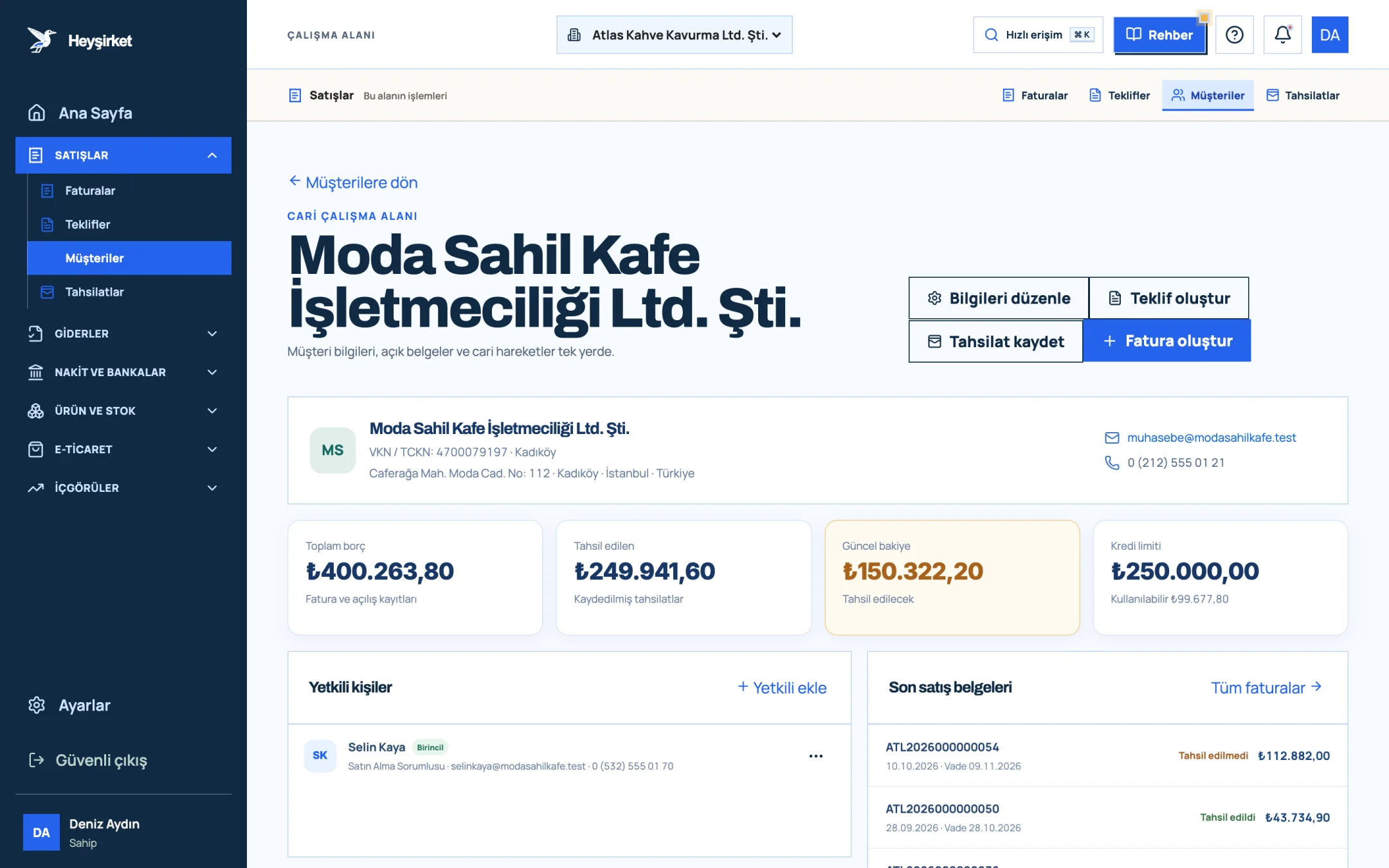
- 1. Quick actions (Create invoice, Record collection)
- 2. Current balance
- 3. Credit limit
- 4. Recent sales documents
The limit is the guard at the door. But what about invoices that are already past the door and overdue? This is the part that makes the real difference.
Part 4 · Rhythm When, and in what tone, should you send payment reminders?
A reminder rhythm is a pre-planned communication schedule that starts before the due date and moves from a polite to a formal tone as the delay grows. Most late payments come from forgetfulness and priorities, not bad intent; a rhythm moves you to the front of the queue.
- 3 days before due — Polite: heads-up note
- Due date + 3 days — Polite: reminder
- Due date + 10 days — Firm: phone call and promised date
- Due date + 20 days — Firm: shipments on hold
- Due date + 30 days — Formal: written notice
- Due date + 45 days — Formal: notarized notice
Polite tone: fixes forgetfulness
The first message doesn't blame, it makes things easy: invoice number, amount, IBAN and a line saying "please disregard if you've already paid". In Heyşirket, the Send reminder button in the invoice details sends exactly this kind of "Payment reminder" email to the customer's address, and the customer can view the invoice through the link.
Firm tone: gets a promised date
At the second stage you pick up the phone with a single goal: a concrete payment date. "Sometime this week" isn't a date; "18.000 TL by Thursday noon" is. Put the promise in writing by email the same day.
Formal tone: creates a record
At the third stage, the correspondence becomes formal: the remaining amount, due date, number of days overdue and any applicable late payment interest are stated clearly. At this stage, holding new shipments is often enough on its own.
In addition, if an invoice is still open after a week and after a month, the user who issued it gets a "Has this invoice been paid?" email. If the payment has arrived, it's recorded in one click; if not, that email is the alarm on your side of the rhythm. Details are in the collections guide.
Part 5 · Legal levers Can you charge interest on late payments?
Yes. In supplies of goods and services between businesses, default interest can be claimed on amounts not paid on time, even if the contract doesn't mention it. If the contract doesn't set a rate, the rate announced each year by the TCMB applies.
| Overdue principal | 100.000,00 TL |
|---|---|
| Annual interest rate (2026, TTK 1530) | 43% |
| Calculation: 100.000 × 0,43 × 45 ÷ 365 | 5.301,37 TL |
| Minimum compensation for collection costs | 2.020,00 TL |
| Total additional amount that can be claimed | 7.321,37 TL |
In practice, whether to claim the interest is a commercial decision; but knowing the figure gives you a concrete argument to put on the table when you talk to the customer.
Formal notice and enforcement: the last steps
An ihtarname (formal notice) is an official demand for payment sent to the debtor through a notary; the date it was served can be proven. For debts with a set due date, a notice isn't required for default, but a formal notice documents that you're serious and often brings in the payment by itself.
If the payment still doesn't come, you can start enforcement proceedings without a court judgment (ilamsız icra). A payment order is served on the debtor; under the general attachment procedure, the objection period is 7 days from service. If the debtor objects, the matter goes to court; for commercial receivables claims involving money, applying to a mediator before filing suit is a precondition under TTK 5/A.
Part 6 · The carrot Is an early payment discount really profitable?
An early payment discount is a small reduction in the invoice amount in return for the customer paying before the due date. The classic example is "2/10 net 30": 2% off if you pay within 10 days, otherwise the full amount in 30 days.
A 2% that sounds small is actually large once annualized. Before deciding, you need to compare the annual cost of this discount with your cost of borrowing.
| Invoice amount | 120.000,00 TL |
|---|---|
| 2% discount | 2.400,00 TL |
| Time gained | 30 − 10 = 20 days |
| Period cost: 2 ÷ 98 | 2,04% |
| Annualized: 2,04% × 365 ÷ 20 | ≈ 37,2% |
| Annual cost of the discount | ≈ 37,2% |
If your short-term loan or overdraft costs more than 37%, the discount is cheap financing for you. If it costs less, lower the discount rate (e.g. 1%) or don't offer one at all.
If you apply the discount after the invoice has been issued, the VAT base needs to be adjusted. Discuss in advance with your accountant how to document it (a price difference or discount invoice); our VAT guide explains the framework.
Part 7 · The system How do you set up a weekly collections routine?
A weekly collections routine is a 30-minute meeting where you review receivables on the same day and in the same order, and decide the next step for every open invoice. The secret of the discipline isn't time, it's consistency.
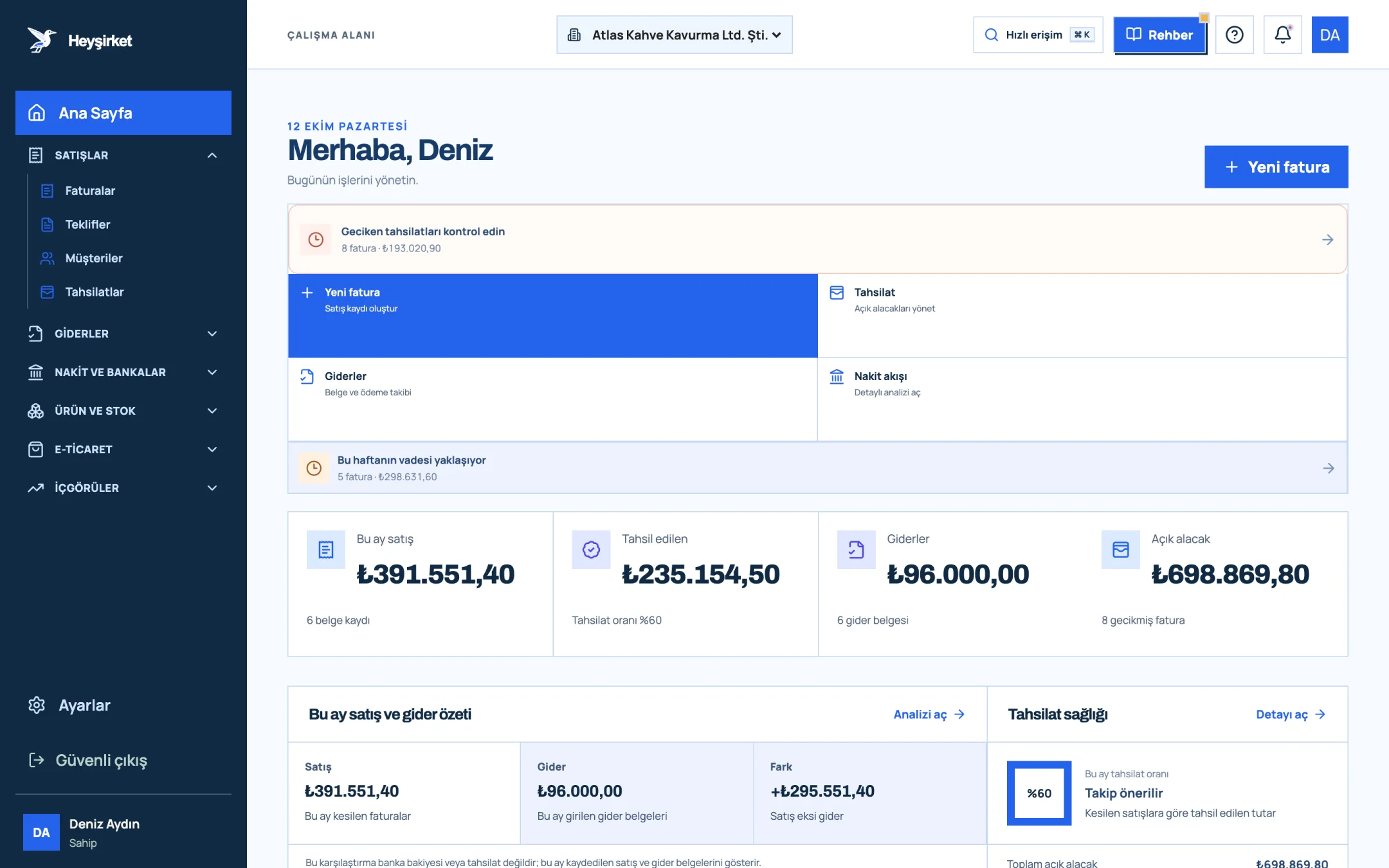
- 1. Create new invoice button
- 2. Overdue collections alert
- 3. Sales invoiced this month
- 4. Total open receivables
Monday 30-minute collections checklist
- Open your bank account transactions and record last week's incoming transfers on the Collections screen with Collect.
- Compare the Overdue indicator with last week; if it's rising, write down why.
- Send polite advance reminders for invoices due this week.
- Call customers past due date + 10 days and get a concrete payment date.
- Hold new orders from customers at their limit until collection has been discussed.
- Prepare a formal letter for receivables past due date + 30 days.
- Note the latest DSO and track the monthly trend.
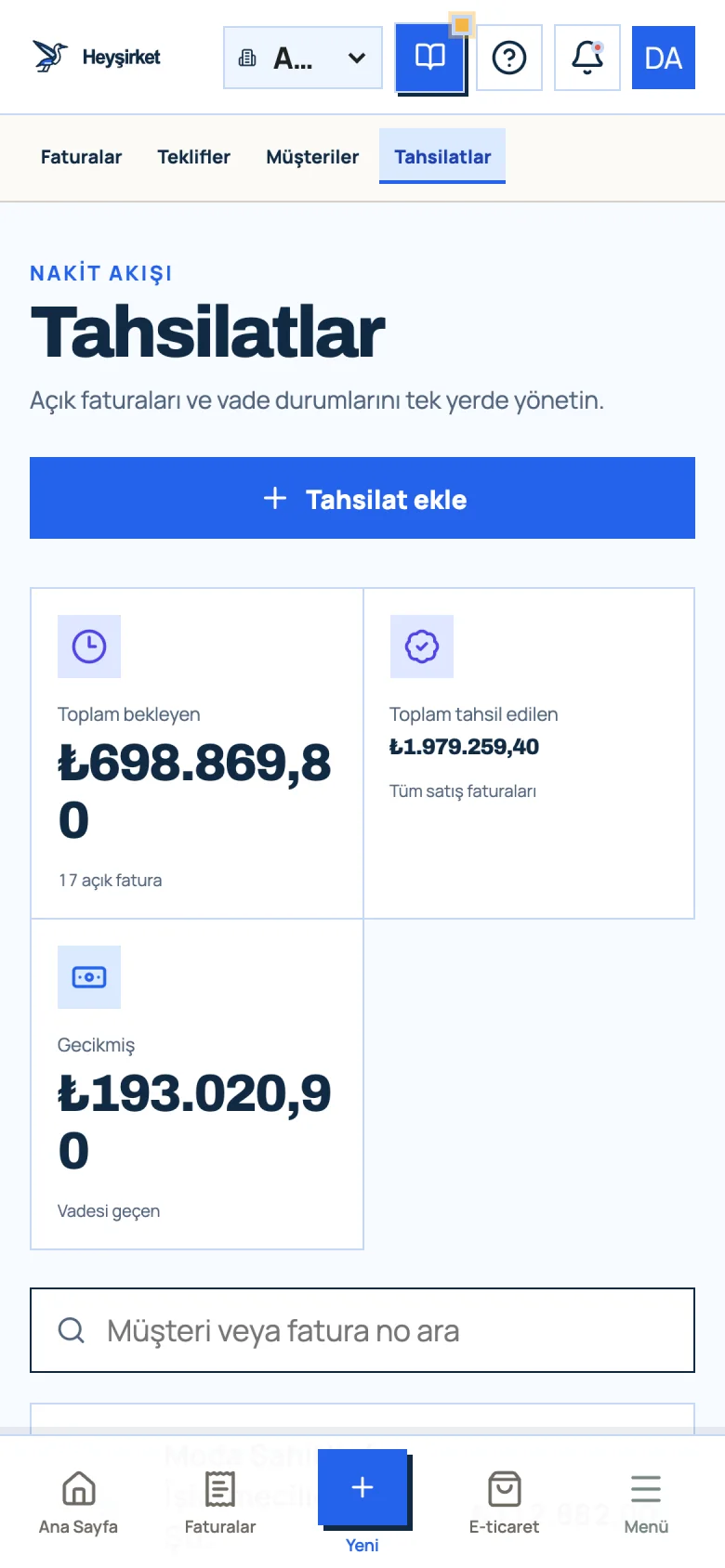
- 1. Add collection
- 2. Total pending
The output of this routine isn't just earlier collections. The account reconciliation you do with your customers at month end also gets easier, because every payment is linked to the right invoice with the right date. For the bigger picture on cash, take a look at our cash flow management article.
The sales team wins the customer; collection discipline keeps the company standing.
What should my DSO be?
There's no single right number; the goal is a DSO as close as possible to the average payment term you give. If you give 30-day terms and your DSO is above 45 days, there's room to improve your collection process.
If the contract doesn't specify a payment term, when is the customer in default?
Under TTK 1530, in supplies of goods and services between businesses, if no payment date has been agreed, the debtor is in default 30 days after receiving the invoice or an equivalent payment request, without the need for a notice.
What is the late payment interest rate in 2026?
The TCMB set the 2026 default interest rate for late payments in supplies of goods and services at 43% a year, and the minimum compensation for collection costs at 2.020 TL. If the contract sets a different rate, that rate applies.
Can enforcement proceedings be started without a formal notice?
For receivables with a set due date, a notice isn't required for default, and enforcement proceedings without a judgment can be started. Even so, a formal notice documents that you're serious and often gets you paid; consult your lawyer about your specific case.
Does Heyşirket send customers automatic payment reminders?
You send the reminder to the customer yourself with the Send reminder button in the invoice details. Automatically, the user who issued the invoice gets a check-in email after a week and after a month, and, if turned on, business owners get an overdue collections summary every Monday.
When should I offer an early payment discount?
It makes sense when the discount's annualized cost is lower than your loan or overdraft cost. The annual cost of 2/10 net 30 terms is about 37%.
Open this week's collections list See your total pending and overdue amounts on the Collections screen, and record incoming payments right away. Open collections
Author: Heyşirket Editorial Team