Customer accounts · 13 min read · Updated:
How to set a customer credit limit: calculating limits and tracking account risk
Selling on credit means giving your customer an interest-free loan. The credit limit is the ceiling on that loan, and it should be set by payment history, not sales excitement.
In short
- A customer credit limit is the highest amount a customer can owe you at any one time; the payment term is how many days after issue a single invoice is paid.
- When setting a limit, consider monthly purchase volume, payment term, payment history, the customer's share of your revenue and any security together.
- Starting a new customer on a small limit and raising it step by step as payments arrive regularly is the lowest-risk approach.
- Account risk tracking regularly watches the open balance, overdue amount, average payment delay and limit usage.
- Heyşirket gives every customer a 0-100 risk score with its reasons; the score warning doesn't block anything, but if you set a credit limit on the customer card, an invoice that exceeds it isn't issued.
A customer places good orders and you're happy. Then one day you notice this customer owes you more than two months' rent. Payments have slowed a little, but orders kept coming. Nobody said “stop”, because the line where you should stop was never drawn. That line is called the customer credit limit.
In this article we explain how a credit limit differs from a payment term, three practical ways of setting a credit limit, when to review it, and the indicators to watch for account risk tracking. In the last part we spell out how Heyşirket's risk score is calculated and what happens when a limit is exceeded.
Part 1 · Definition What is a customer credit limit, and how is it different from a payment term?
A credit limit (also called a risk limit) is the highest amount a customer can owe you at any one time. The payment term says how many days after issue a single invoice is to be paid. The two work together: the term answers “when”, the limit answers “at most how much”.
A customer on 30-day terms with a 100.000 TL limit gets no new credit sales once their open balance reaches 100.000 TL, even if those invoices aren't due yet. They pay first, room opens up in the limit, and then the new order is invoiced on credit. The limit stops one customer's payment problem from becoming your cash problem.
| Payment term | Credit limit | |
|---|---|---|
| What does it limit? | The payment period of a single invoice | The customer's total open debt |
| Unit | Days | TL |
| When exceeded | The invoice is overdue | New credit sales are put on hold |
| Who sets it? | The contract and trade practice | Your credit policy |
Part 2 · Inputs What information do you need to set a credit limit?
A good limit rests on data, not guesswork. For a small business, five pieces of information are enough:
- Monthly purchase volume: How much did the customer buy on average over the last three or six months?
- Payment term: The longer the term, the more invoices are open at once, and the bigger the limit needs to be.
- Payment history: Did they pay recent invoices on time, or how many days late? Is the delay growing?
- Share of your revenue: If one customer makes up more than a fifth of your total sales, their problem is your problem.
- Security and paperwork: Is there a cheque, promissory note or signed contract? Has a cheque of theirs ever bounced?
A new business customer has no payment history. In that case, the founding date in the trade registry, references in the sector, and early orders paid upfront or on short terms are the most reliable information.
Part 3 · Calculation How do you calculate a credit limit? Three methods
1. Purchase volume and term formula
The most common starting formula is: average monthly purchases × (payment term in days ÷ 30) × safety margin. The safety margin is usually 1,2 to leave room for order fluctuations. The formula answers “if the customer works normally, what's the most they will owe?”.
| Average monthly purchases over the last 6 months | 80.000 TL |
|---|---|
| Payment term | 45 days (45 ÷ 30 = 1,5) |
| Raw need: 80.000 × 1,5 | 120.000 TL |
| Safety margin | × 1,2 |
| Suggested credit limit | 144.000 TL |
Figures are illustrative. If the customer has been paying late recently, lower the safety margin to 1,0 or shorten the term.
2. A scorecard
The formula measures volume but not behaviour. To balance this, you can use a simple scorecard. Give each heading 0-3 points and adjust the formula's result based on the total.
| Heading | 3 points | 1 point | 0 points |
|---|---|---|---|
| Payment history | On time | Up to 15 days late | More than 30 days late |
| Length of relationship | More than 2 years | 6 months - 2 years | Less than 6 months |
| Share of revenue | Below 10% | 10-20% | Above 20% |
| Security | Cheque/note or contract | Written order | None |
For example, a customer scoring 10-12 might get the full formula result, 6-9 points 70 percent of it, and 5 or less 40 percent. Set the ratios to suit your business; what matters is that the rule is written down and applied to everyone the same way.
3. Stepped limits (for new customers)
Instead of giving a large limit from day one to a customer with no history, use a ladder: first orders paid upfront or on short terms, then a small limit roughly equal to one month's purchases, then the amount the formula suggests after three months of regular payments. Limit increases come from payment history, not from the sales team's wishes.
Part 4 · Review When should a credit limit be reviewed?
A limit isn't a number you write once and forget. Review all customers every three or six months. Beyond that, look straight away when one of these happens:
- The customer paid two invoices in a row more than 15 days late.
- One of their cheques or notes bounced.
- Their orders suddenly doubled; sometimes that's growth, sometimes a cash squeeze.
- The contact person, company name or ownership changed.
- The customer passed a fifth of your total revenue.
Lowering a limit is also a decision. Reducing the limit of a customer whose payments have slipped doesn't mean losing them; it means tying new sales to upfront or partial upfront payment.
Part 5 · Tracking Which indicators matter for account risk tracking?
The limit is a ceiling; account risk tracking is watching how the customer approaches that ceiling. The four indicators below flag most problems weeks in advance.
| Indicator | How it's calculated | Warning sign |
|---|---|---|
| Open balance | Invoices issued − payments | Approaching 90% of the limit |
| Overdue amount | The part that is due and unpaid | A significant part of the open balance is late |
| Average payment delay | Average of payment date − due date | A clear increase over the last three months |
| Limit usage | Open balance ÷ limit | Constantly close to 100% |
Watching these for every customer takes time, so focusing on the five riskiest customers once a month is enough. We described the weekly routine for overdue invoices in invoice due date tracking.
Part 6 · In practice How do credit limits and risk scores work in Heyşirket?
The Ticari tercihler (commercial preferences) section of the customer card has two fields: Varsayılan vade (gün) (default payment term, days) and Risk limiti (₺) (credit limit). If you leave the limit empty, there's no cap for that customer; the customer page shows the limit as “Sınırsız” (unlimited).
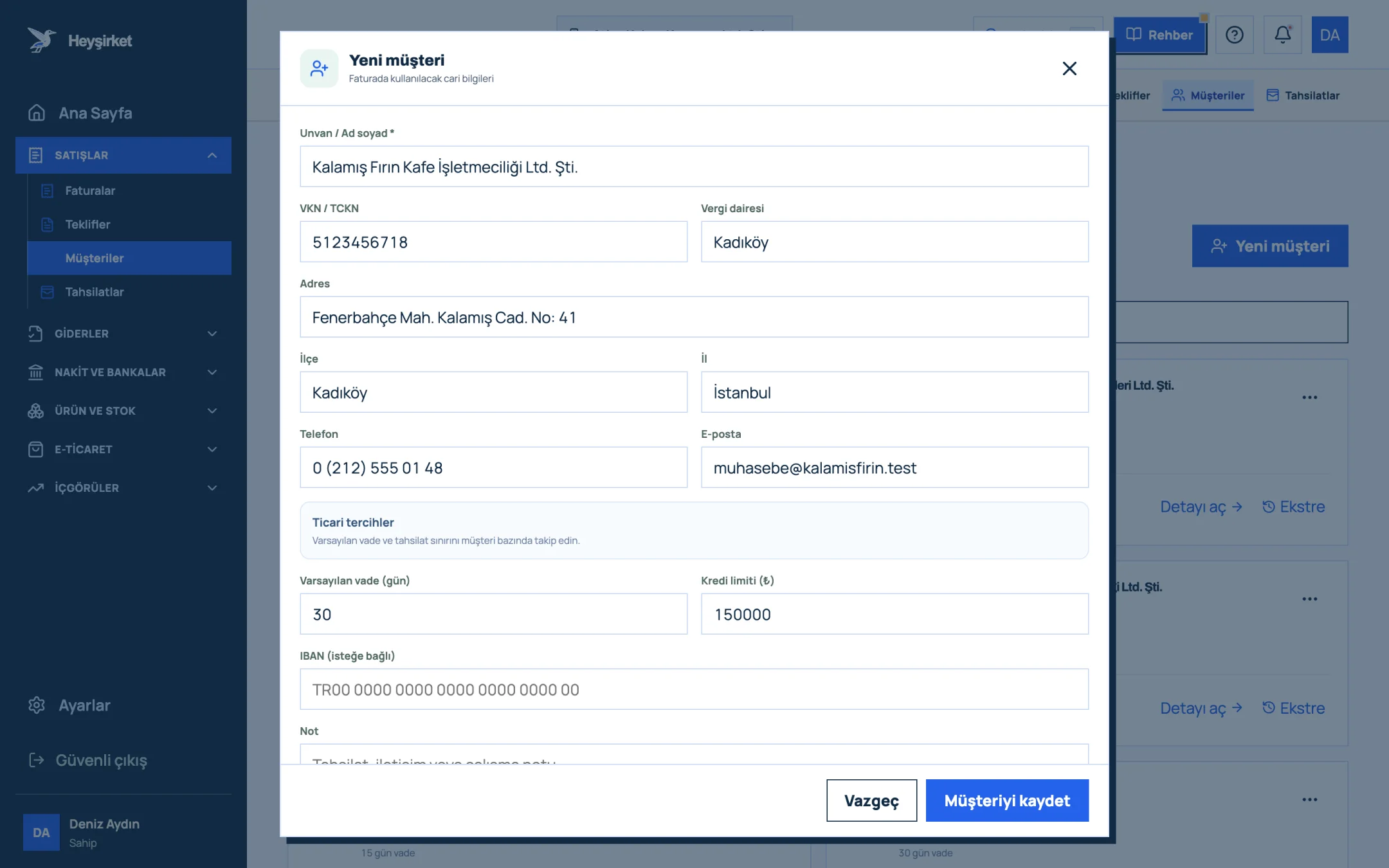
- 1. Company name field
- 2. Tax ID / national ID and tax office
- 3. Payment terms and credit limit
- 4. Save button
Heyşirket also calculates a risk score from 0 to 100 for every customer. Below 30 is Low, 30-59 Medium and 60 or above High risk. Next to the score it writes the reasons in a plain sentence, for example “Paid the last 3 invoices an average of 47 days late”.
| Component | When it adds points |
|---|---|
| Overdue amount | When there are overdue open invoices; more days overdue means more points |
| Payment history | When the last three paid invoices were on average more than 3 days late |
| Slowing down | When the delay in the last three months grew by 10 days or more compared with before |
| Revenue concentration | When the customer makes up more than 20% of your last 12 months' revenue |
| Returns and cancellations | When at least a fifth of their documents in the last 12 months were returns or cancellations |
| Bounced cheques / notes | When the customer has a bounced cheque or promissory note |
| Credit limit | When the open balance reaches 90% of the limit or exceeds it |
Invoices imported from other software don't count in the delay calculation because they have no real payment dates. The score is recalculated every day; when you record an invoice or payment, that customer's score is updated shortly after.
The difference between a warning and a block
When you prepare an invoice, quote or delivery note for a medium or high-risk customer, a warning card appears showing the reasons, the open balance and the overdue amount. This card is for information and doesn't block your action; it reminds you to consider asking for upfront or partial payment.
The credit limit, however, is really checked when an invoice is issued. If the customer's account balance plus the new invoice (minus any upfront payment recorded with the invoice) exceeds the limit, the invoice isn't issued; you see the message “Bu fatura müşterinin risk limitini aşıyor” (this invoice exceeds the customer's credit limit) and the available limit. What you entered is saved as a draft, so you can carry on once a payment arrives or you update the limit. On quotes and delivery notes, the limit is shown only as a warning.
- Riskiest customers: A card on the home screen lists the five highest-scoring customers with their main reason. From there, Hatırlatma gönder (Send reminder) sends a payment reminder for the oldest overdue invoice and Ekstre gönder (Send statement) sends the current account statement.
- Customer risk panel: The customer page shows the score, reasons, open balance, overdue amount, average payment delay, share of revenue and a chart of payment delays over the last six months.
- Phone notification: When a customer moves into high risk, company owners get a notification from the Heyşirket mobile app.
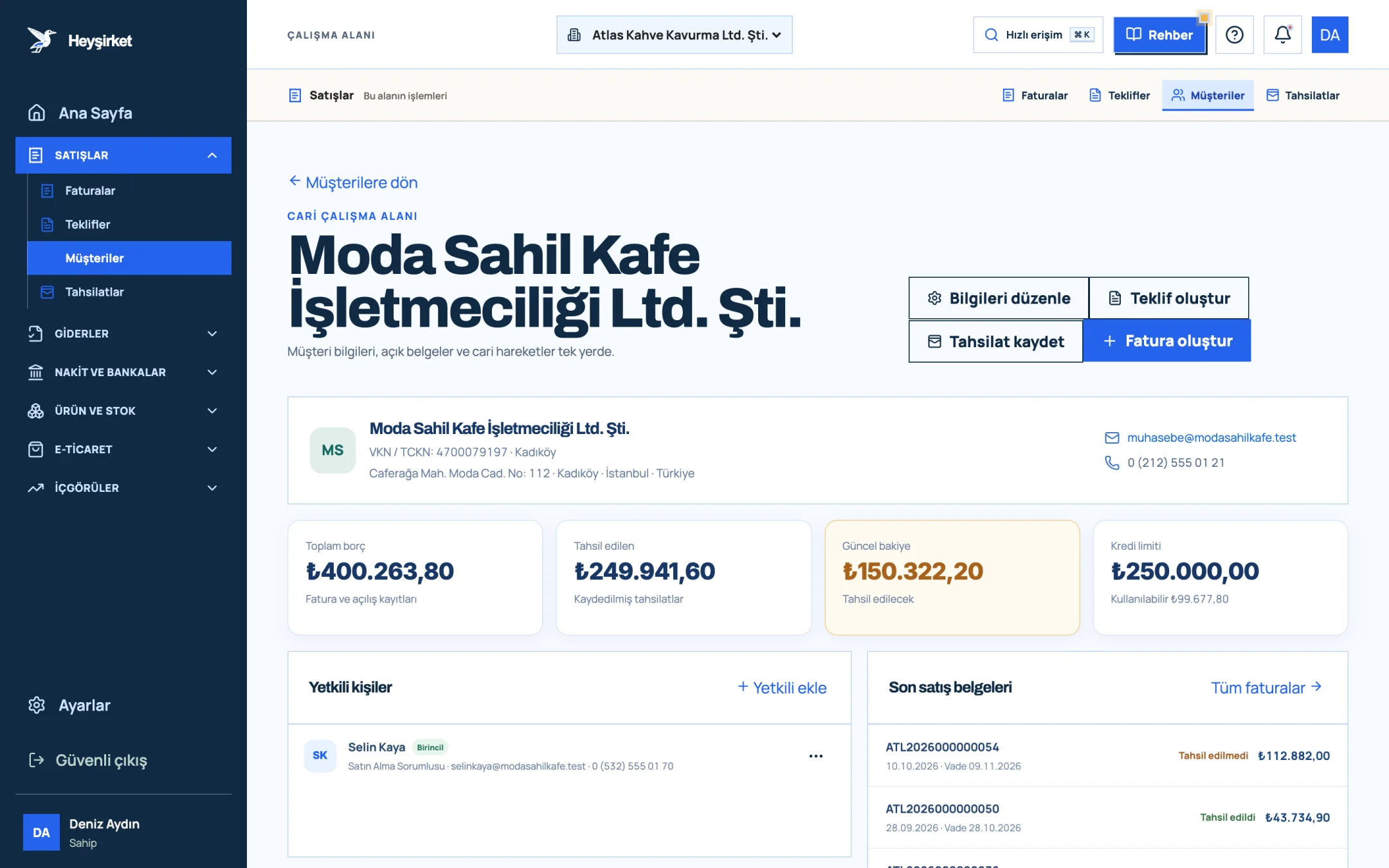
- 1. Quick actions (Create invoice, Record collection)
- 2. Current balance
- 3. Credit limit
- 4. Recent sales documents
All sections of the customer page are in the customer workspace guide. Customer cards, statements and reconciliation as a whole are on the customer accounts page.
Part 7 · Decision What should you do when a customer exceeds their limit?
Four steps when a limit is exceeded
Look at the numbers first
Separate how much of the open balance is overdue and how much isn't due yet. If the limit filled up with invoices that aren't due, it may be a sign of growth.
Talk to the customer
Ask for a firm payment date for the overdue amount. Tie the new order to that payment.
Offer partial or upfront payment
Taking part of the new order upfront limits risk without losing the sale. An upfront payment recorded with the invoice is deducted in the limit calculation.
Change the limit deliberately
If payment history is good and volume has grown for good, recalculate the limit with the formula and raise it. Write the decision and the reason in the customer card's notes.
Are a risk limit and a credit limit the same thing?
In trade the two terms are mostly used to mean the same thing: the highest amount a customer can owe you at once. It shouldn't be confused with a bank credit limit; here you are the one extending credit.
How much credit should a new customer get?
For a customer with no history, the safest path is to work upfront or on short terms for the first orders, then give a small limit of roughly one month's purchases, and raise it step by step as payments arrive regularly.
What is the formula for calculating a credit limit?
A common starting formula is average monthly purchases × (payment term in days ÷ 30) × a 1,2 safety margin. The result is adjusted up or down based on payment history and the customer's share of your revenue.
Does Heyşirket stop me invoicing a high-risk customer?
No. The risk score and warning card are for information and don't block invoices, quotes or delivery notes. The only thing that blocks is the credit limit you write on the customer card: if the account balance plus the new invoice exceeds that limit, the invoice isn't issued and the details are saved as a draft.
What happens if I leave the credit limit empty?
No limit check is made for the customer and the customer page shows the limit as unlimited. The risk score is still calculated; only the limit-related component isn't added.
How often should I update credit limits?
Review all customers every three or six months. If you see a signal such as repeated late payments, a bounced cheque, a sudden jump in orders or an ownership change, update without waiting.
Set payment terms and limits for your customers Enter the default payment term and credit limit on the customer card; the risk score and its reasons appear on the customer page. Open customers
Author: Heyşirket Editorial Team