Foreign trade · 16 min read · Updated:
E-export guide for businesses in Türkiye: micro exports, ETGB, export invoices and VAT refunds
Your first order from abroad is exciting; your first customs declaration is usually confusing. In this article we walk through every stop under Turkish rules, from the parcel leaving your door to the VAT refund landing in your account.
In short
- A micro export is an export shipment sent by post or express courier that, from 3 January 2026, does not exceed 600 kilograms gross and 30,000 euros, and is cleared with an ETGB (Electronic Commerce Customs Declaration).
- For goods exported with a standard customs export declaration, e-Fatura users issue an e-Fatura with the EXPORT (İHRACAT) scenario; for micro exports cleared with an ETGB, an e-Arşiv invoice is issued.
- Exports of goods are exempt from KDV (VAT) under Article 11/1-a of the VAT Law; VAT paid on purchases related to exports that cannot be offset can be claimed as a refund.
- The export exemption is declared in the VAT return for the period that includes the closing date of the customs declaration; the amount is converted to Turkish lira at the CBRT foreign exchange buying rate on that date.
- As a rule, export proceeds must be brought back to Türkiye within 180 days of the actual export date.
One morning an order from Berlin landed in Atlas Kahve's online store: twelve packs of specialty-roast Ethiopia Yirgacheffe and two V60 brewing sets. The buyer was a café owner who had tasted the coffee on holiday in Kadıköy.
Packing the order took twenty minutes. Deciding on the invoice type, which declaration the parcel would leave under and what would happen to the VAT took two days. By the end of this article you'll be able to make the same decisions in twenty minutes, and you'll also learn about a refund most SMEs never claim.
Part 1 · Definition What is e-export, and how is it different from traditional exporting?
E-export means shipping goods out of Türkiye after selling them online to a buyer abroad. The order might come through your own website, an international marketplace or by email; what sets it apart is that the sale happens through a digital channel and the goods are usually shipped by courier.
From a tax and customs perspective, e-export is not a separate type of export. What matters is the declaration the goods leave under: a standard customs export declaration, or an ETGB (Electronic Commerce Customs Declaration)? The invoice type, the VAT return and the refund file all follow from this distinction.
| Route | Declaration | Best suited for | Invoice |
|---|---|---|---|
| Traditional goods export | Customs export declaration (GÇB) | Wholesale, container and pallet shipments | e-Fatura with the EXPORT scenario if you're an e-Fatura user |
| Micro export | ETGB (post and express courier) | Shipments up to 600 kg and 30,000 euros | e-Arşiv invoice |
| E-export via a marketplace | GÇB or ETGB depending on the marketplace's model | Brands selling on international marketplaces | Depends on the model; follow the marketplace's guidance |
Two situations that look like exports but work differently
Delivery for export (ihraç kaydıyla teslim): If you don't ship the goods abroad yourself but through an exporting company, you make a delivery to that exporter for export purposes. VAT is calculated on the invoice but not collected; the goods must be exported within a set period, and if the deadline is missed the tax is pursued from the exporter, not from you. Discuss the conditions with your accountant (mali müşavir) before using this model.
Export of services: Running an online barista training for a hotel chain abroad is not an export of goods. It may qualify for the VAT exemption provided the service is performed for a customer abroad and used there, but there's no customs declaration and the paperwork is different. This article focuses on exports of goods.
Atlas's Berlin order is a single box worth a few hundred euros. That's a textbook micro export. So where does the micro export limit end?
Part 2 · Micro export What is a micro export, and what is the ETGB limit in 2026?
A micro export is an export shipment sent abroad by post or express courier that stays within certain weight and value limits and is cleared with an ETGB. You usually don't prepare the ETGB yourself; the express courier you work with files it on your behalf.
- 600 kg Gross weight limit per shipment (from 3 January 2026)
- 30.000 € Value limit per shipment (previous limit: 15.000 €)
- 180 days General deadline for bringing export proceeds back to Türkiye
The higher limits mean some pallet-sized B2B shipments can now go out through the courier channel too. For a roaster selling equipment to cafés, that opens the door to selling directly to small chains in Europe.
- Order — Website, marketplace or email
- e-Arşiv invoice — VAT-exempt, in foreign currency
- Courier handover — Invoice and parcel details to the courier
- ETGB — Filed by the courier
- Exit — Declaration is closed
- Payment and refund — Proceeds home, VAT refund file
The second box in the flow is where most mistakes happen. If the invoice isn't issued as the right type, the customs declaration and the invoice won't match, and the refund file is in trouble before it even starts.
Part 3 · Invoice Should an export invoice be an e-Fatura or an e-Arşiv invoice?
The declaration the goods leave under determines the export invoice type: for goods exported with a customs export declaration, e-Fatura (Turkish e-invoice) users issue an e-Fatura with the EXPORT scenario; for micro exports cleared with an ETGB, an e-Arşiv (e-archive) invoice is issued.
- e-Fatura with the EXPORT scenario: Even though the buyer is abroad, the invoice is sent to the customs administration's system and the customs declaration is linked to it. The delivery terms (such as FOB or CIF), shipping method and customs tariff details appear on the invoice.
- e-Arşiv invoice for micro exports: The invoice is issued as an e-Arşiv invoice in the name of the buyer abroad; the VAT line is shown as zero with an exemption code. In practice, linking the ETGB number to the invoice makes the later refund file easier.
- Currency: Export invoices are usually issued in the currency the buyer pays in. For exchange rate differences and how foreign-currency documents work, see our foreign-currency invoice guide.
The invoice was issued as the right type, with a zero VAT line. But behind that zero lies a right: the right to get back the VAT you paid for the export.
Part 4 · Exemption How does the VAT exemption on exports work?
The export exemption means that deliveries to a buyer abroad, where the goods leave the Turkish customs territory, are exempt from VAT. It is based on Article 11/1-a of VAT Law No. 3065 and is a full exemption: no VAT is charged on the sale, but you can deduct the VAT on purchases made for that sale and claim a refund for the part you can't offset.
In practice this means a declaration issued on the last day of September and closed on the first day of October goes into October's VAT return, not September's. For shipments near the end of the month, this date gap often leads to filing errors.
| Topic | Domestic sale | Export of goods |
|---|---|---|
| VAT on the sale | Charged (1%, 10% or 20%) | Not charged, exempt |
| VAT on purchases | Deducted from output VAT | Deducted; the part that can't be offset may be refunded |
| Return period | Invoice date | Closing date of the customs declaration |
| Converting foreign-currency amounts | Rate in the contract | CBRT FX buying rate on the closing date |
| Extra obligation | None | Bringing export proceeds back to Türkiye |
The exemption works automatically. The refund doesn't; it takes a file, documents and patience.
Part 5 · Refund How do you get a VAT refund on exports?
An export VAT refund means recovering, from the tax office, the VAT paid on producing or purchasing the exported goods that couldn't be offset against output VAT because of the export, either in cash or by offsetting it against other tax debts. It is based on Article 32 of the VAT Law.
| Export amount (TL equivalent) | 180.000,00 TL |
|---|---|
| Upper limit: export amount × general rate of 20% | 36.000,00 TL |
| VAT paid on the exported products (beans, packaging, shipping) | 11.400,00 TL |
| Maximum refundable amount (capped at VAT paid) | 11.400,00 TL |
This example is simplified. The refundable amount is limited both by the VAT paid in connection with the export and by the amount found by applying the general VAT rate to the export amount; the lower of the two applies. If there is output VAT from domestic sales in the same period, the deduction mechanism runs first and the refundable amount is calculated separately on the return. The final calculation is your accountant's.
- Declare: The export amount is declared in the exemption line of that month's VAT return, and the refund request is indicated on the return.
- Petition and lists: The refund request petition, along with the sales invoice list, the list of VAT paid and the list of deductible VAT, is submitted through the Revenue Administration's electronic system.
- Documents: Keep the GÇB or ETGB, export invoices and export-related purchase documents ready. Documents accessible electronically may not need to be submitted separately.
- Report or guarantee: For cash refund requests above certain amounts, a tax inspection report, a sworn financial advisor (YMM) report or a guarantee may be required. The thresholds are updated from time to time.
- Outcome: Once the tax office completes its review, the refund is paid to your account in cash or offset against your tax debts.
Let's say the money came back. Then there's the money coming in from abroad itself, which has its own timeline and rules.
Part 6 · Collection When must export proceeds be brought back to Türkiye?
Under the CBRT Export Circular, export proceeds must, as a rule, be brought back to Türkiye within 180 days of the actual export date at the latest. When the payment reaches the bank, the bank issues an Export Proceeds Acceptance Certificate (İhracat Bedeli Kabul Belgesi).
For some time there has also been a requirement to sell a certain portion of the foreign currency received to the bank; this rate stood at 35% in the first half of 2026 and is reset by the CBRT from time to time. Check the current rate and exceptions with your bank and at tcmb.gov.tr.
Check before your first export
- Measure the shipment's weight and value: if it's under 600 kg and 30,000 euros, confirm the ETGB route with your courier.
- Choose the invoice type based on the declaration type: e-Arşiv, or e-Fatura with the EXPORT scenario?
- Check that the buyer's country, address, currency and product descriptions on the invoice match the customs declaration exactly.
- Note the declaration's closing date and declare the exemption in that month's return.
- Tag purchase invoices related to exports separately; they're the raw material of the refund file.
- Open a foreign-currency account for export payments and keep track of the 180-day timeline.
- Look into the Ministry of Trade's e-export support programs at ticaret.gov.tr.
That covers the rules. In the last part, let's take an honest look at how this process maps to Heyşirket, and what it can't do today.
Part 7 · In practice Where does Heyşirket fit into e-export?
Heyşirket doesn't issue export invoices today: sales invoices are issued in Turkish lira with 1%, 10% or 20% VAT rates, and there's no support yet for e-Fatura with the EXPORT scenario or invoices with a VAT exemption code. You'll need to issue your export invoice from your e-document provider's own screen or from the system your accountant uses.
Where Heyşirket helps is the operations around the invoice: seeing orders from abroad, tracking foreign-currency payments and keeping the expenses that make up your refund file in order.
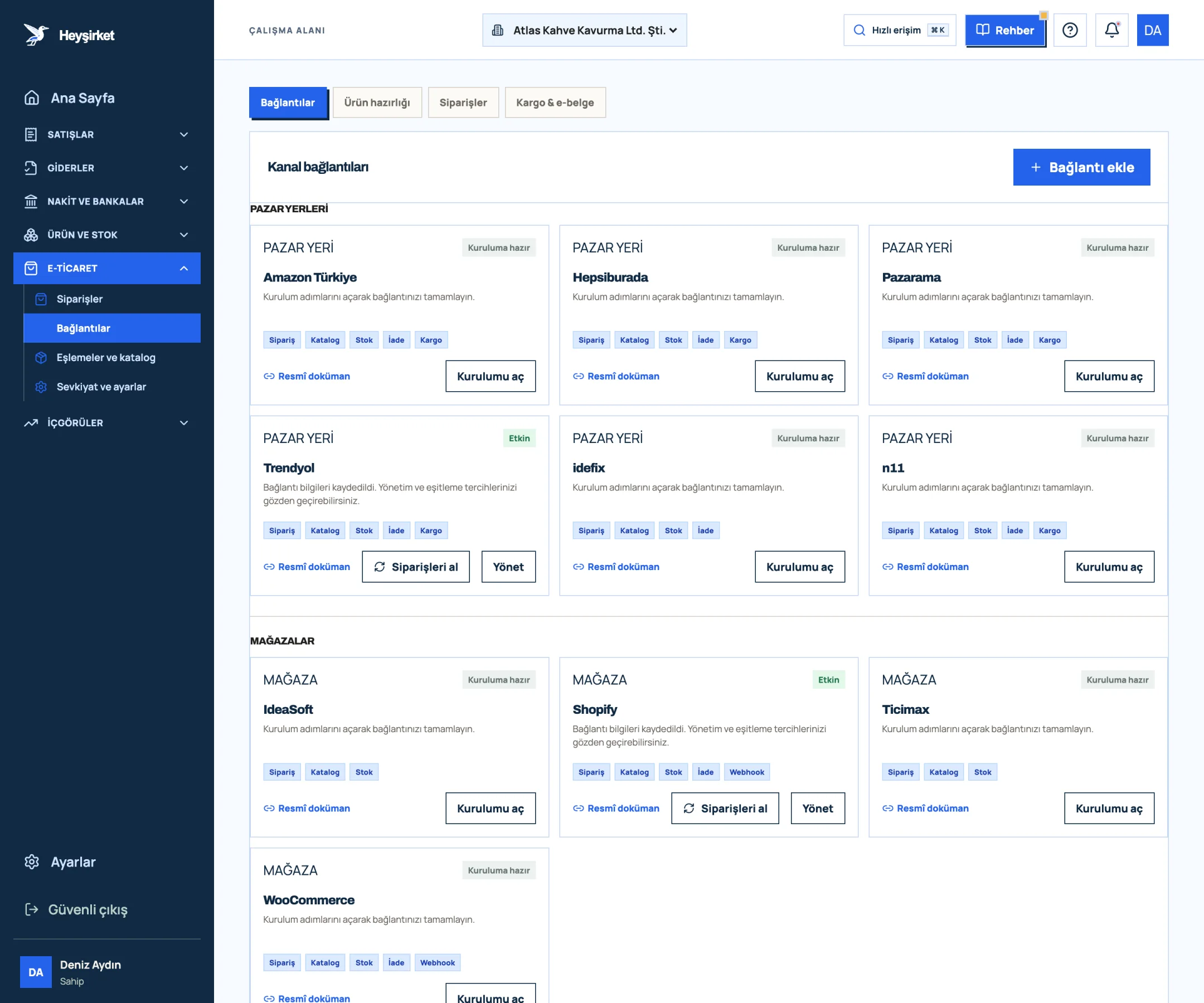
- 1. Add connection
- 2. Active Trendyol connection
- 3. Fetch orders button
- 4. Active Shopify store
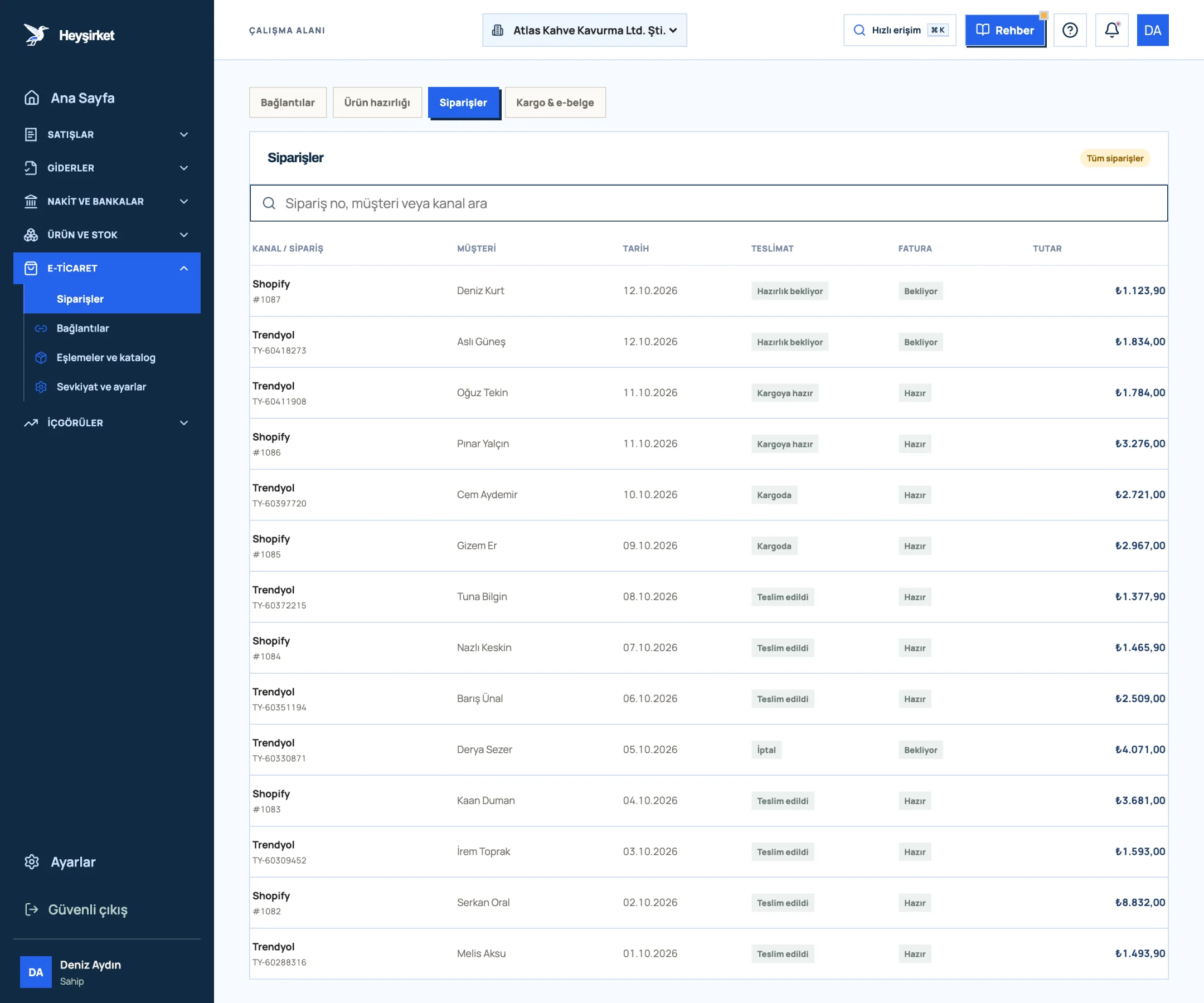
- 1. E-commerce tabs
- 2. Order search
- 3. New incoming Shopify order
- 4. Trendyol order ready to ship
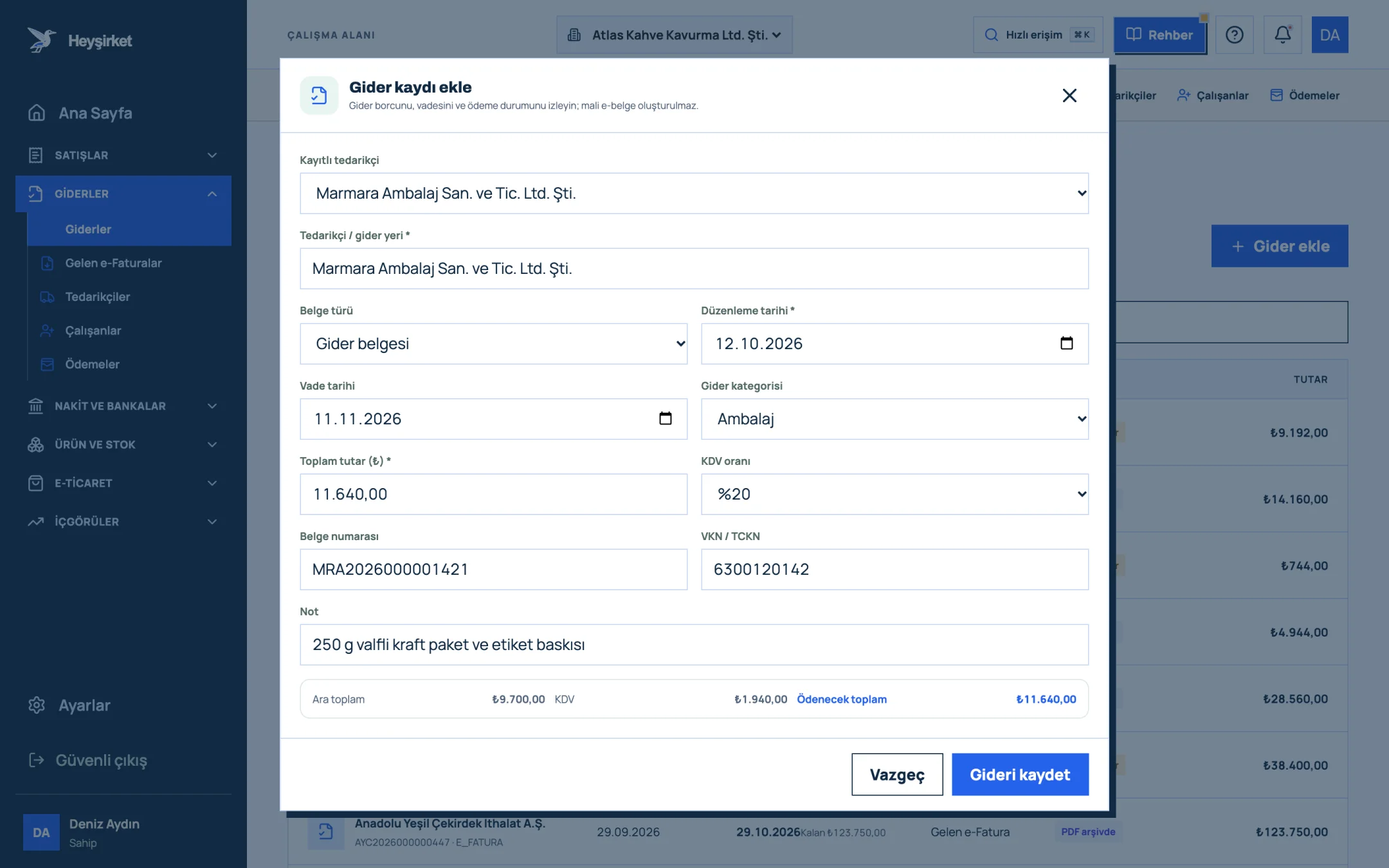
- 1. Supplier selection
- 2. Expense category
- 3. Amount and VAT rate
- 4. Subtotal, VAT and total payable
- 5. Save expense
| Task | In Heyşirket | Note |
|---|---|---|
| Export invoice (e-Fatura or e-Arşiv) | No | Issued from your e-document provider's screen |
| ETGB and customs declaration | No | Filed by the courier or customs broker |
| Viewing store and marketplace orders | Yes | The Orders tab in the E-commerce hub |
| Keeping USD or EUR accounts | Yes | The Currency choice on the Cash & Bank screen |
| Separating export expenses by category | Yes | Expense category in the Add expense record window |
| Preparing the VAT refund file | No | Your accountant prepares it; you can give them access with the Accountant role and show the categorized expense records directly |
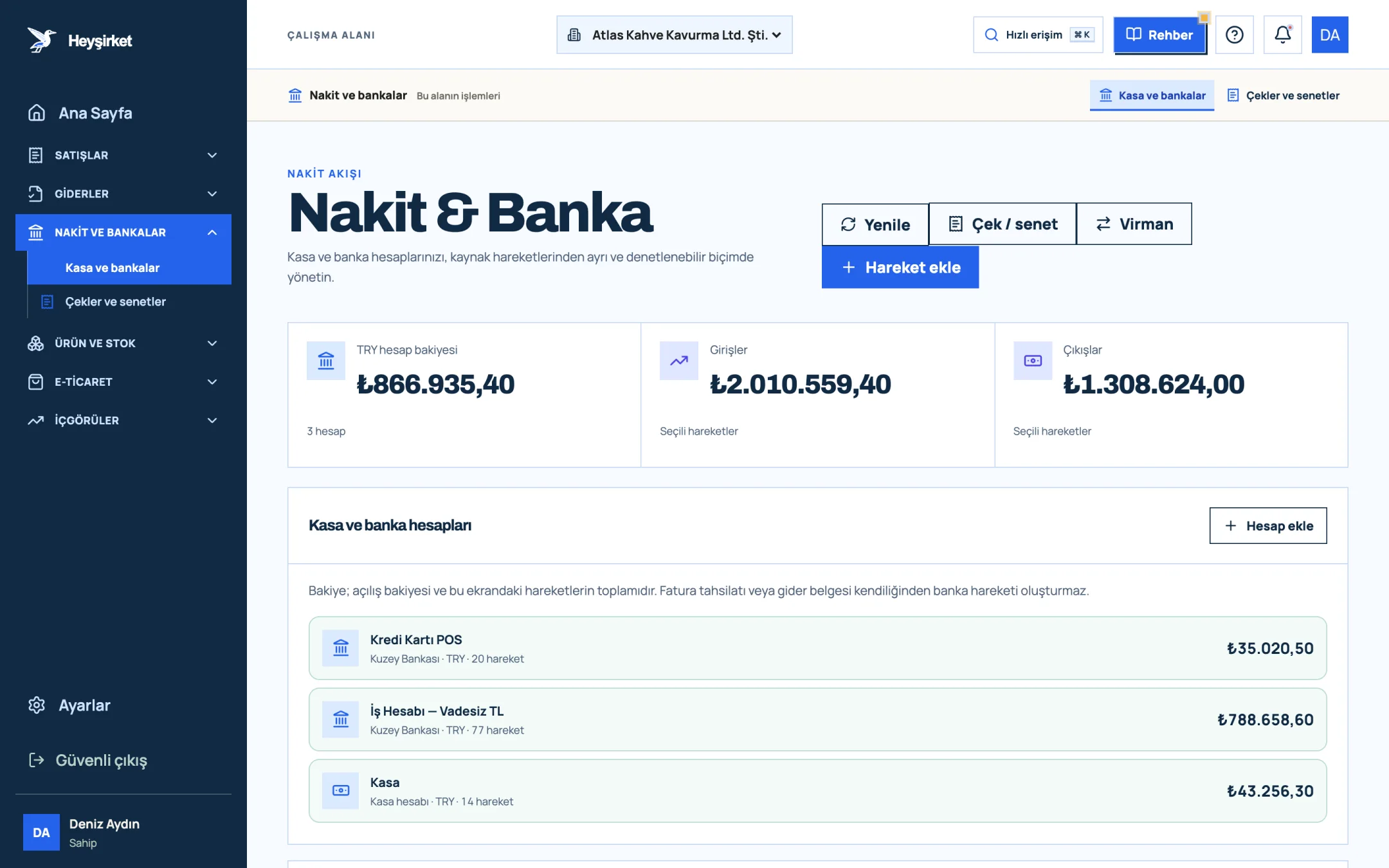
- 1. Add transaction button
- 2. Transfer between accounts
- 3. Total TRY balance
- 4. Cash and bank account list
If you sell through marketplaces, our marketplace seller accounting guide covers the domestic side of commission, shipping and payout records, and our marketplace connection guide shows you how to connect your orders.
Do I need a company to do micro exports?
You need to be a registered taxpayer who can issue invoices; it doesn't matter whether that's a sole proprietorship or a limited or joint-stock company. If you're thinking of selling abroad as an individual, you'll first need to register as a taxpayer and consider which company type suits you; see our article on sole proprietorship vs limited company.
Who files the ETGB?
The ETGB is filed by the postal or express courier carrying the shipment, based on your invoice and shipment details. Your job is to issue the invoice as the right type and pass the details to the courier in full.
Can I get a VAT refund on micro exports?
Yes. Exports cleared with an ETGB are also covered by the export-of-goods exemption; VAT paid on export-related purchases that can't be offset can be claimed as a refund. Prepare the file with your accountant.
Which month's VAT return does an export invoice go into?
It depends on the closing date of the customs declaration, not the invoice date. The exemption is declared in the VAT return for the month in which the declaration was closed.
Can I issue an export invoice in Heyşirket?
Not today. Sales invoices in Heyşirket are issued in Turkish lira with 1%, 10% and 20% VAT rates; there's no support for the export scenario or VAT exemption codes. You can track orders, foreign-currency accounts and export expenses in Heyşirket.
Bring your orders from abroad into one list Connect your store or marketplace account and track orders, delivery and invoice statuses together in the Orders tab. Open channel connections
Author: Heyşirket Editorial Team