Cost and pricing · 16 min read · Updated:
How to calculate product cost: finding the true cost of a kilo of coffee
Most producers think their unit cost is just the price of raw materials, and only see the gap at year end. In this article we work out the cost of a kilo of roasted coffee down to the last kuruş, then connect that figure to the price.
In short
- Unit cost is found by dividing the direct materials, direct labour and manufacturing overhead incurred to make a product ready for sale by the quantity produced.
- Waste (fire) is the part of the input lost during production; in the unit cost calculation, raw material requirements are scaled up by the waste rate: input required = output / (1 − waste rate).
- Manufacturing overhead (rent, energy, depreciation, maintenance) is shared among products using an allocation key such as kilograms, machine hours or labour hours; the key should be the measure closest to what actually drives the cost.
- In a workshop running below capacity, fixed costs are spread over fewer products, so unit cost rises; pricing decisions should be based on cost calculated at normal capacity.
- The selling price should be worked back from the target profit margin, not set as a percentage added on top of cost: price = unit cost / (1 − target margin).
For years, Atlas Kahve's founder Deniz Aydın worked with a single calculation in his head: green beans cost 520 TL a kilo, and the café price of the Espresso Blend is 924 TL. That's a difference of more than 400 TL, so business is good.
But the table his accountant (mali müşavir) prepared at year end told a different story: revenue had grown, yet gross profit was half what he expected. By the end of this article, you'll see where that half went, using a single kilo of coffee. Waste, labour, rent and capacity all play a part in this story.
Part 1 · Definition What is unit cost, and why isn't it the raw material price?
Unit cost is the total of all production costs incurred to make a single unit of a product ready for sale. Raw material is only one part of it; on top come labour, energy, machinery, premises and the material lost during production.
In cost accounting, this total is grouped under three main headings. Knowing this split shows you which items you can control and which are a burden that shrinks as volume grows.
| Component | Definition | Atlas Kahve example | Behaviour |
|---|---|---|---|
| Direct materials and supplies | Inputs that go directly into the product | Green beans, valve bag, label | Variable: repeats with every kilo |
| Direct labour | The cost of staff who directly make the product | The roaster's wages and SGK (social security) cost | Semi-variable: depends on capacity |
| Manufacturing overhead | Costs that serve production but can't be charged directly to a single product | Workshop rent, natural gas, electricity, depreciation of the roasting machine, maintenance | Mostly fixed: falls per kilo as volume grows |
For products you buy and resell rather than make, the calculation is shorter. The unit cost of the espresso machines Atlas imports from Italy is the purchase price plus every cost incurred to bring the goods to the warehouse, such as freight, insurance, customs duty and the customs broker's fee. There's no labour or waste line, but if these extra items are forgotten, the machine also looks more profitable on paper than it is.
Tax cost and management cost aren't always the same. The calculation in this article is the management cost you use to make pricing decisions. But both start in the same place: the input itself. And the sneakiest thing about coffee as an input is that it doesn't come out of the roaster the way it went in.
Part 2 · Waste How does the waste rate change unit cost?
Waste is the part of the input that is lost, evaporates or becomes unusable during production. In the unit cost calculation, waste increases the amount of input required: input required for one unit of output = 1 / (1 − waste rate).
As coffee roasts, it loses most of its moisture and some dry matter. Roasters know that weight loss is between 15 and 20 percent, depending on the roast level. On Atlas's espresso profile, the rate is 18 percent.
| Target output | 1,00 kg roasted coffee |
|---|---|
| Roasting waste | 18% |
| Green beans required (1 / 0,82) | 1,22 kg |
| Green bean price per kilo excl. VAT (example) | 520,00 TL |
| Bean cost of 1 kg roasted coffee | 634,40 TL |
The calculation is rounded to 1,22 kg. The 114,40 TL gap between the 520 TL in Deniz's head and the real bean cost is money lost before the product even reaches the bag.
Waste doesn't only happen during roasting. Coffee spilled during packing, samples set aside for cupping and damaged bags are all waste too. Normal waste is part of cost; abnormal losses should be documented separately. We covered the record-keeping side in our inventory management basics article.
So that's the cost of the beans. But someone puts those beans in the roaster, watches the profile, cools them and packs them. How does that cost get written onto the kilo?
Part 3 · Labour How is direct labour cost charged per kilo?
Direct labour cost is found by dividing the total employer cost of staff working directly in production (gross wages, including the employer's SGK and unemployment insurance contributions) by the quantity produced in the same period. The basis is the total cost to the employer, not net salary.
At Atlas, the person directly responsible for roasting is Ece Karaca. The cost of Burak, who handles sales and training, or Selin, who looks after accounting, belongs not to production but to sales and administrative expenses. This distinction is the first rule for keeping unit cost accurate without inflating it.
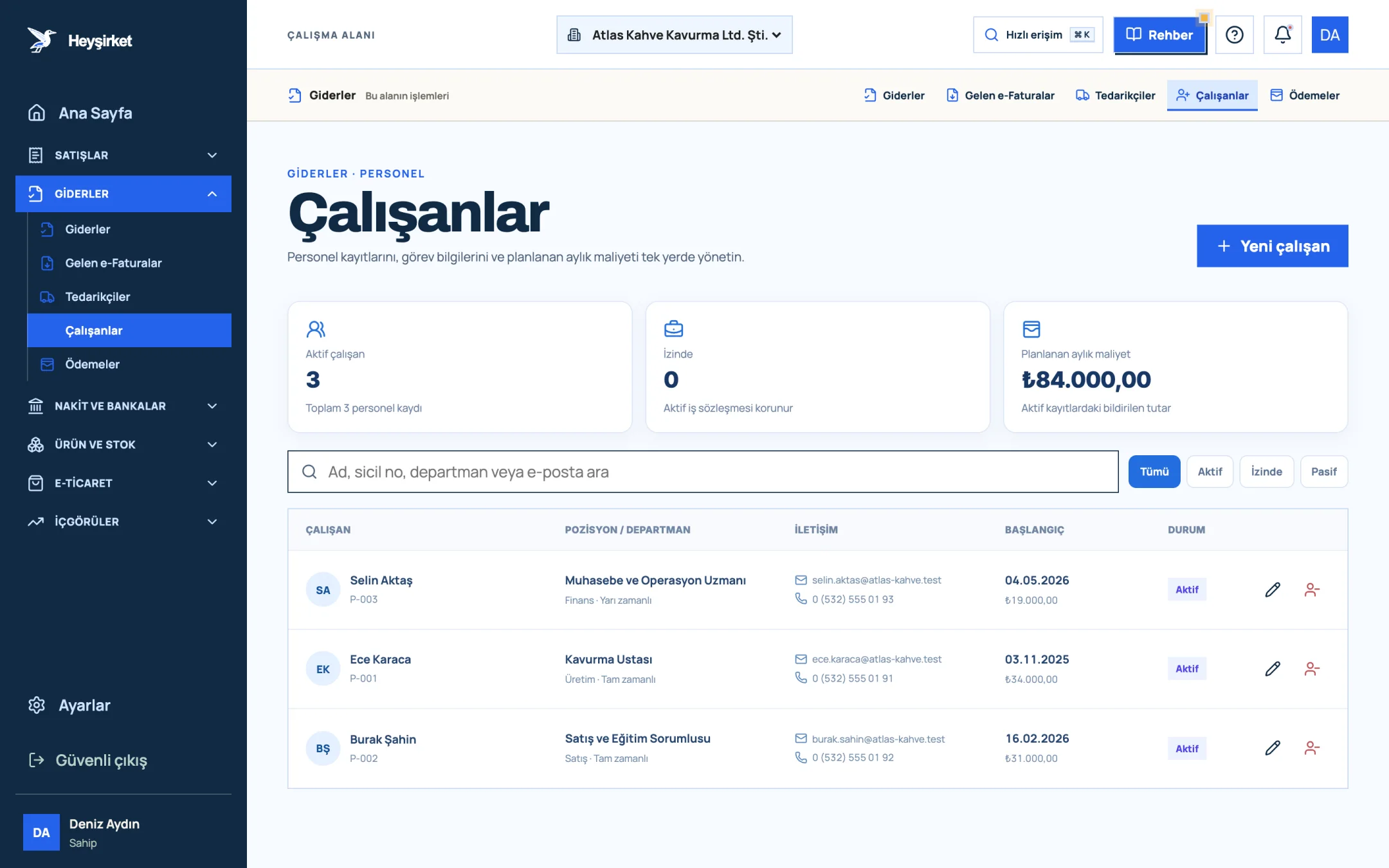
- 1. New employee
- 2. Planned monthly cost
- 3. Employee list
- Ece's total monthly cost to the employer (example): 32.000 TL
- The workshop's normal monthly roasting capacity: 1.600 kg
- Direct labour per kilo: 32.000 / 1.600 = 20,00 TL
Choose the capacity figure carefully, too. 1.600 kg is the amount Atlas can comfortably roast on a single shift after deducting maintenance days, not the machine's theoretical maximum capacity. If you use theoretical capacity, the labour and overhead share shrinks artificially and cost comes out lower than it really is.
We explained in detail how to calculate the employer cost of wages and contributions in our employee cost calculation article. The key point here is that labour cost doesn't fall when production drops. That brings us to the most overlooked character in the story.
Part 4 · Allocation How is manufacturing overhead allocated to products?
Overhead allocation means sharing production costs that can't be charged directly to a single product among products using an allocation key. The allocation key is the measure that best explains the cost: kilograms, machine hours, labour hours or floor area.
| Cost | Monthly amount | Note |
|---|---|---|
| Workshop rent (production area share) | 30.000 TL | Shop and office share excluded |
| Natural gas and electricity | 14.000 TL | Roasting machine and cooling |
| Depreciation of the roasting machine | 12.000 TL | Monthly share set by the accountant |
| Maintenance, cleaning, filters | 8.000 TL | Including chimney cleaning |
| Total | 64.000 TL | Divided by 1.600 kg normal capacity |
Because Atlas only roasts coffee, a single key, kilograms, is enough: 64.000 / 1.600 = 40,00 TL. But if the workshop both roasted coffee and ran barista training, part of the rent would have to be allocated to the training area. Otherwise the coffee would be paying the training's rent.
- Green beans — 1,22 kg × 520 TL = 634,40 TL
- Packaging — Valve bag and label: 28,00 TL
- Direct labour — 20,00 TL
- Manufacturing overhead — 40,00 TL
- Unit production cost — 722,40 TL
Four boxes, one number: 722,40 TL. Now let's put that number into a single table and place it next to the selling price.
Part 5 · The calculation The cost of a kilo of roasted coffee: the full calculation
Unit production cost is the sum of the per-kilo amounts of direct materials, direct labour and manufacturing overhead. For 1 kg of Atlas Kahve's Espresso Blend, this total is 722,40 TL.
| Green beans (1,22 kg × 520 TL) | 634,40 TL |
|---|---|
| Valve bag and label | 28,00 TL |
| Direct labour | 20,00 TL |
| Manufacturing overhead | 40,00 TL |
| Unit production cost | 722,40 TL |
| Café Wholesale 2026 price (excl. VAT) | 924,00 TL |
| Gross profit | 201,60 TL |
| Gross profit margin at the café price | 21,8% |
At the list price of 1.050 TL, gross profit is 327,60 TL and the margin is 31,2%. The 12% discount on the price list pulls the margin down by about 9,4 points. Shipping, sales commission and administrative expenses have not been deducted yet.
This is where the gap between the calculation in Deniz's head and the real one becomes clear. At a price of 924 TL, the profit is 201,60 TL, not 404 TL. Half of it was left behind in waste, packaging, labour and rent.
| Scenario | New unit cost | Change | Margin at 924 TL |
|---|---|---|---|
| Current situation | 722,40 TL | — | 21,8% |
| Waste rises from 18% to 20% (1,25 kg) | 738,00 TL | +15,60 TL | 20,1% |
| Green bean price rises 10% (572 TL) | 785,84 TL | +63,44 TL | 15,0% |
| Only 1.000 kg roasted in the month | 758,40 TL | +36,00 TL | 17,9% |
| Packaging supplier changes (22 TL) | 716,40 TL | −6,00 TL | 22,5% |
The table speaks plainly: around 88 percent of Atlas's cost is beans. And the beans are bought in dollars. So the real variable that sets this company's profit margin is the exchange rate. We explained how to monitor this risk in our foreign currency invoices and exchange differences article.
Part 6 · Price How do you get from cost to selling price?
A cost-based selling price is found by dividing unit cost by one minus the target profit margin: price = unit cost / (1 − target margin). Confusing a percentage added on top of cost (markup) with a target margin is the most expensive rounding error SMEs make.
| Method | Calculation | Price | Actual margin |
|---|---|---|---|
| Add 30% to cost (markup) | 722,40 × 1,30 | 939,12 TL | 23,1% |
| 30% target margin | 722,40 / 0,70 | 1.032,00 TL | 30,0% |
The 92,88 TL difference is money left on the table with every kilo of coffee. We covered the difference between markup and margin, contribution margin and the break-even point in detail in our pricing strategy article. The only rule we'll add here is this: factor in the discounts on your price list as well.
The 12% discount Atlas gives its café customers brings the 1.032 TL target price down to about 908 TL. If you want to keep a 30% target margin after the discount, the list price should be 1.032 / 0,88 = about 1.173 TL.
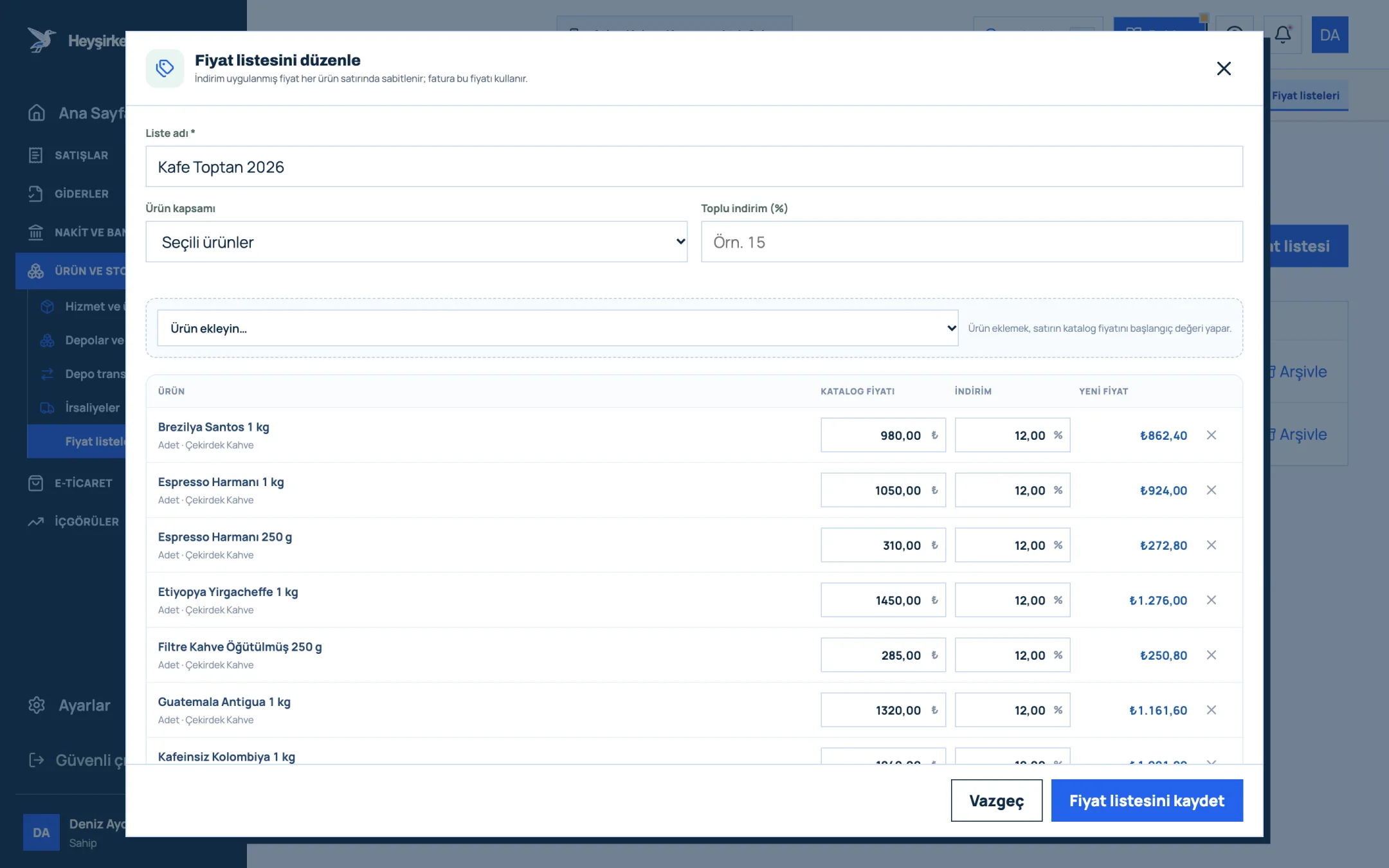
- 1. List name and scope
- 2. Discount rate and new price
- 3. Save button
Part 7 · In practice Where do you collect your cost data in Heyşirket?
Heyşirket isn't a production costing module: the product card has no recipe or cost field, and it doesn't calculate unit cost automatically. But it keeps the three data sources that feed your cost table in order: purchase costs, expense categories and employee costs.
Step by step: a routine that feeds your cost table every month
Buy beans with a purchase order
Create a Purchase order in the Purchases tab of the Operations center and enter a Unit cost for each item. When the goods arrive, post them to stock with Receive, then record the supplier balance with Create expense document.
Enter overhead with a category
When entering rent, energy, maintenance and packaging invoices in the Add expense record window, choose an Expense category. At month end, total manufacturing overhead comes out with a single filter.
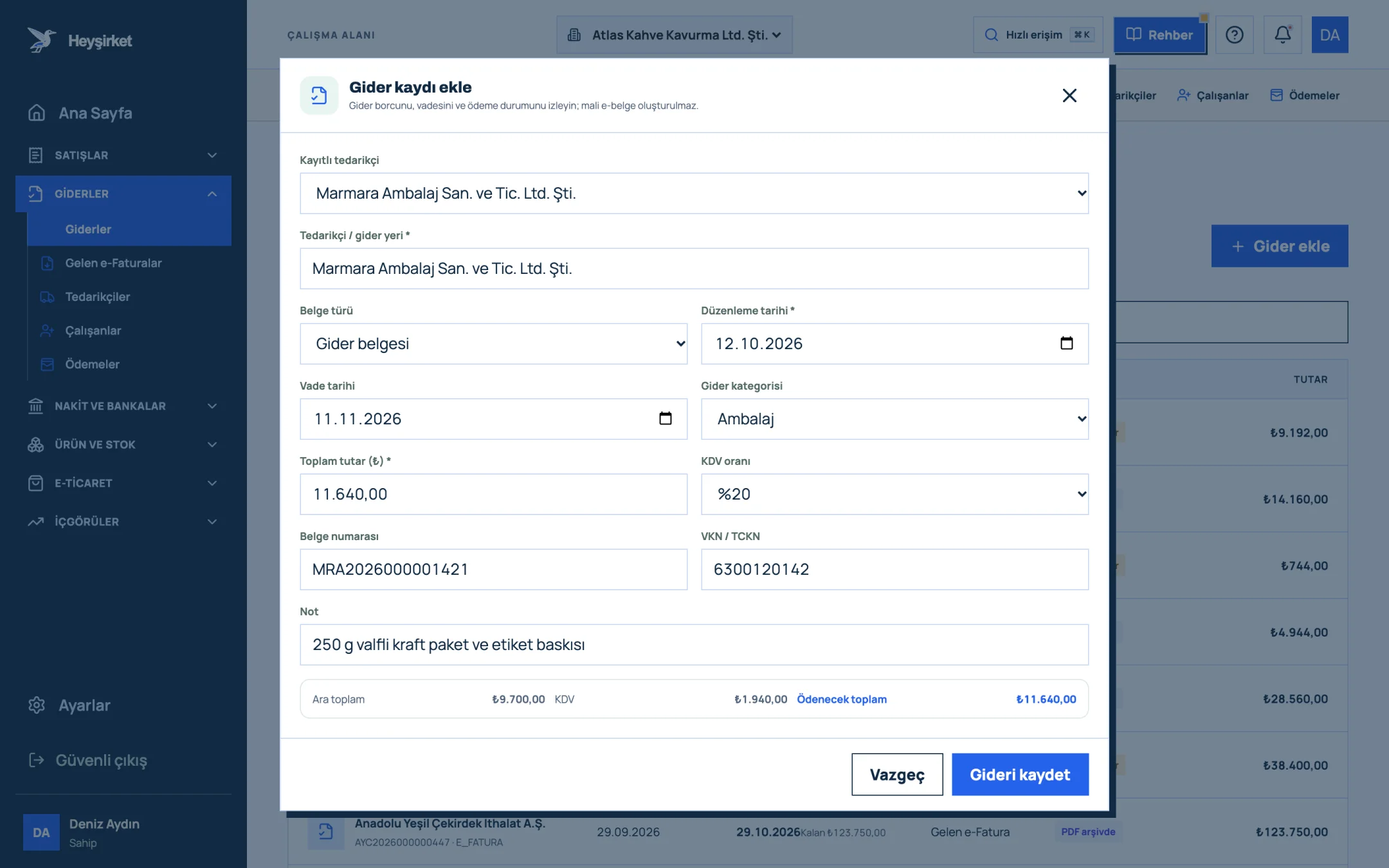
Enter overhead with a category - 1. Supplier selection
- 2. Expense category
- 3. Amount and VAT rate
- 4. Subtotal, VAT and total payable
- 5. Save expense
Set up categories once
In the categories section of Settings, create categories of the Expense category type such as “Production · Energy”, “Production · Rent” and “Packaging”. Keeping production and administrative expenses in separate categories makes the allocation easier.
Identify production staff
The Employees screen shows each employee's job title and monthly cost. For direct labour, take only the cost of people working in production.
Identify production staff - 1. New employee
- 2. Planned monthly cost
- 3. Employee list
Check actuals at month end
See the period's sales and expense totals on the Income and expenses report screen. If there's a big gap between the assumptions in your cost table and actual expenses, update the table.
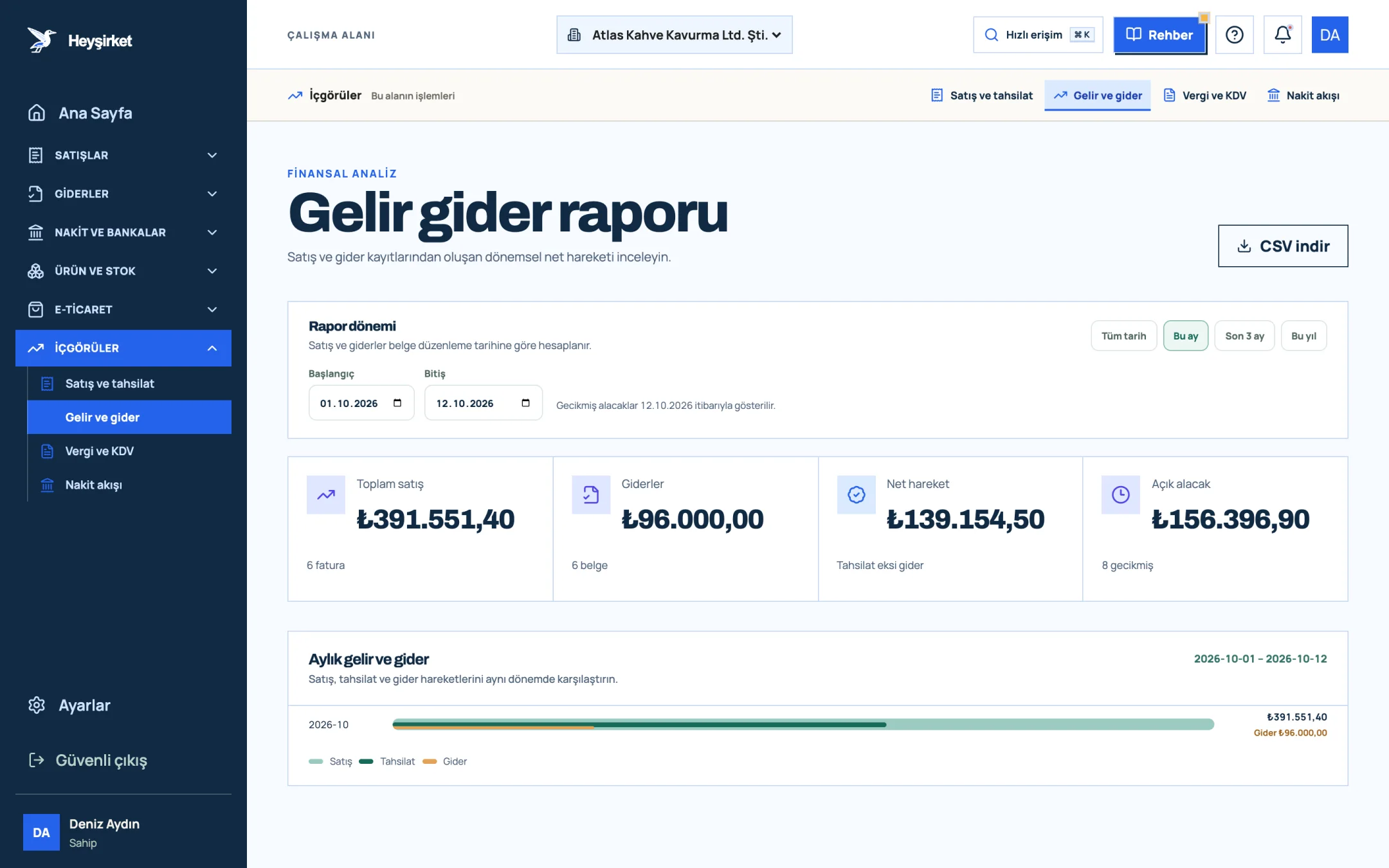
Check actuals at month end - 1. Total sales and expenses
- 2. Monthly income and expense chart
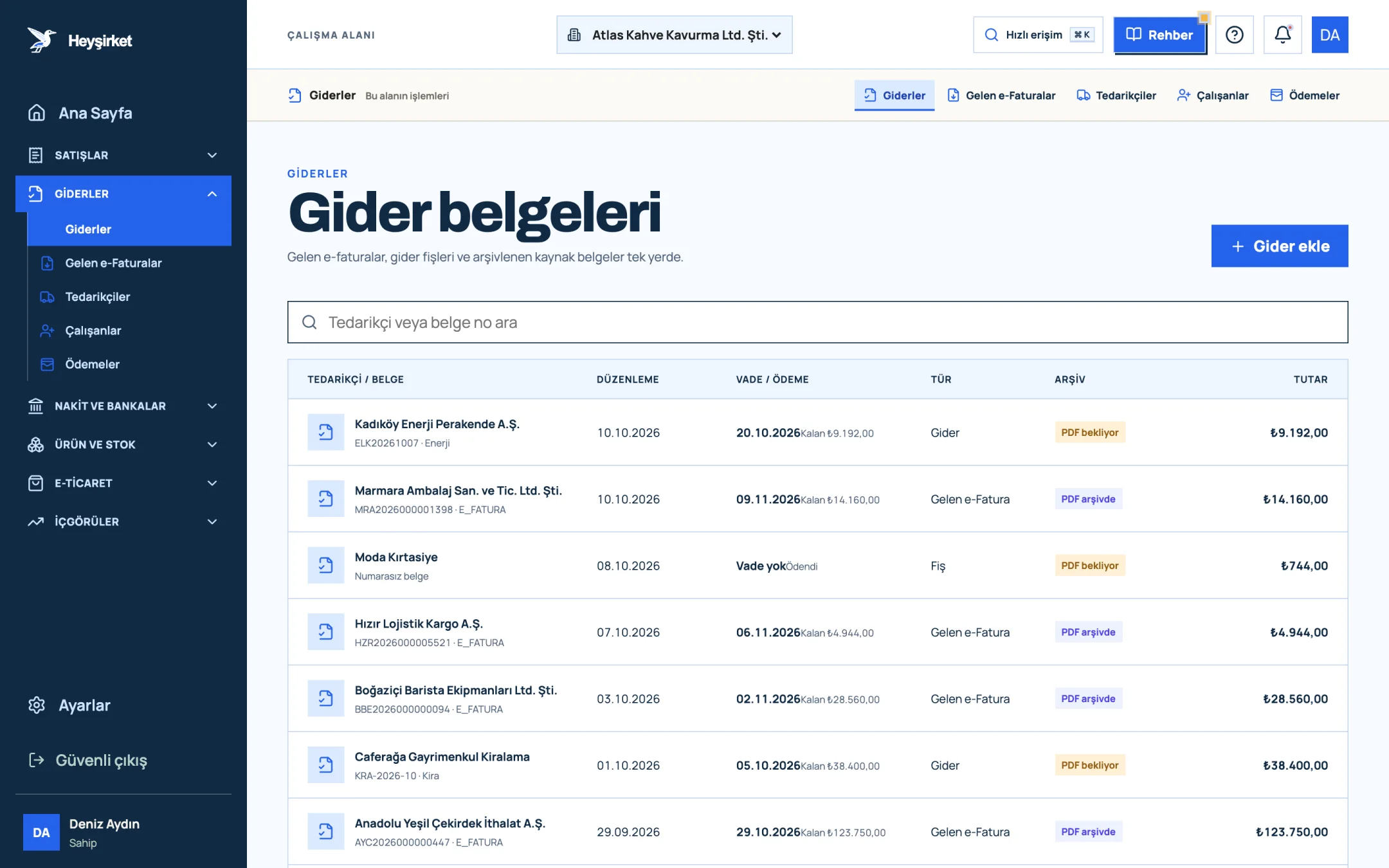
- 1. Add expense button
- 2. Due date and remaining payment
- 3. Document type (Expense, Incoming e-Fatura, Receipt)
- 4. Expense document row
Do this for your cost table this month
- Calculate the unit cost of your three best-selling products using the four lines in this article.
- Measure your waste rate by weighing for a week.
- Separate manufacturing overhead from administrative expenses and divide it by normal capacity.
- Include under direct labour only the total employer cost of people working in production.
- Check that the discounted prices on your price list don't fall below your target margin.
- Rerun the table whenever the raw material price or exchange rate changes by more than 5 percent.
Are shipping and sales commission included in unit cost?
They aren't included in production cost; they are selling and distribution expenses. However, when making pricing decisions you need to factor in the shipping and commission per product separately. If you sell on a marketplace, commission is often the second-largest item.
What should the waste rate be?
There's no single correct rate; it varies by product, machine and process. In coffee roasting, weight loss is usually between 15 and 20 percent. Measure your own rate on the scale and check it with one batch every month.
Which key should I use to allocate overhead?
Choose the measure closest to what actually drives the cost. In a workshop producing a single product group, kilograms are enough. For products that use machines for different lengths of time, machine hours give a more accurate result; for labour-intensive products, labour hours do.
Does Heyşirket calculate unit cost automatically?
No. In Heyşirket the product card has no recipe or cost field. The Unit cost on purchase orders, categorised expense records and employee costs keep the data feeding your cost table in order; you do the calculation itself in a spreadsheet.
How often should I update my cost calculation?
At least every three months, and also whenever the main raw material price or exchange rate changes significantly. In periods of high inflation, monthly updates stop your price lists from falling behind.
Record your raw material costs Enter your next bean purchase with a Purchase order; let each item's Unit cost be the first line of your cost table. Open purchases
Author: Heyşirket Editorial Team