Pricing · 15 min read · Updated:
Pricing strategy: cost-plus, contribution margin, profit margin and repricing under inflation
“We add 30 percent on top” hides the fact that most businesses keep less profit than they think. This article turns price from a habit into a calculated decision.
In short
- Markup (profit as a share of cost) is calculated on cost, while profit margin is calculated on the selling price; adding 30% on top of cost gives not a 30% margin but about a 23,1% margin.
- To find a price from a target margin, divide cost by (1 − target margin): with a 600 TL cost and a 30% margin, the price is 857,14 TL.
- Contribution margin is what's left from the selling price after variable costs to cover fixed expenses, and it determines the break-even point.
- On a product with a 30% gross margin, a 10% discount requires a 50% increase in sales volume to keep the same gross profit.
- During inflation, prices should be updated regularly based on the latest purchase cost and a trigger rule set in advance.
The founder of Atlas Kahve worked out a cost of 600 TL for a kilo of espresso blend, said “let's add 30 percent on top” and set the price at 780 TL. At year end, the accountant (mali müşavir) asked about the gross margin. The founder said confidently, “30%”. The answer was 23,1%.
Those 7 points can turn into a gap of hundreds of thousands of lira over a year. In this article you'll see where that gap comes from, which method you should use to set your price, and the right repricing rhythm during inflation. By the end, you'll be able to work out the real margin of your best-selling product with a pen and paper.
Part 1 · The mix-up What's the difference between profit margin and markup?
Markup is profit as a share of cost; profit margin is profit as a share of the selling price. The same profit amount looks large when divided by cost and small when divided by the selling price.
| Unit cost (excl. VAT) | 600,00 TL |
|---|---|
| Markup 30% → profit (600 × 0,30) | 180,00 TL |
| Selling price (excl. VAT) | 780,00 TL |
| Profit margin (180 / 780) | %23,1 |
| Real profit margin | %23,1 |
Calculations use amounts excluding VAT. KDV (VAT) isn't the seller's profit; it's a tax you collect and pass on to the state.
If you want to find a price from a target margin, the formula is different: price = cost / (1 − target margin). If you want a 30% margin on a product that costs 600 TL, you should charge 600 / 0,70 = 857,14 TL. The 77 TL difference from 780 TL is money you leave on the table with every sale.
| Markup (on cost) | Profit margin (on price) | Price with a 600 TL cost |
|---|---|---|
| %20 | %16,7 | 720,00 TL |
| %25 | %20,0 | 750,00 TL |
| %30 | %23,1 | 780,00 TL |
| %42,9 | %30,0 | 857,14 TL |
| %50 | %33,3 | 900,00 TL |
| %100 | %50,0 | 1.200,00 TL |
When one person on your team says “margin” and another says “profit rate”, they may mean different things. The first job is to pick one language across the business. But speaking the right language isn't enough to find the right price; first you need to build the cost itself correctly.
Part 2 · Method How does cost-plus pricing work?
Cost-plus pricing means calculating a product's unit cost and adding the target profit on top to set the price. It's simple and most SMEs start with it; its weak spot is underestimating cost.
The cost of a kilo of espresso blend isn't just green beans. Weight loss during roasting, packaging, labels, shipping, marketplace commission and payment commission are all part of the cost.
| Item | Amount (excl. VAT) | Note |
|---|---|---|
| Green beans (1,18 kg) | 472,00 TL | About 15% weight is lost in roasting, so 1 kg needs more beans |
| Packaging and label | 28,00 TL | Valve bag, label printing |
| Roasting energy | 22,00 TL | Gas and electricity, allocated per kg |
| Shipping (B2B average) | 38,00 TL | Per-order cost divided by the number of bags |
| Payment commission | 15,00 TL | For card payments |
| Total variable cost | 575,00 TL | Cost incurred with every bag sold |
Wastage is especially easy to miss. 1 kg of roasted coffee needs not 1 kg but about 1,18 kg of green beans. We also cover how wastage feeds into cost in the inventory management basics article.
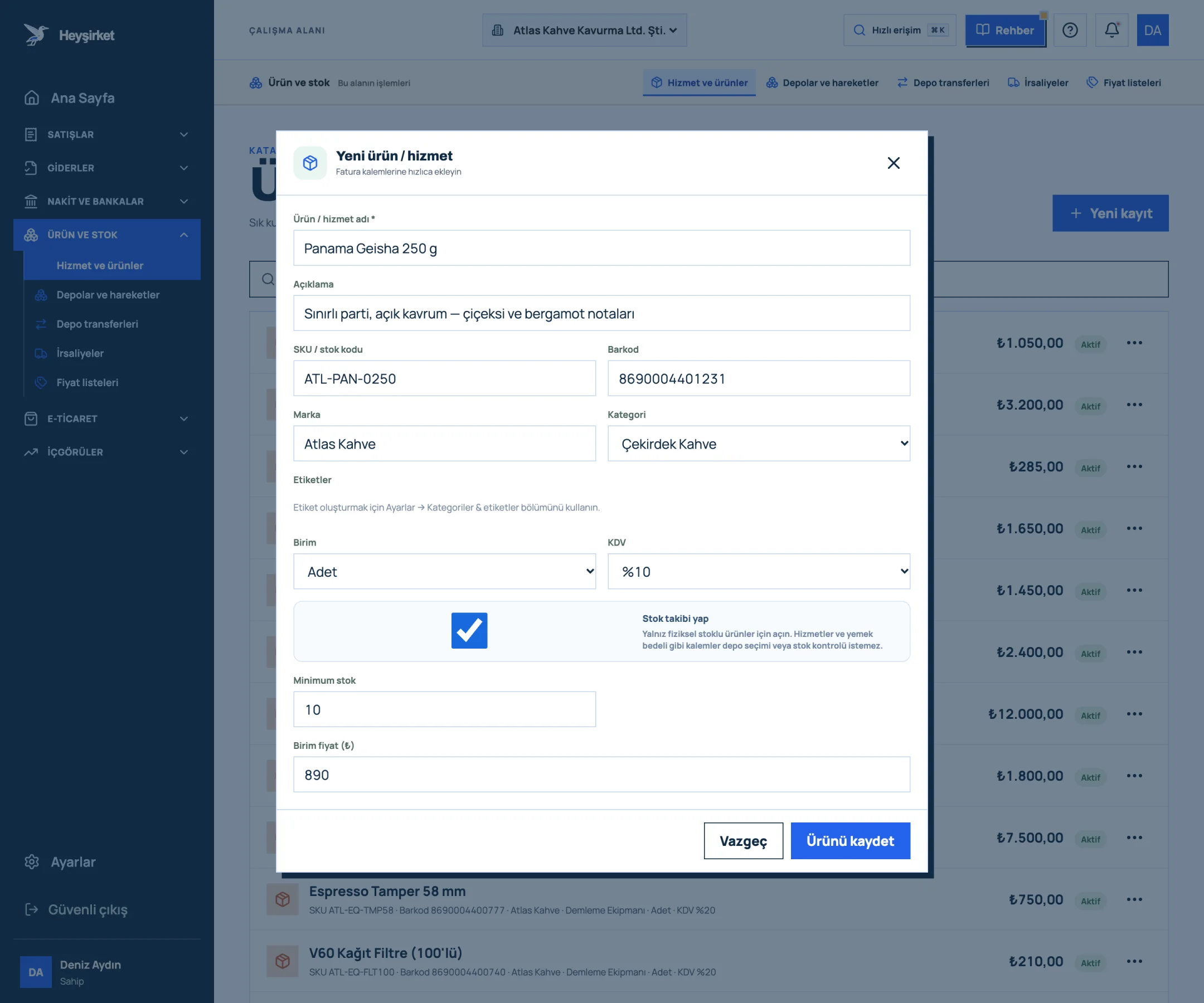
- 1. Product / service name
- 2. SKU and barcode
- 3. Category selection
- 4. Track stock option
- 5. Save product
The limit of cost-plus: customers see value, not your cost
Cost-plus gives you the floor your price shouldn't go below; the ceiling is set by the value the customer perceives and by competitors' prices. The range between the two is the real playing field for your pricing decision.
Atlas Kahve's single-origin Ethiopian coffee and its standard espresso blend cost about the same. But a third-wave café is willing to pay noticeably more for the single origin's story, tasting notes and limited batch. Applying the same markup to both products means leaving money on the table with the single origin.
A competitor's price is a reference, not a target. If a competitor is cheaper than you, ask two questions first: is their cost structure the same as yours, and do they offer the same service? Differences such as delivery speed, training support or equipment servicing can justify a price gap. Instead of matching the competitor, try explaining the difference to the customer.
Cost-plus gives you a floor price. But to see which price will keep your business going, you need to take one more step: contribution margin.
Part 3 · Contribution What is contribution margin, and how do you find the break-even point?
Contribution margin is what remains of the selling price after variable costs and “contributes” to covering fixed expenses. The break-even point is the sales quantity at which total contribution equals fixed expenses.
| Selling price (excl. VAT) | 850,00 TL |
|---|---|
| Variable cost | 575,00 TL |
| Unit contribution margin (850 − 575) | 275,00 TL |
| Monthly fixed expenses (rent, salaries, insurance, software) | 165.000,00 TL |
| Break-even sales quantity (165.000 / 275) | 600 bags / month |
From the 601st bag on, every sale leaves 275 TL of profit. If you cut the price by 50 TL, contribution drops to 225 TL and break-even rises to 734 bags.
This calculation shows why discount decisions are dangerous. Seen through contribution margin, a small price cut pushes the break-even point up a lot.
| Discount | New gross margin | Volume increase needed for the same gross profit |
|---|---|---|
| %5 | %26,3 | %20 |
| %10 | %22,2 | %50 |
| %15 | %17,6 | %100 |
| %20 | %12,5 | %200 |
Here's how to read it: a product sold for 100 TL with a 70 TL cost makes 30 TL profit. With a 10% discount, the price becomes 90 and profit 20 TL. To keep the same 30 TL total profit, you need to sell 1,5 times as many. A discount isn't a small gesture made in negotiation; it's a big volume commitment.
Part 4 · Segments Should every customer get the same price?
Segment-based pricing means offering the same product at different prices to customer groups that differ in volume, payment terms and cost to serve. The basis for a justified price difference is what it costs you to serve that customer.
- Volume: You don't serve a hotel buying 200 kilos a month and a café buying 5 kilos a month with the same shipping and preparation cost.
- Payment terms: A customer paying on 60-day terms uses your money longer than one who pays upfront. During inflation, that difference is a serious cost.
- Service intensity: The cost of serving a customer who needs equipment installation, training and frequent deliveries should be reflected in the price.
To make the cost of payment terms concrete, calculate it with a simple assumption. If money costs you 3% a month, making an 850 TL sale on 60-day terms means a financing cost of roughly 850 × 0,03 × 2 = 51 TL. That's almost a fifth of the 275 TL contribution margin. Any discount given to a customer on credit comes on top of this cost.
That's why you should design a segment discount not as a single number but as a package of conditions: volume commitment, payment terms and delivery frequency written down together. If a condition is broken, for example if the customer falls short of the committed volume, your right to switch them to another list should be agreed from the start. We cover the collections side of credit sales in the speeding up receivables collection article.
| Segment | Example customer | Discount | List price | Condition |
|---|---|---|---|---|
| Catalog | Online store, new cafés | %0 | 850,00 TL | Upfront or short terms |
| Café partners | Kuzguncuk Fırın & Kahve | %8 | 782,00 TL | At least 20 kg per month |
| Hotels and restaurants | Karaköy Pera Otel, Nişantaşı Bistro | %12 | 748,00 TL | At least 60 kg per month, 30-day terms |
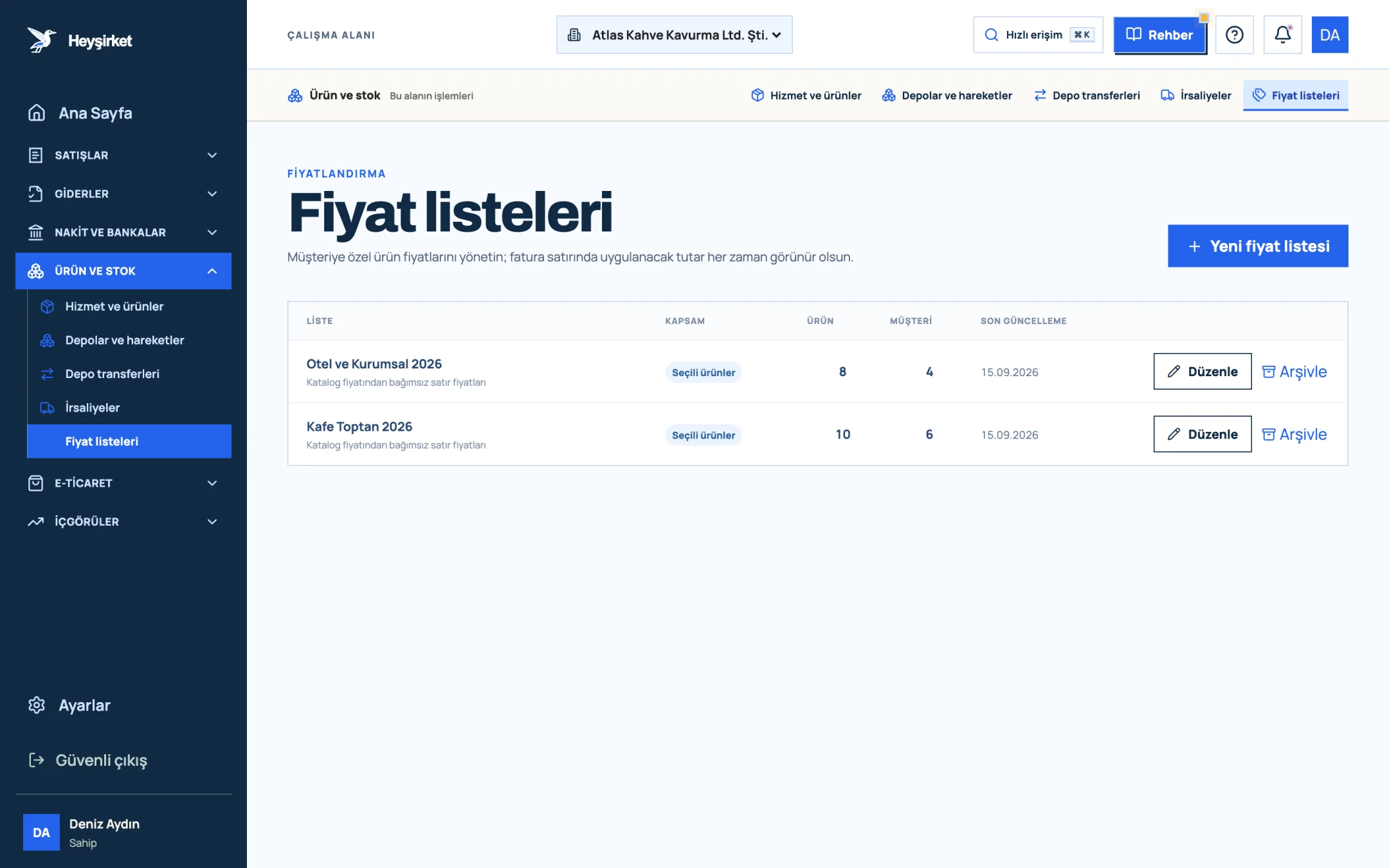
- 1. New price list
- 2. Kafe Toptan 2026 list
- 3. Number of assigned customers
When a customer is assigned to a list, the invoice screen shows the list name with an “applied” note, and products on the list come in at the special price. That gives you a pricing setup based on records rather than your sales team's memory. Setup steps are in the creating a price list guide.
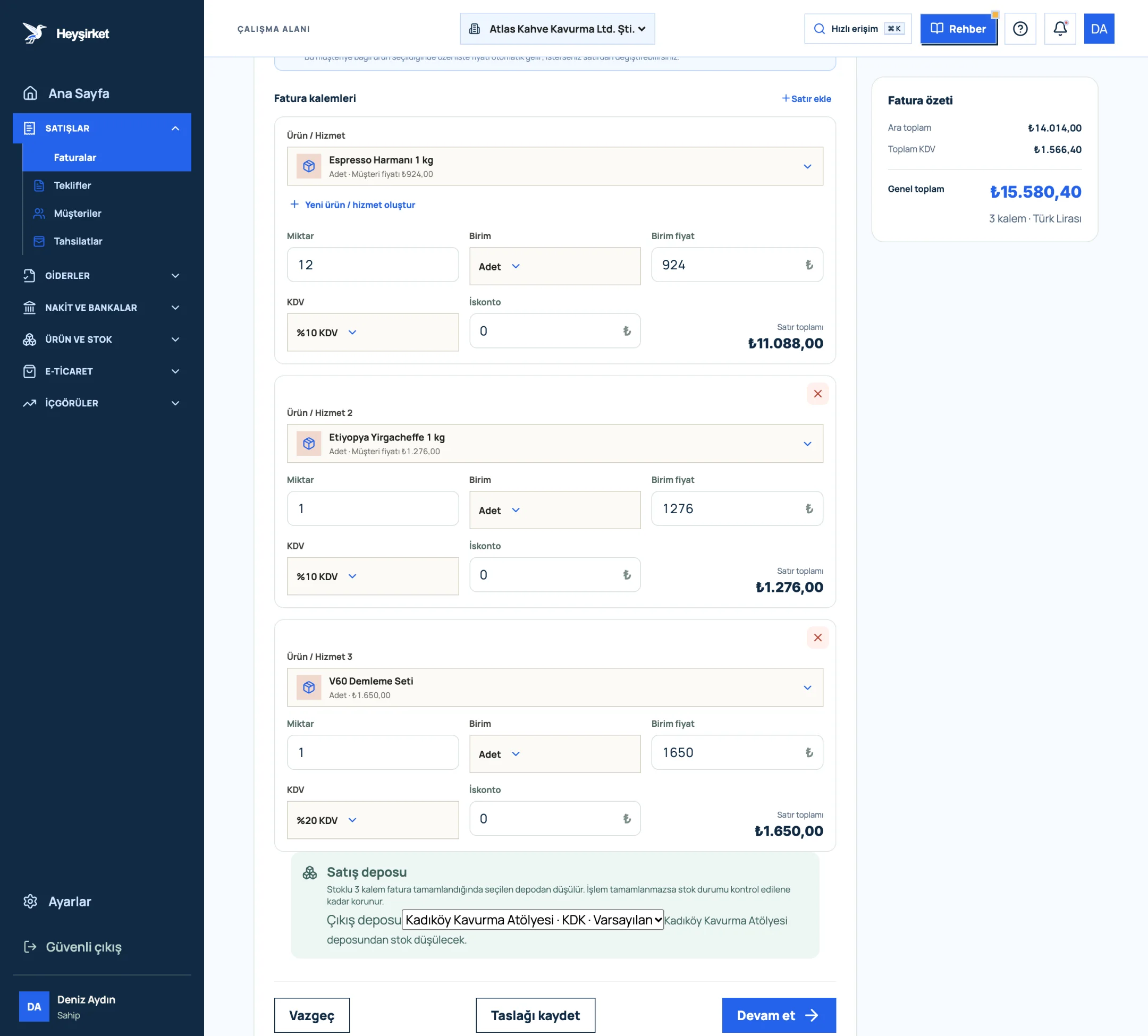
- 1. First invoice line item
- 2. VAT rate selection
- 3. Add row
- 4. Invoice summary and VAT total
Part 5 · Rhythm How often should prices be updated during inflation?
In an inflationary environment, repricing should follow a rule written in advance and tied to cost changes, not to the calendar. A “we'll raise prices once at New Year” approach erodes your margin month by month when costs rise throughout the year.
The basic mistake is setting the selling price based on the old purchase cost of goods in stock. If the beans on the shelf were bought at 400 TL but the next batch will cost 460 TL, failing to price on replacement cost means every bag you sell weakens your ability to fund the next purchase.
- Track cost — Latest purchase invoices
- Check the trigger — Has cost risen 5%?
- Calculate the new price — With the target margin
- Update the card and lists — Same day
- Notify the customer — In advance, in writing
- Set a trigger. For example: “If the unit cost of group A products has risen 5% since the last price update, the price is updated.”
- Set a review rhythm. Check the trigger at least once a month; every two weeks if costs are changing fast.
- Calculate with the target margin. Find the new price not by adding a percentage to the old price but by dividing the new cost by (1 − target margin).
- Plan the notice. Notify B2B customers of the change in writing before the effective date; a surprise price rise hurts the relationship more than the price itself.
- Shorten quote validity. If costs are changing fast, keep quote validity periods short accordingly.
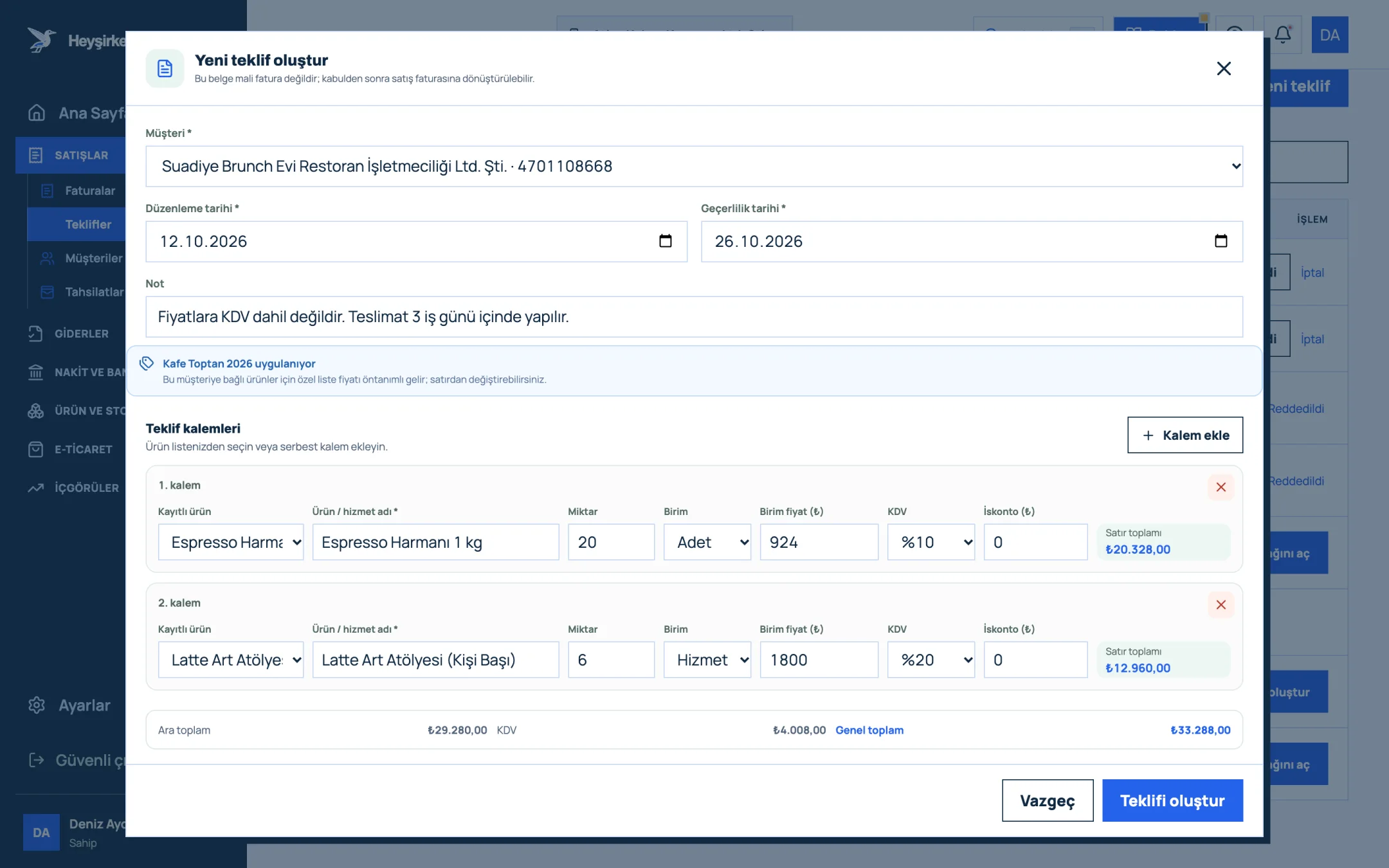
- 1. Customer and date fields
- 2. Quote line items
- 3. Add line item
- 4. Quote total
- 5. Create quote button
To follow general inflation indicators you can check TCMB (Central Bank of the Republic of Türkiye) publications, but the real indicator for your pricing decision is the cost change on your own purchase invoices. Your sector's inputs can move very differently from general inflation.
Part 6 · In practice How do you review your prices this month?
Rebuilding your pricing strategy doesn't require a big consulting project. A one-hour exercise starting with your five best-selling products reveals the biggest leaks.
Monthly pricing checklist
- Recalculate the variable cost of your five best-selling products, including wastage, packaging, shipping and commission.
- Calculate each product's real profit margin on the price excluding VAT; don't confuse it with markup.
- Work out the unit contribution margin and the monthly break-even sales quantity.
- If cost increases since the last price update have crossed the trigger threshold, calculate the new price with the target margin.
- Update all price lists on the same day as the Unit price (₺) on the product card.
- Check that segment discounts still match volume, payment terms and cost to serve.
- Review the Valid until dates on open quotes.
- Notify your B2B customers of price changes in writing before they take effect.
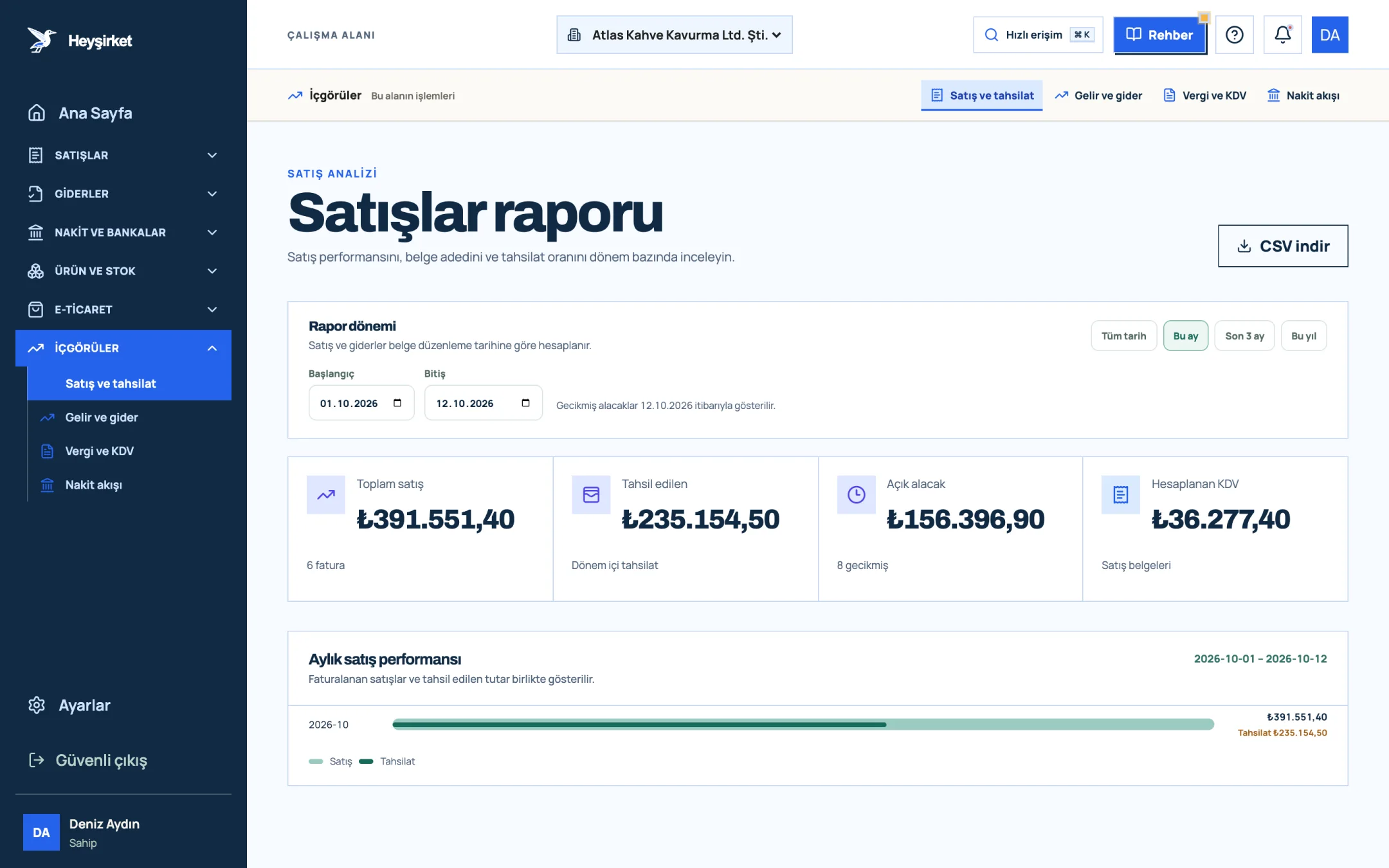
- 1. Report period selection
- 2. Total sales
- 3. Collected
- 4. Monthly sales performance chart
- 5. Download CSV
When Atlas Kahve's founder first ran through this list, they found that the real margin on the 780 TL espresso blend wasn't 23% but much lower once shipping and commissions were deducted. Rebuilding the price on the target margin changed the year-end picture, even with the same number of units sold. To keep going with reading the numbers, continue to the reading financial reports article.
What's the difference between profit margin and markup?
Markup is profit as a share of cost, and profit margin is profit as a share of the selling price. If you sell a product that costs 600 TL for 780 TL, the markup is 30% and the profit margin is 23,1%.
How do you calculate a selling price from a target profit margin?
Price = cost / (1 − target margin). For a 600 TL cost and a 30% target margin: 600 / 0,70 = 857,14 TL.
Is contribution margin the same as gross profit?
Similar, but not the same. Contribution margin deducts only variable costs from the price and shows the ability to cover fixed expenses. Gross profit is calculated using the accounting definition of cost of goods sold.
How often should I update prices during inflation?
Set a rule tied to cost changes rather than the calendar, for example updating when cost rises 5%. Check the trigger at least once a month.
Should prices be calculated including VAT?
Margin and markup are calculated on amounts excluding VAT. VAT isn't the seller's income; it's a tax that's collected and declared. In Heyşirket, product card and price list prices are excluding VAT.
How do I make a customer-specific price permanent?
Create a price list per segment and assign the customer to it. Invoices issued to the assigned customer pick up the list price automatically; details are in the creating a price list guide.
Set up your segment price lists Catalog, café partners, hotels and restaurants: start with three lists and assign your customers. Open Price lists
Author: Heyşirket Editorial Team