Employees · 16 min read · Updated:
Calculating employee costs in Türkiye in 2026: gross, net and what the employer really pays
When you tell an employee "47 thousand net a month", more than 70 thousand leaves the company. We break the difference down item by item under Turkish rules and calculate the real annual cost in TL.

In short
- In 2026 the gross asgari ücret (minimum wage) is 33.030 TL and the net minimum wage is 28.075,50 TL; the monthly employer cost without incentives is 40.874,63 TL.
- On top of the gross wage, as of 2026 the employer pays 21,75% social security and 2% unemployment insurance premiums, 23,75% in total; 14% and 1% are deducted from the employee.
- From 2026, the premium discount on the employer's share is 5 points in manufacturing and 2 points in other sectors, and is subject to conditions.
- The real cost of an employee includes, in addition to the gross wage and employer premiums, a provision for severance pay and fringe benefits such as meals and transport.
- The portion matching the minimum wage is exempt from income and stamp tax in every employee's wage; that's why the net of the same gross wage can change from month to month during the year.
When Deniz, the founder of Atlas Kahve, agreed terms with the new head roaster, the figure in mind was "47 thousand in hand". When the payroll came at the end of the month, the amount leaving the company was over 71 thousand. And at year-end, after adding up the severance provision, the meal card and other items, the roaster's annual cost had reached almost 1 million TL.
This isn't a mistake; it's the natural result of how wages are structured in Türkiye. By the end of this article you'll be able to calculate the gross, the net and the real annual cost for any employee yourself, and make hiring decisions based on that figure.
Part 1 · Three numbers What's the difference between gross wage, net wage and employer cost?
The gross wage is the wage written in the employment contract, before deductions; the net wage is the amount paid into the employee's account; and the employer cost is the total found by adding the premiums the employer pays on top of the gross wage. Net is the smallest figure, employer cost the largest.
- Gross wage — The amount in the contract
- Employee deductions — SGK 14%, unemployment 1%, taxes
- Net wage — Into the employee's account
- Employer premiums — SGK 21,75%, unemployment 2%
- Employer cost — What leaves the company
The rule of thumb: always discuss salary in gross terms, and always budget on employer cost. An employer who agrees on a net figure may have to cover the difference out of their own pocket as the employee's tax bracket changes during the year.
Let's start with the most basic figure: the minimum wage everyone uses as a reference.
Part 2 · Minimum wage How much does the minimum wage cost the employer in 2026?
In 2026 the gross asgari ücret (minimum wage) is 33.030 TL a month and the net minimum wage is 28.075,50 TL. Without a premium discount, its monthly cost to the employer is 40.874,63 TL.
- 33.030 TL 2026 gross minimum wage (monthly)
- 28.075,50 TL 2026 net minimum wage (monthly)
- 40.874,63 TL Employer cost without incentives (monthly)
| Gross wage | 33.030,00 TL |
|---|---|
| Employee SGK premium (14%) | − 4.624,20 TL |
| Employee unemployment premium (1%) | − 330,30 TL |
| Income tax and stamp tax | Exempt, 0 TL |
| Net wage | 28.075,50 TL |
| Employer SGK premium (21,75%) | + 7.184,03 TL |
| Employer unemployment premium (2%) | + 660,60 TL |
| Total employer cost without incentives | 40.874,63 TL |
With the premium discount, the cost falls to 40.214,03 TL with the 2-point discount in other sectors and to 39.223,13 TL with the 5-point discount in manufacturing. The short-term insurance branch rate may vary with the workplace's risk class; the calculation uses the general rate.
The minimum wage is a starting point. But most people in your business earn more than that, and that's where the calculation gets a little more interesting.
Part 3 · A real example How do you get from gross to net on a salary above the minimum wage?
The gross-to-net calculation deducts the employee's SGK (social security) and unemployment premiums from the gross wage, calculates income tax on the remainder and stamp tax on the gross, and subtracts the exemption corresponding to the minimum wage from both taxes. On wages above the minimum wage, tax now arises.
Let's take Atlas Kahve's head roaster, Ece Karaca, as an example. Her gross wage is 60.000 TL, and the calculation is for January, so the cumulative base is still in the first bracket.
| Gross wage | 60.000,00 TL |
|---|---|
| SGK employee share (14%) | − 8.400,00 TL |
| Unemployment employee share (1%) | − 600,00 TL |
| Income tax base | 51.000,00 TL |
| Income tax (15%) minus minimum wage exemption (7.650,00 − 4.211,33) | − 3.438,67 TL |
| Stamp tax (7,59 per mille) minus minimum wage exemption (455,40 − 250,70) | − 204,70 TL |
| January net wage | 47.356,63 TL |
This is an illustrative example. Once the cumulative base exceeds 190.000 TL in April, part of the wage enters the 20% bracket and the net wage falls. For the exact payroll, rely on your mali müşavir's (accountant's) payroll software.
| Gross wage | 60.000,00 TL |
|---|---|
| Employer SGK premium (21,75%) | + 13.050,00 TL |
| Employer unemployment premium (2%) | + 1.200,00 TL |
| Total without incentives | 74.250,00 TL |
| Non-manufacturing, with the 2-point discount | 73.050,00 TL |
| Monthly cost in manufacturing with the 5-point discount | 71.250,00 TL |
Food production activities such as coffee roasting may be classified under manufacturing; check with your accountant whether your workplace's activity code qualifies for the discount.
The result is striking: while 47.356 TL reaches the employee, 71.250 TL leaves the company every month. That's roughly 1,5 times the net wage. And we haven't counted fringe benefits yet.
Part 4 · Incentives How does the 5-point SGK discount work in 2026?
The 5-point premium discount means the disability, old-age and survivors' insurance premium on the employer's share is paid 5 points lower, subject to certain conditions. From 2026 this discount continues at 5 points in manufacturing, while in other sectors it has been reduced to 2 points.
| Situation | Employer SGK | Unemployment | Total employer share |
|---|---|---|---|
| No incentive | 21,75% | 2% | 23,75% |
| Non-manufacturing, 2-point discount | 19,75% | 2% | 21,75% |
| Manufacturing, 5-point discount | 16,75% | 2% | 18,75% |
To benefit from the discount, declarations generally have to be filed on time, premiums paid on time and there must be no overdue premium debt. A premium paid a month late can cost you that month's discount. That's why the discount is a direct part of cash planning.
Besides the premium discount, there are other forms of support, such as for youth and women's employment, employment of people with disabilities, regional incentives and minimum wage support paid to employers. Each has different conditions, durations and rules on combining them; asking your accountant "which incentive suits this person?" before hiring often saves you more than a month's salary.
Part 5 · Below the iceberg What employee costs don't show up on the payroll?
Hidden employee costs are expenses that don't appear as a separate line on the monthly payroll but that the employer bears over the year, such as the severance pay provision, meals, transport, leave and bonuses. If they aren't set aside in the budget, they arrive at year-end as a lump-sum surprise.
- Severance pay provision: A worker who has been employed for at least one year is, once the conditions are met, paid kıdem tazminatı (severance pay) equal to 30 days' gross wages for each full year. Setting aside roughly one twelfth of the gross wage every month is a common approach.
- Meals: In 2026, the portion of meal allowances up to 300 TL a day is exempt from income tax; the exemption doesn't mean this amount isn't an expense for the employer.
- Transport: For payments intended for public transport, the 2026 daily exemption amount is 158 TL.
- Annual leave: Wages are paid while the employee is on leave and someone else does the work; operationally, it may require extra capacity.
- Recruitment and training: Job ads, the onboarding period and low productivity in the first months are a real cost.
- Occupational health and safety: Mandatory services depending on the hazard class, health reports and equipment.
| Monthly employer cost × 12 (71.250 × 12) | 855.000 TL |
|---|---|
| Severance pay provision (1 month's gross) | 60.000 TL |
| Meals (300 TL × 22 days × 12 months) | 79.200 TL |
| Annual total, monthly average 82.850 TL | 994.200 TL |
This is an illustrative example; items such as bonuses, transport and occupational health and safety aren't included. Because you keep the gross wage fixed, the cumulative tax bracket change doesn't affect employer cost; it reduces the employee's net.
A conversation that started with 47 thousand TL net turned into a decision worth roughly 1 million TL a year. That's the real figure behind a hiring decision. So where should you record it so you see it every month?
Part 6 · Calendar When are salaries, taxes and SGK premiums paid?
The cash calendar for employee costs splits into three dates: the net wage goes to the employee on the payment day in the contract; income and stamp tax go to the tax office with the muhtasar ve prim hizmet beyannamesi (withholding and premium service return) by the 26th of the following month; and SGK premiums go to SGK by the end of the following month.
| Item | Paid to | Deadline (general rule) |
|---|---|---|
| Net wage | Employee | The payment day in the contract, e.g. 31 October |
| Income tax and stamp tax | Tax office | 26 November (filing and payment) |
| SGK premiums (employee and employer share) | SGK | 30 November |
This split matters for cash planning: roughly a third of October's payroll goes out in November. If the deadline falls on a holiday, it moves to the next working day. To see all obligations on one calendar, take a look at our tax calendar article; we explain how to place staff payments in the 13-week table in our article on cash flow management.
Part 7 · In practice How do you track employee costs in Heyşirket?
Heyşirket's Employees screen is a staff list that brings together employee records and the monthly employer cost you enter for each employee in one place. It doesn't calculate payroll or prepare SGK declarations; your accountant does that. The screen's purpose is to keep your team's monthly cost to the company in view at all times.
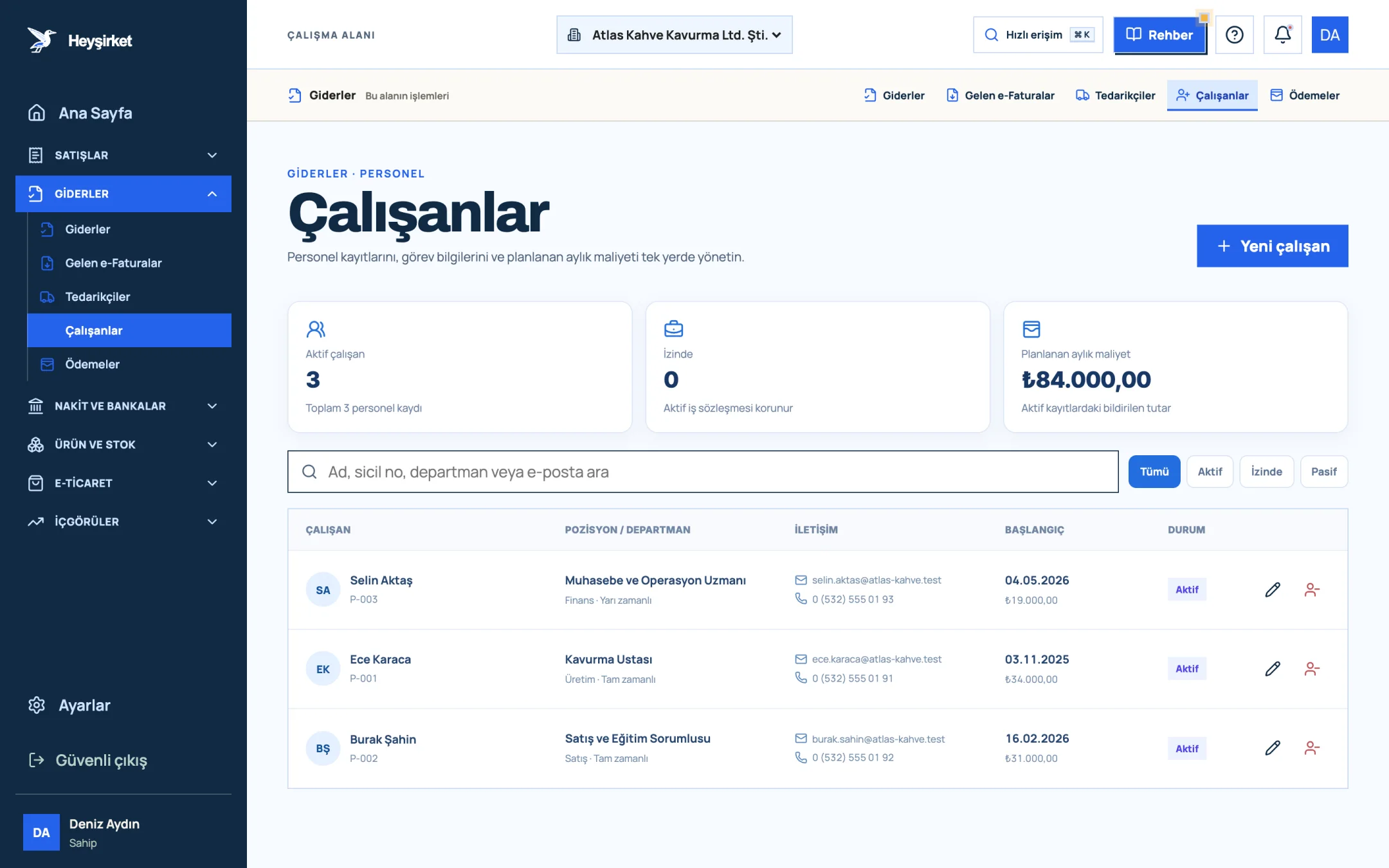
- 1. New employee
- 2. Planned monthly cost
- 3. Employee list
Recording an employee's real cost
Create a new record
On the Employees screen, press the New employee button in the top right. First name, last name and start date are required; if the employee ID is left blank, it's assigned automatically.
Create a new record - 1. New employee
- 2. Planned monthly cost
- 3. Employee list
Choose the work type
In the Work type field, select the right option from Full-time, Part-time, Contract or Intern; fill in the position and department too.
Enter the real cost
In the Monthly employer cost (₺) field, enter not the gross from the payroll but the total you calculated as above. If you enter the monthly average including the severance provision and meals, the total on screen shows your real budget.
Save and keep it up to date
Finish with Save employee. After a pay rise or a minimum wage change, open the record and update the cost; for an employee going on leave, set the Status field to On leave.
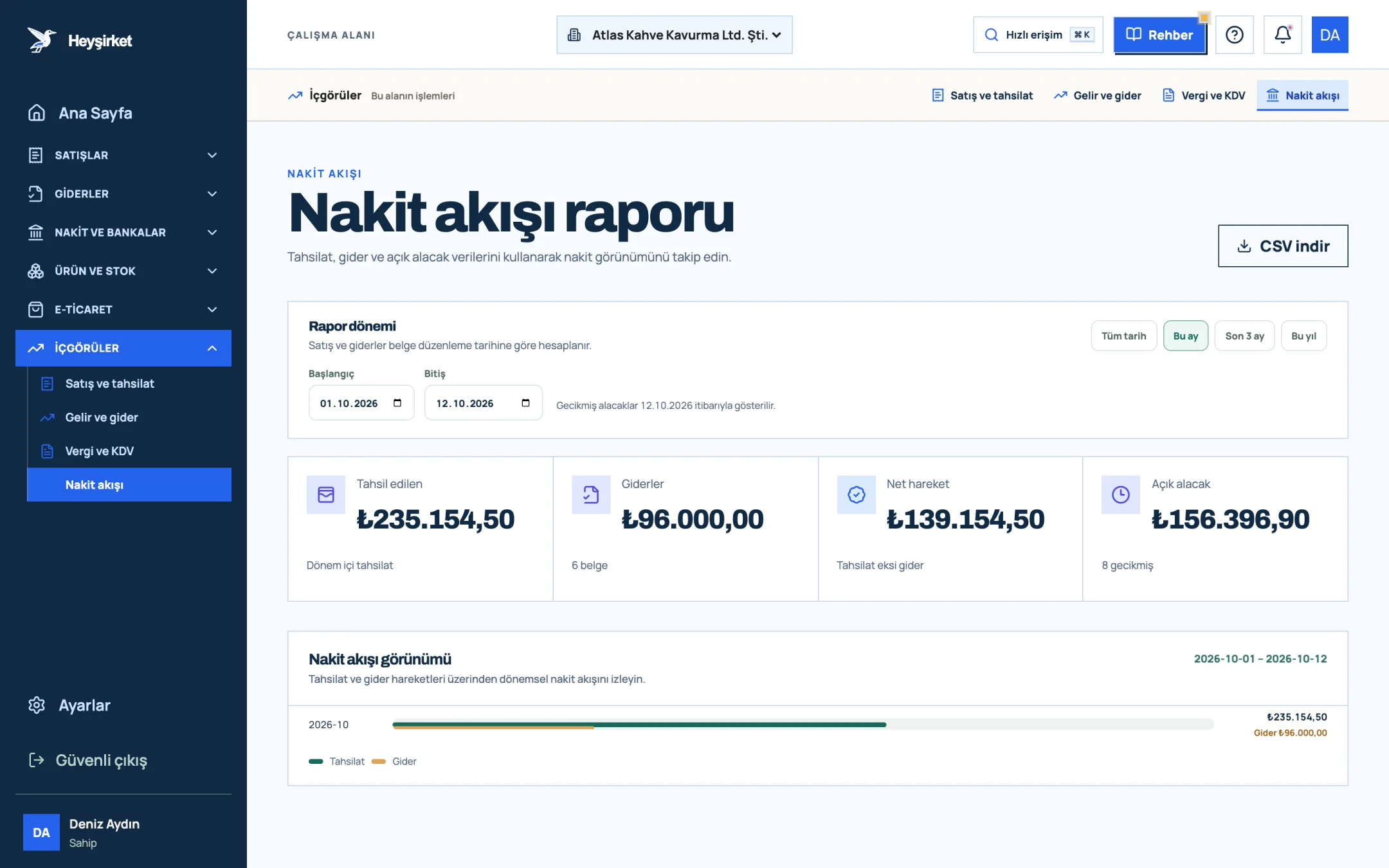
- 1. Collected and expenses
- 2. Cash flow view
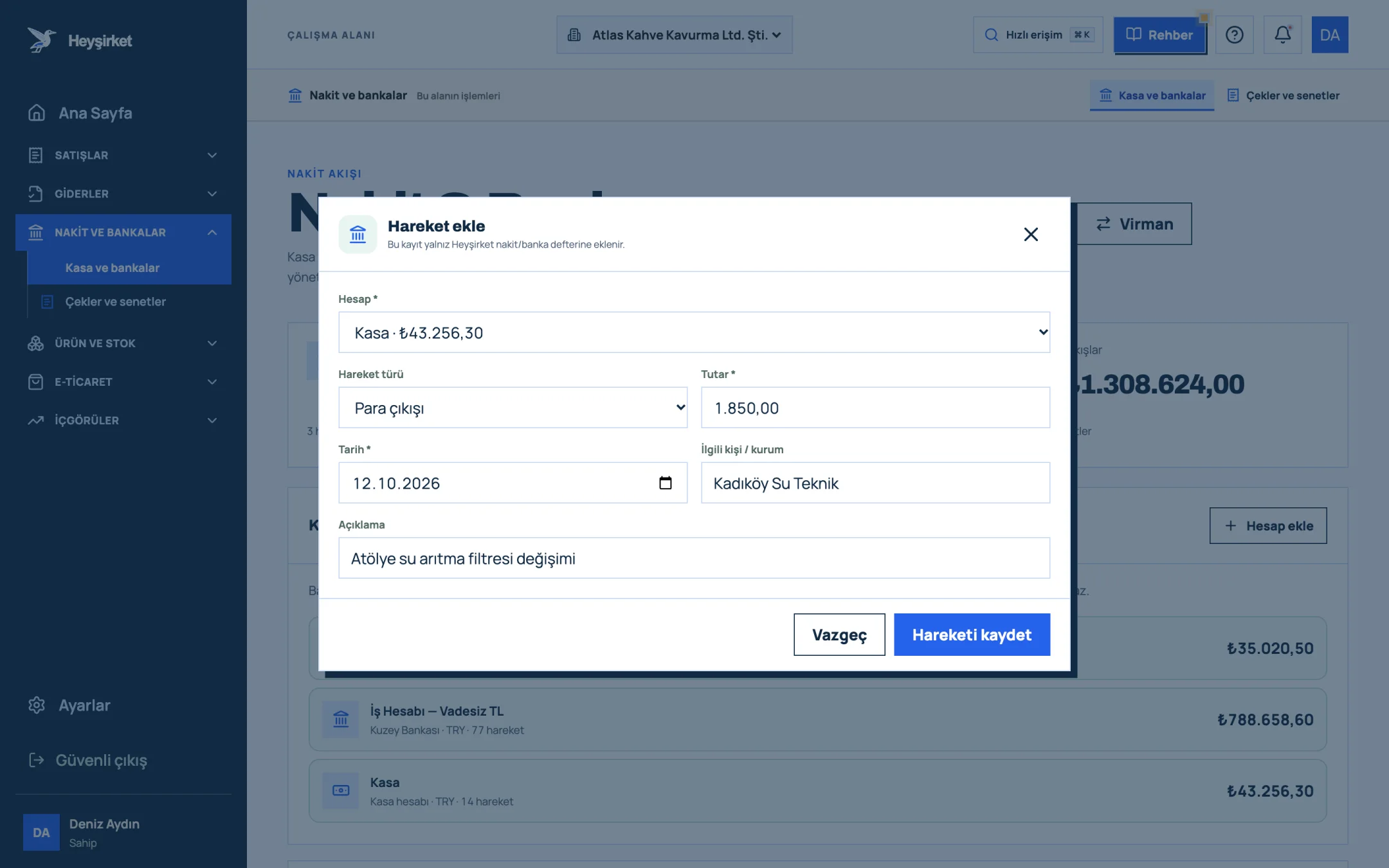
- 1. Account selection
- 2. Amount
- 3. Save button
You'll find detailed instructions for the Employees screen in the employee management guide, and for recording bank transactions in the cash and bank accounts guide. To carry staff costs into your annual budget, our article on preparing an annual budget is a good next step.
Before hiring a new employee
- I discussed the wage in gross terms and wrote the gross into the contract.
- I found out whether I can benefit from the 5- or 2-point discount based on my workplace's activity code.
- I asked my accountant whether any incentive applies to this person.
- I calculated the monthly employer cost including fringe benefits and the severance provision.
- I added the following month's tax and SGK payment dates to my cash plan.
- I recorded the employee in Heyşirket with their real monthly cost.
A hiring decision is made on annual cost, not on salary. Agreeing on net is easy; thinking in gross is what saves the budget.
Today, before opening a new position, Deniz does this calculation first, then checks where the total on the Employees screen will land with the new figure. The next hire will happen once the roasting machine's second shift brings in at least 90 thousand TL of extra gross profit a month.
How much does the 2026 minimum wage cost the employer?
Without incentives, it's 40.874,63 TL a month. With the 2-point premium discount in non-manufacturing sectors it falls to 40.214,03 TL, and with the 5-point discount in manufacturing to 39.223,13 TL. Employers may also receive minimum wage support, subject to conditions.
What percentage is the SGK employer share in 2026?
At the general rate, the employer's social security premium is 21,75% (disability, old-age and survivors 12%, general health insurance 7,5%, short-term insurance branches 2,25%), and the employer's unemployment insurance share is 2%. The total employer share is 23,75%.
Why does the net of the same gross salary fall during the year?
Income tax is calculated on the base accumulated since the start of the year. When the total base exceeds 190.000 TL, part of the wage enters the 20% bracket, and above 400.000 TL the 27% bracket. The minimum wage exemption applies every month, but moving into a higher bracket reduces the net.
Does Heyşirket calculate payroll?
No. Heyşirket's Employees screen tracks staff records and the monthly employer cost you enter; payroll, SGK declarations and the muhtasar (withholding tax) return are prepared by your accountant.
How much should I set aside each month for severance pay?
A common practice is to set aside roughly one twelfth of each employee's monthly gross wage as a provision, because severance equal to 30 days' gross wages can arise for each full year of service. Consult your accountant about the ceiling on the wage used for severance and whether fringe benefits are included.
See your team's real cost in a single figure Enter the monthly employer cost for each employee, including fringe benefits, and let the Planned monthly cost card total up your budget's staff line for you. Open Employees
Author: Heyşirket Editorial Team