Inventory management · 16 min read · Updated:
Inventory management basics: stock counts, minimum stock, ABC analysis, costing and delivery notes
Stock is cash sitting on a shelf. This article covers how to count it, protect it and value it correctly, in the order an accountant would walk you through it across the table.

In short
- Minimum stock is calculated by multiplying average daily consumption by the lead time and adding safety stock.
- ABC analysis ranks products by annual consumption value and focuses your counting and ordering attention on the few high-value items.
- When prices are rising, FIFO gives a lower cost of goods sold and a higher period-end stock value than average cost.
- A delivery note (irsaliye) is issued before the goods are shipped; the invoice is issued within at most 7 days of delivery.
- Taxpayers with gross sales revenue of 10 million TL or more must issue e-İrsaliye (electronic delivery notes) from the start of July in the year after they exceed the threshold.
At the year-end stock count, the founder of Atlas Kahve Kavurma noticed something: there was 1,2 million TL worth of green coffee beans in the warehouse, yet the bank account could barely cover payday. Sales were good. So where had the money gone?
The answer was sitting on the shelf. Six months' worth of Brazilian beans sat next to Ethiopian beans that ran out in two weeks. In this article you'll see the six core tools of inventory management, using a roastery's real figures. By the end, you'll be able to look at your own stock this morning and answer the question “which products have I tied my money up in?”
Part 1 · The basics What is inventory management, and why is it cash management?
Inventory management is the discipline of holding the right product, in the right quantity, in the right place and at the right cost. The goal isn't zero stock; it's holding little enough not to lock up cash and enough not to miss sales.
Every bag of coffee is money that has been paid out but hasn't come back until it's sold. That's why stock decisions should be made at the same table as cash flow decisions.
- Purchasing — Cash goes out
- Goods receipt — Incoming delivery note
- Sitting in the warehouse — Counts, transfers, wastage
- Shipping — Outgoing delivery note
- Invoice — A receivable arises
- Collection — Cash comes back
Every link in this cycle needs a record. If one link is missing, a gap opens up between the stock figure and reality. Let's look at where that gap is caught first: in the stock count.
Part 2 · Counting How do you do a stock count, and how often?
A stock count means comparing the quantity in your records with the quantity physically counted on the shelf, and recording the difference along with its reason. The year-end count is a legal habit, but on its own it isn't enough.
For small businesses the most useful routine is cycle counting: each week you count a specific product group rather than the whole warehouse. High-value products are counted often, low-value ones rarely. We'll work out which products count as “high-value” with ABC analysis in a moment.
- Count at a time with no shipments. A figure counted while goods are moving can't be trusted.
- Separate the person counting from the person keeping records. If the same person does both, mistakes stay hidden.
- Prefer blind counts. Let the counter count without seeing the expected quantity, then compare.
- Record the difference with its reason. “5 bags missing” isn't information; “5 bags used as samples, not recorded” is.
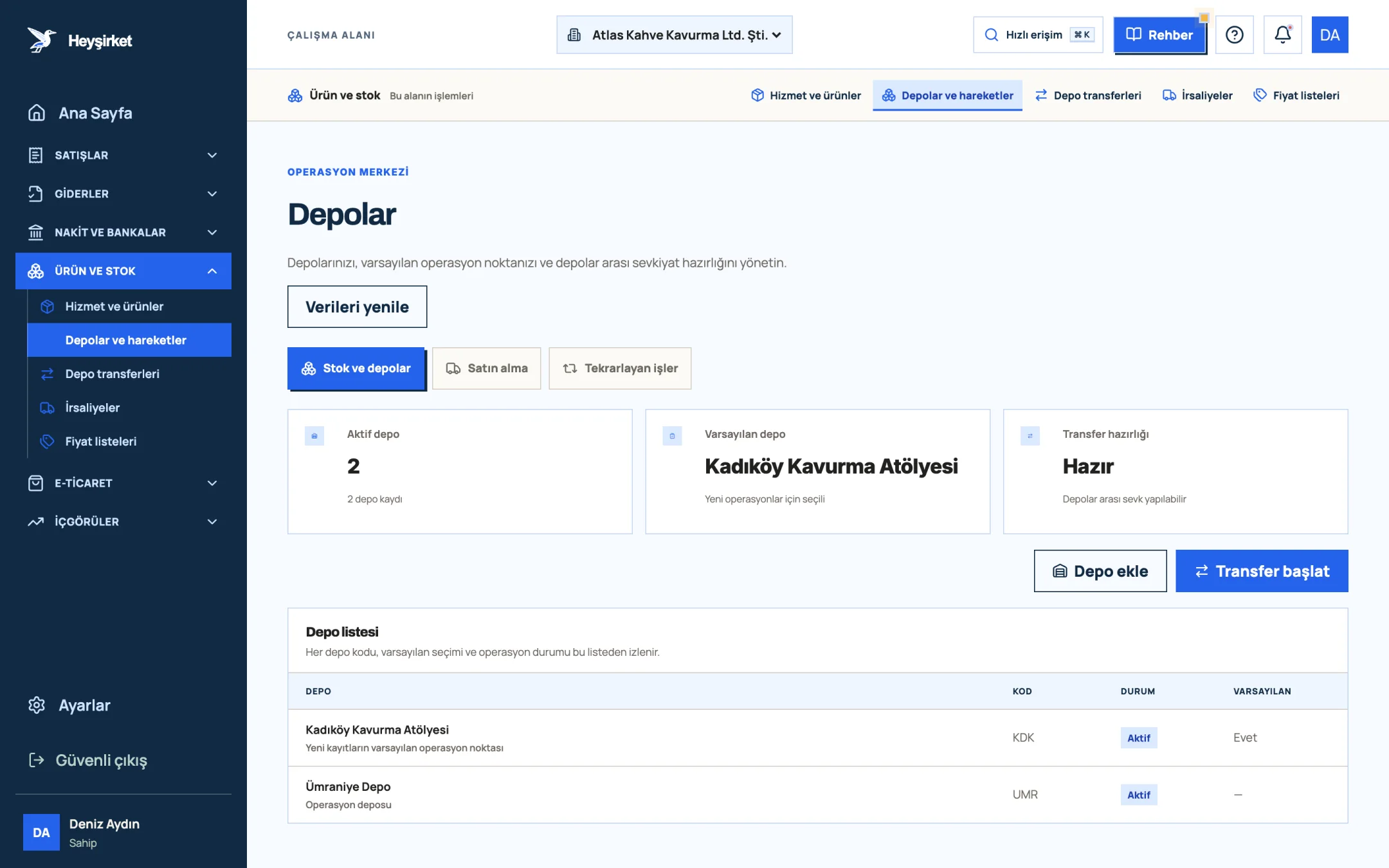
- 1. Add warehouse
- 2. Start transfer
- 3. Default warehouse
- 4. Warehouse list
Heyşirket's count form shows the “Expected physical” quantity for each product and includes only the products you count; those you leave blank stay out. This naturally supports cycle counting. The full steps are in the warehouse and stock movements guide.
Part 3 · The threshold How do you calculate minimum stock?
Minimum stock (the reorder point) is calculated by multiplying average daily consumption by the lead time and adding safety stock. When stock drops to this level you place an order, so there's still product on the shelf until the new goods arrive.
Safety stock is the buffer you hold against supplier delays or an unexpected order. Set it too high and you tie up cash; set it to zero and you'll miss sales at the first delay.
| Average daily sales | 6 bags |
|---|---|
| Lead time (green beans + roasting) | 5 days |
| Consumption during the lead time (6 × 5) | 30 bags |
| Safety stock (2 days of sales) | 12 bags |
| Minimum stock | 42 bags |
An order is placed when stock drops to 42 bags. If sales speed changes with the seasons, redo the calculation every quarter.
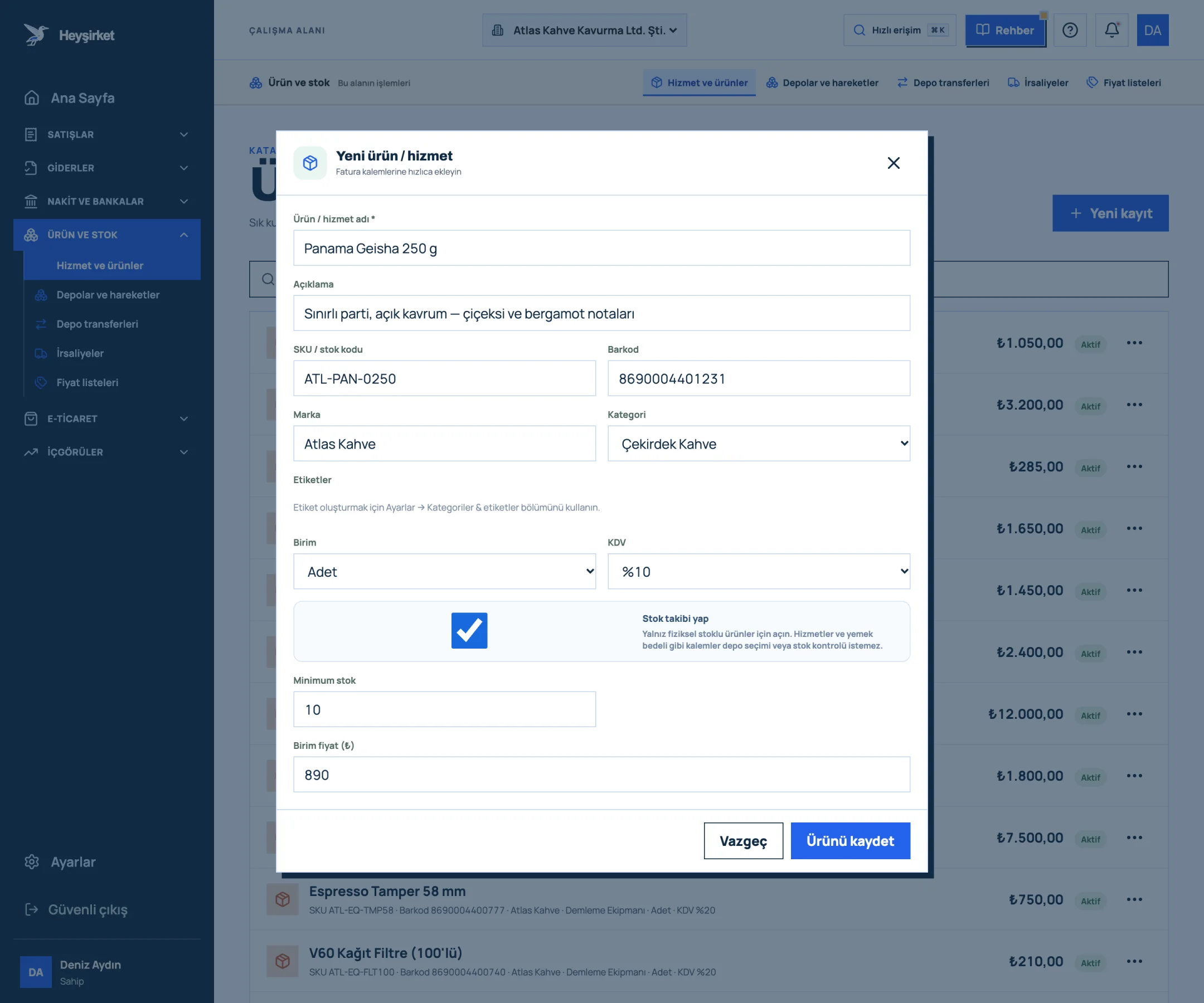
- 1. Product / service name
- 2. SKU and barcode
- 3. Category selection
- 4. Track stock option
- 5. Save product
How much should you order?
Minimum stock tells you when to order; how much to order is a separate decision. Small, frequent orders protect cash but increase shipping and handling costs per order. Large, infrequent orders can lower the unit price but tie money up on the shelf.
A practical approach: for A products, place frequent orders close to the supplier's minimum order quantity; for C products, buy in bulk a few times a year. When a supplier offers a volume discount, compare the discount with the cost to you, in cash, of the extra stock. A 3% discount for six months' worth of stock doesn't always cover the cost of that money being out of your till for six months.
Setting the threshold is only half the job; without knowing how much attention each product deserves, you end up trying to give every product the same care. This is where ABC analysis comes in.
Part 4 · Priorities What is ABC analysis, and how do you do it?
ABC analysis is a method of ranking products from largest to smallest by annual consumption value (annual quantity sold × unit cost) and splitting them into three groups. The pattern you commonly see in practice: a small number of products make up most of the stock value.
| Group | Typical share | Example products | Management rule |
|---|---|---|---|
| A | Roughly 10-20% of items, roughly 70-80% of value | Espresso blend, Brazilian and Colombian green beans | Weekly counts, tight minimum stock, regular price talks with the supplier |
| B | Roughly 30% of items, roughly 15-25% of value | Single-origin coffees, filter paper, packaging materials | Monthly counts, standard threshold |
| C | Roughly 50% of items, roughly 5% of value | Spoons, stirrers, spare gaskets | Quarterly counts, bulk and infrequent orders |
The percentage ranges aren't a rule; they're a starting point. To build your own list, add up the last 12 months' sales quantities by product, multiply by unit cost, sort from largest to smallest and look at the cumulative percentage. A spreadsheet is more than enough for the job.
The real benefit of ABC analysis is the time it saves. When Atlas Kahve started counting its 18 A products weekly instead of all 140 items every month, most of the year-end difference showed up in the very first month.
Part 5 · Costing FIFO or average cost? How is stock valued?
Stock valuation is the method that determines the cost of goods sold and the value of the stock left on hand at the end of the period. When you buy the same product at different prices, you have to adopt a method for deciding which price each kilo sold went out at.
- FIFO (first in, first out): Goods sold are assumed to go out at the oldest purchase price. Stock left on hand is valued at the newest prices.
- Weighted average cost: The total amount of all purchases in the period is divided by the total quantity; every kilo sold and every kilo remaining is valued at the same average price.
| Item | FIFO | Weighted average |
|---|---|---|
| 1 September purchase: 100 kg × 400 TL | 40.000 TL | 40.000 TL |
| 20 September purchase: 100 kg × 460 TL | 46.000 TL | 46.000 TL |
| Unit cost | First 400, then 460 TL | 86.000 / 200 = 430 TL |
| Cost of 120 kg used in October | 100 × 400 + 20 × 460 = 49.200 TL | 120 × 430 = 51.600 TL |
| Value of the remaining 80 kg | 80 × 460 = 36.800 TL | 80 × 430 = 34.400 TL |
In a period of steadily rising prices, FIFO shows a lower cost of goods sold and therefore a higher profit for the period. Average cost smooths out the fluctuation. Both methods describe the same money overall; the difference is which period's profit it shows up in.
Which cost you base your prices on is also affected by this choice. In an inflationary period, setting the sales price based on the old purchase price means losing money when you restock; we covered this in detail in our pricing strategy article.
Part 6 · Losses How do you record wastage and lost goods?
Fire (wastage) is the loss of quantity that naturally occurs during production, storage or transport; zayi (loss) is an extraordinary loss such as breakage, spoilage or theft. In coffee roasting, beans lose moisture, so part of the weight inevitably goes; that's technical wastage.
In both cases the job is the same: record the quantity, write down the reason and document it. The only difference is the tax consequence.
In Heyşirket you can record a loss without an invoice as a Stock out movement in the Add stock movement form or, best of all, record it in a regular count by writing the reason for the difference in the General note field. Whichever route you choose, keep a separate written report of the loss.
Part 7 · Location How do you track stock across multiple warehouses?
In a business with more than one warehouse, stock is tracked not only by “how much” but also by “where”. Even if you have enough goods in total, an order is delayed if the goods are in the wrong warehouse.
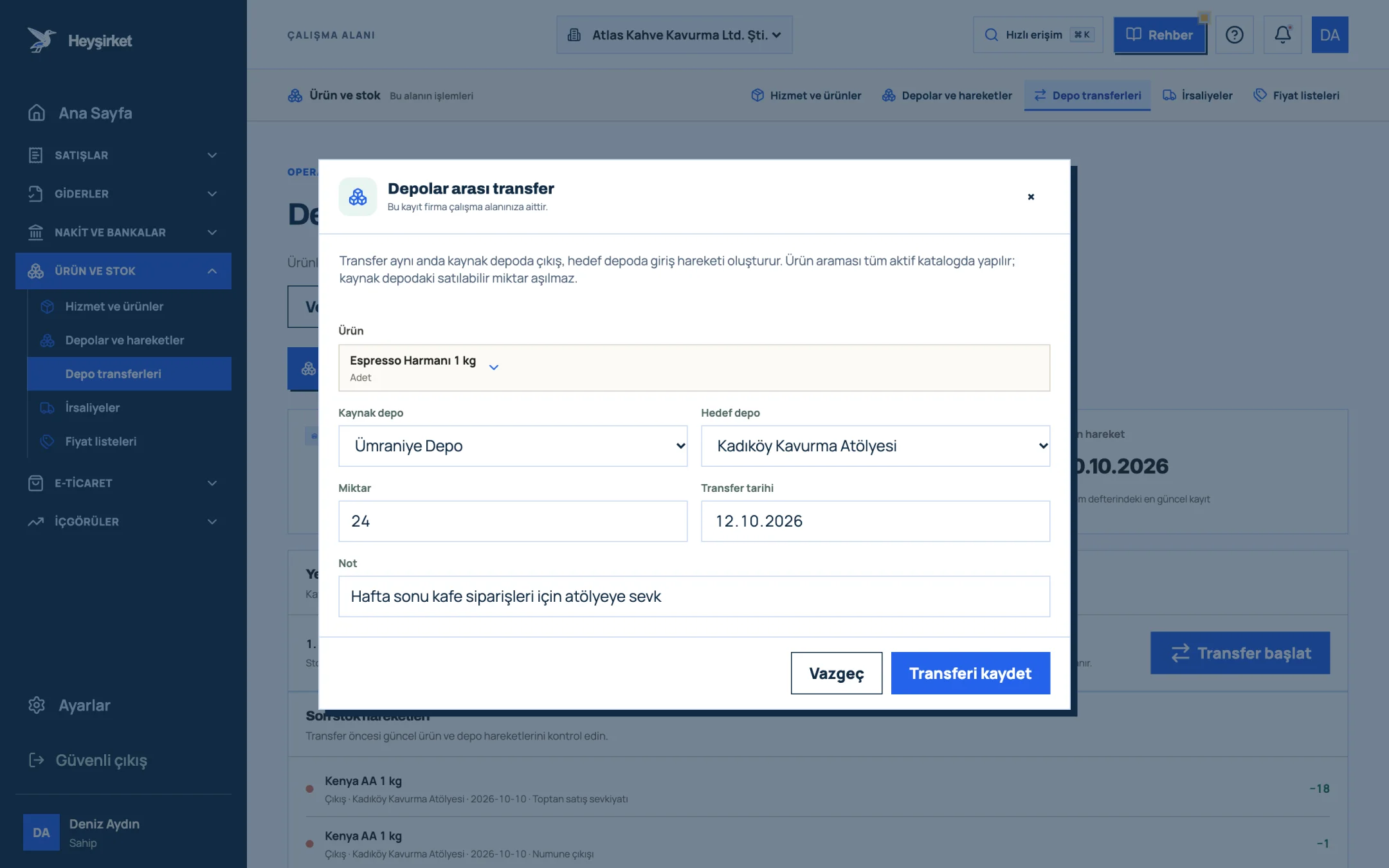
- 1. Product selection
- 2. Source and destination warehouse
- 3. Transfer quantity
- 4. Save transfer
A good rule: make transfers the exception, not the plan. If one warehouse keeps asking another for goods, its minimum stock is set up wrong. Reviewing transfer records every three months helps you put stock in the right place from the start. For the steps, see the warehouse transfer guide.
Part 8 · Documents When is a delivery note issued, and who must use e-İrsaliye?
A sevk irsaliyesi (dispatch note) is a document issued before goods leave the seller's warehouse, and it travels with the goods throughout transport. For goods shipped with a delivery note, the invoice is issued within at most 7 days of delivery.
| Question | Answer |
|---|---|
| When is a delivery note issued? | Before the goods are shipped; it stays in the vehicle during transport |
| When is the invoice issued? | Within at most 7 days of the delivery date (VUK Art. 231/5) |
| Who must use e-İrsaliye? | Taxpayers with gross sales revenue of 10 million TL or more; in some sectors (e.g. fuel, iron and steel) no revenue condition applies |
| Switch-over date | The start of July in the year after the accounting period in which the threshold is exceeded; e.g. 1 July 2026 for those whose 2025 revenue exceeded the threshold |
| Timing of the e-İrsaliye | Issued and transmitted to the GİB (Turkish Revenue Administration) system before the goods are actually shipped |
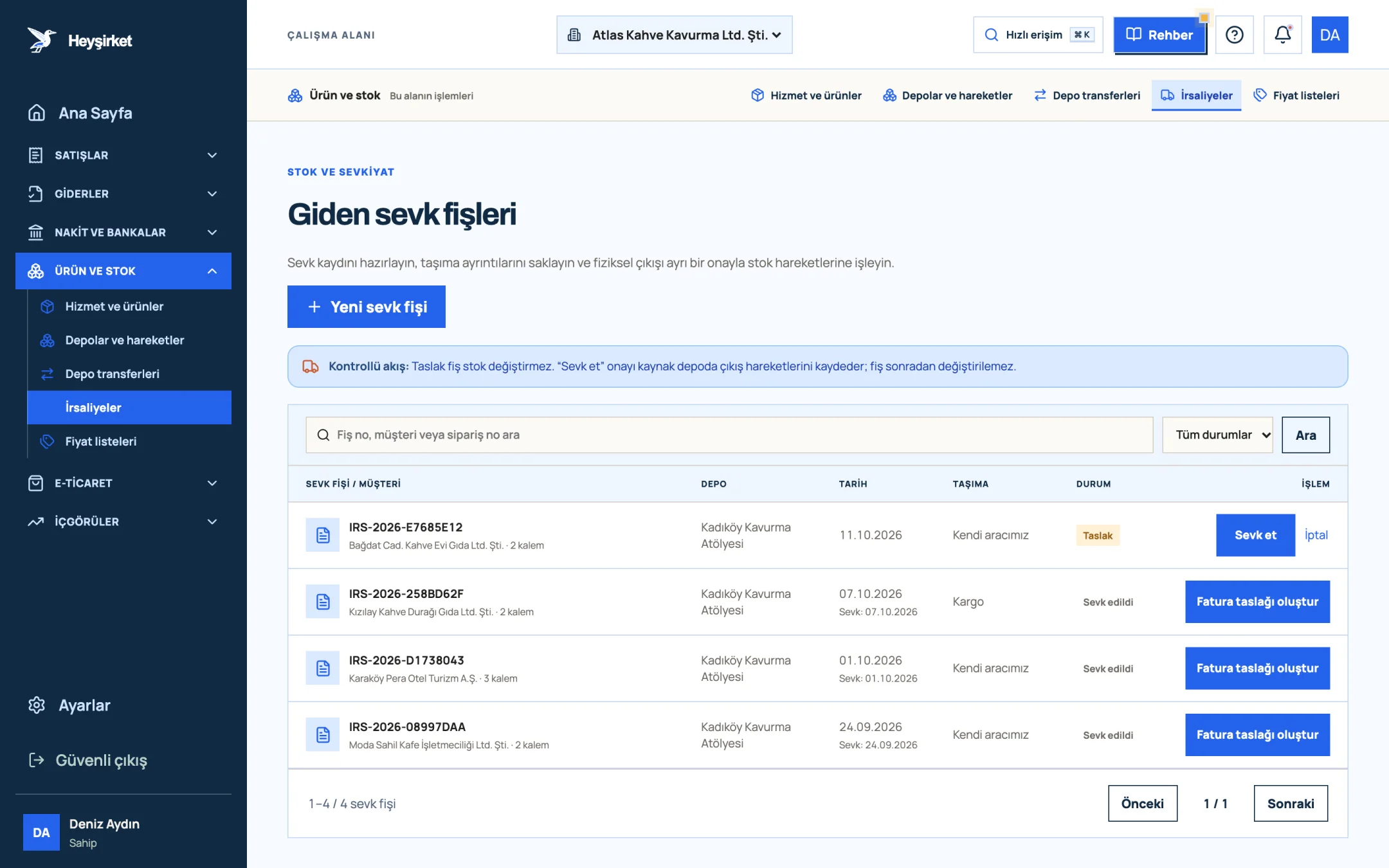
- 1. New delivery note
- 2. Shipping a draft note
- 3. Invoice draft from a shipped note
- 4. Controlled flow info
The trap for businesses that invoice in bulk at month-end: each shipment's 7-day period runs separately. The invoice for goods shipped on the 2nd can't wait until the 30th. Scanning once a week for slips that have been shipped but not invoiced closes this risk. The step-by-step flow is in the how to issue a delivery note guide.
Part 9 · In practice What can you do for your stock this week?
Getting inventory management in order doesn't take a big project; small steps taken in the right order are enough. The list below is a starter plan you can complete in a week.
A one-week stock routine plan
- Check that the Track stock box is ticked on stocked product cards and off for services.
- Build your first ABC list from the last 12 months of sales and identify your A products.
- Calculate minimum stock for A products and enter it in the Minimum stock field on the card.
- Count your A products this week and record the differences with their reasons through Stock count.
- Put in writing who on the team records wastage and sample withdrawals, and how.
- Scan for dispatch slips that have been shipped but not invoiced; invoice those nearing the 7-day limit.
- Compare your gross sales revenue with the 10 million TL e-İrsaliye threshold and talk to your accountant.
- Confirm your stock valuation method with your accountant and use the same method in your price calculations.
After these steps, the year-end count stops being a surprise and becomes simply a confirmation. And the “money stuck on the shelf” moment Atlas Kahve's founder went through won't happen again, because you'll see every week how much money you've tied up in which product.
How many times a year should you do a stock count?
The period-end count is done once a year, but on its own it isn't enough. A cycle-counting routine that counts high-value products weekly or monthly and low-value ones quarterly catches differences early.
Are minimum stock and safety stock the same thing?
No. Safety stock is the buffer held against delays. Minimum stock is the sum of the quantity consumed during the lead time plus safety stock, and it tells you when to place an order.
Which is better, FIFO or average cost?
There's no single right answer. When prices are rising, FIFO shows a higher profit for the period and average cost a more balanced one. The method should be applied consistently and chosen together with your accountant.
Do I need a delivery note when moving goods between my own warehouses?
The general rule is that a dispatch note must accompany goods during transport; confirm the practice for moves between your own warehouses and branches with your accountant. If you're registered for e-İrsaliye, the document is issued electronically.
How do I know whether I've exceeded the e-İrsaliye threshold?
The threshold is based on gross sales revenue, using the figure for the accounting period declared annually. If your revenue is approaching 10 million TL, plan the switch-over timeline with your accountant.
Does Heyşirket calculate stock cost using FIFO?
Heyşirket tracks stock quantities per warehouse through movements and counts. Stock valuation and the costing method are part of your accounting records; handle that calculation together with your accountant.
Take a snapshot of your stock today Available-to-sell stock, active warehouses and products below the threshold, all on one screen. Start your first cycle count this week. Open stock and warehouses
Author: Heyşirket Editorial Team