Collections · 12 min read · Updated:
How to keep a cash book: a practical method for tracking petty cash every day
Cash is the easiest money to lose track of in a business. A five-minute cash book habit each day removes the month-end question of "where did this money go?"

In short
- A cash book is a list where a business records its cash in and out day by day, with date, document, description, in, out and balance columns.
- The cash book balance is compared with a physical count at the end of each day; any difference is recorded separately as a cash shortage or surplus, not covered up.
- Cash deposited at the bank isn't an expense but a transfer between two accounts; it appears as money out in the cash book and money in on the bank account.
- Under VUK General Communiqué No. 459, taxpayers' collections and payments over 30.000 TL must go through intermediary financial institutions such as banks or PTT and be documented.
- In Heyşirket, the cash box is opened as a separate account; if you choose it as the collection account for a cash payment, the amount is written to the cash ledger automatically.
You take cash payments during the day, and money goes out of the till to the courier, for cleaning supplies, to a repairman. In the evening there's some money in the drawer, but the morning amount plus what came in minus what went out never quite matches. A cash book exists to catch exactly that difference.
In this article we explain which columns a cash book has, how to set up daily entries and counts, how to deal with shortages and surpluses, and the most common mistakes. At the end we show how to set this up in Heyşirket. The screen-by-screen steps for opening accounts and making transfers are in the cash and bank accounts guide.
Part 1 · Definition What is a cash book and why keep one?
A cash book is a list where the business records, in order, the cash it receives and pays out. Each line is a money movement; the balance in the last column shows how much should be in the till at that moment.
A cash book isn't an official type of ledger; it doesn't replace the books required by tax law, such as the business account book or journal. But it makes sure correct information reaches those books. Giving your accountant (mali müşavir) a tidy cash list at month end instead of an envelope full of receipts makes their job and your own control easier.
- Catches losses and errors early: if a difference is noticed the same day, the cause is found too. A month later, it isn't.
- Makes cash flow visible: knowing how much cash comes in and goes out each week is the first step to planning payments.
- Enforces document discipline: the habit of writing a receipt or invoice against every payment stops expenses getting lost.
- Clarifies responsibility: if more than one person handles the till, it's clear who entered which line.
Part 2 · Layout Which columns should a cash book have?
It doesn't matter whether the book is on paper, in Excel or in a program. What matters is that every line holds the same information.
| Date | Document | Description | In | Out | Balance |
|---|---|---|---|---|---|
| 14.10 | Brought forward | Carried over from the previous day | 3.200,00 | ||
| 14.10 | Invoice 041 | Cash sale, Yılmaz Market | 2.400,00 | 5.600,00 | |
| 14.10 | Receipt 1187 | Courier payment | 185,00 | 5.415,00 | |
| 14.10 | Invoice 042 | Cash sale, individual customer | 2.350,00 | 7.765,00 | |
| 14.10 | Invoice A-552 | Water filter replacement | 1.665,00 | 6.100,00 | |
| 14.10 | Bank receipt | Deposited at the bank | 5.000,00 | 1.100,00 |
Three details in this example matter. Every line has a document. The money deposited at the bank is recorded as a transfer from cash to bank, not as an "expense". And the balance is recalculated on every line, not left for the end of the day.
Part 3 · Counting How do you count cash, and what is a cash shortage?
A cash count means counting the money in the till at the end of the day and comparing it with the book balance. If the count is lower than the balance, there's a cash shortage; if it's higher, a surplus.
| Book balance at end of day | 1.100,00 TL |
|---|---|
| Notes and coins counted | 1.060,00 TL |
| Cash shortage | 40,00 TL |
The figures are illustrative. When there's a difference, first check the latest entries, sales where change was given and small payments that weren't entered.
What to do when there's a difference
Check the latest entries
Look for a receipt that wasn't entered, a sale entered twice or a wrong amount. Most differences turn up here.
Think about change and small payments
Small unrecorded outflows such as change down to the kuruş, tips paid from the till or tea-room payments are the most common cause of small shortages.
Record the difference on a separate line
If no cause is found, write the difference as a separate line described as "cash shortage" or "cash surplus". Don't change another entry to make the balance match the count.
If it keeps happening, change the process
If you get more than one shortage in the same week, review who handles the till and when entries are made. If entries aren't made at the moment of payment, they're more likely to be forgotten.
Part 4 · Regulations Is there a limit on cash collections and payments?
Yes. Taxpayers can't make collections and payments above a certain amount in cash; they must go through intermediary financial institutions such as banks or PTT and be documented. As of 26 October 2026 the limit is 30.000 TL.
In practice: if your cash book shows a cash collection or payment above 30.000 TL, that transaction should have gone through the bank. Large cash movements also inflate the cash balance; a high cash balance that appears in the books but doesn't physically exist is among the topics questioned in tax audits.
Part 5 · Tools Should you track cash in Excel or in a program?
If you have one till, one person makes the entries and your cash movements don't exceed a few lines a day, Excel may be enough. Have a formula calculate the balance, start a new sheet each month and use a single copy of the file.
Excel falls short when you record a cash collection once on the invoice and again in the cash book, when more than one person writes to the same file, when you move money between cash and bank often, and when you want to see cash and bank totals on one screen at month end. Then keeping cash tracking in the same place as invoices and collections removes double entry.
Part 6 · Heyşirket How do you track cash in Heyşirket?
In Heyşirket's pre-accounting, the Nakit & Banka (Cash & Bank) screen shows your cash and bank accounts in one place. The till is a separate account of type Kasa (cash); its balance is the opening balance plus the movements recorded on that account.
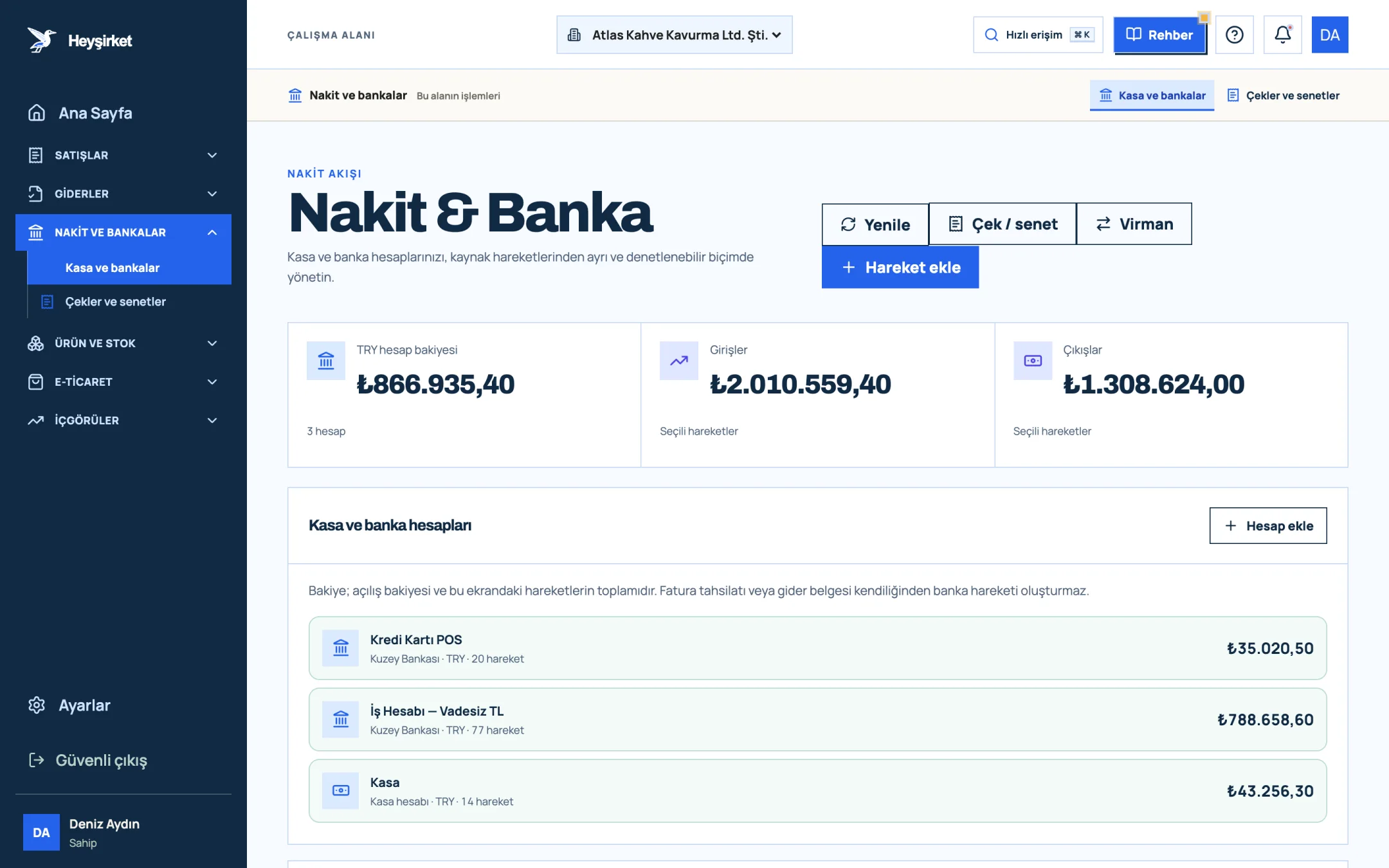
- 1. Add transaction button
- 2. Transfer between accounts
- 3. Total TRY balance
- 4. Cash and bank account list
Step by step: moving your cash book into Heyşirket
Open a cash account
With Hesap ekle (add account), choose Kasa as the Hesap türü (account type), name it (e.g. "Main till") and enter the count from the day you start tracking as the Açılış bakiyesi (opening balance).
Link cash collections to the till
When recording a cash payment on an invoice, choose Nakit (cash) as the payment method and the till as the Tahsilat hesabı (collection account). The note on screen says it too: the collection is written to the chosen account's ledger. So you don't need to enter the same money in the cash book a second time.
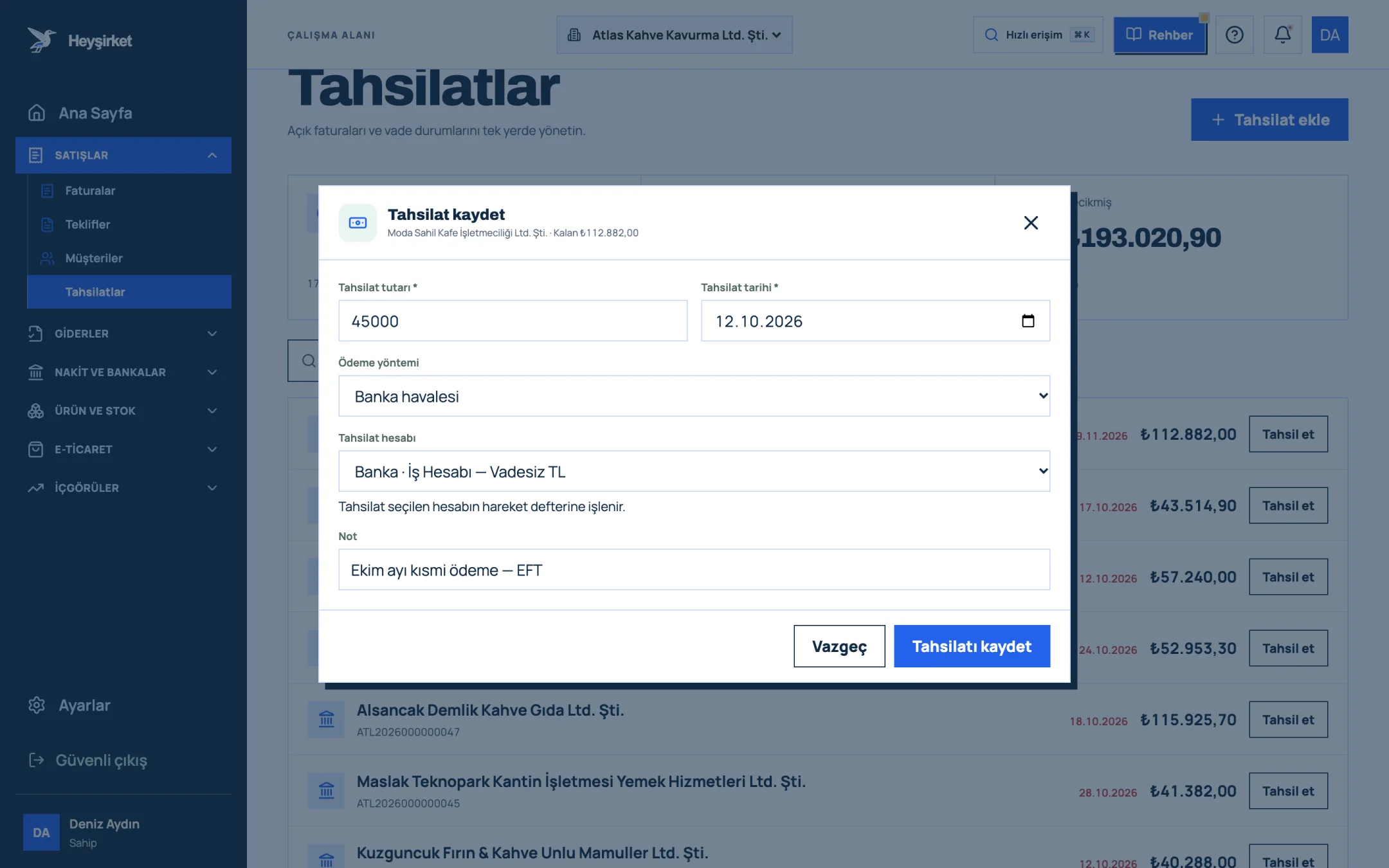
Link cash collections to the till - 1. Collection amount
- 2. Payment method
- 3. Cash/bank account receiving the payment
- 4. Save button
Add movements without invoices
For courier fees, small purchases or a cash shortage, use Hareket ekle (add movement). Choose the till as the account and Para girişi (money in) or Para çıkışı (money out) as the type; put the document number in the İlgili kişi / kurum (related party) and Açıklama (description) fields.
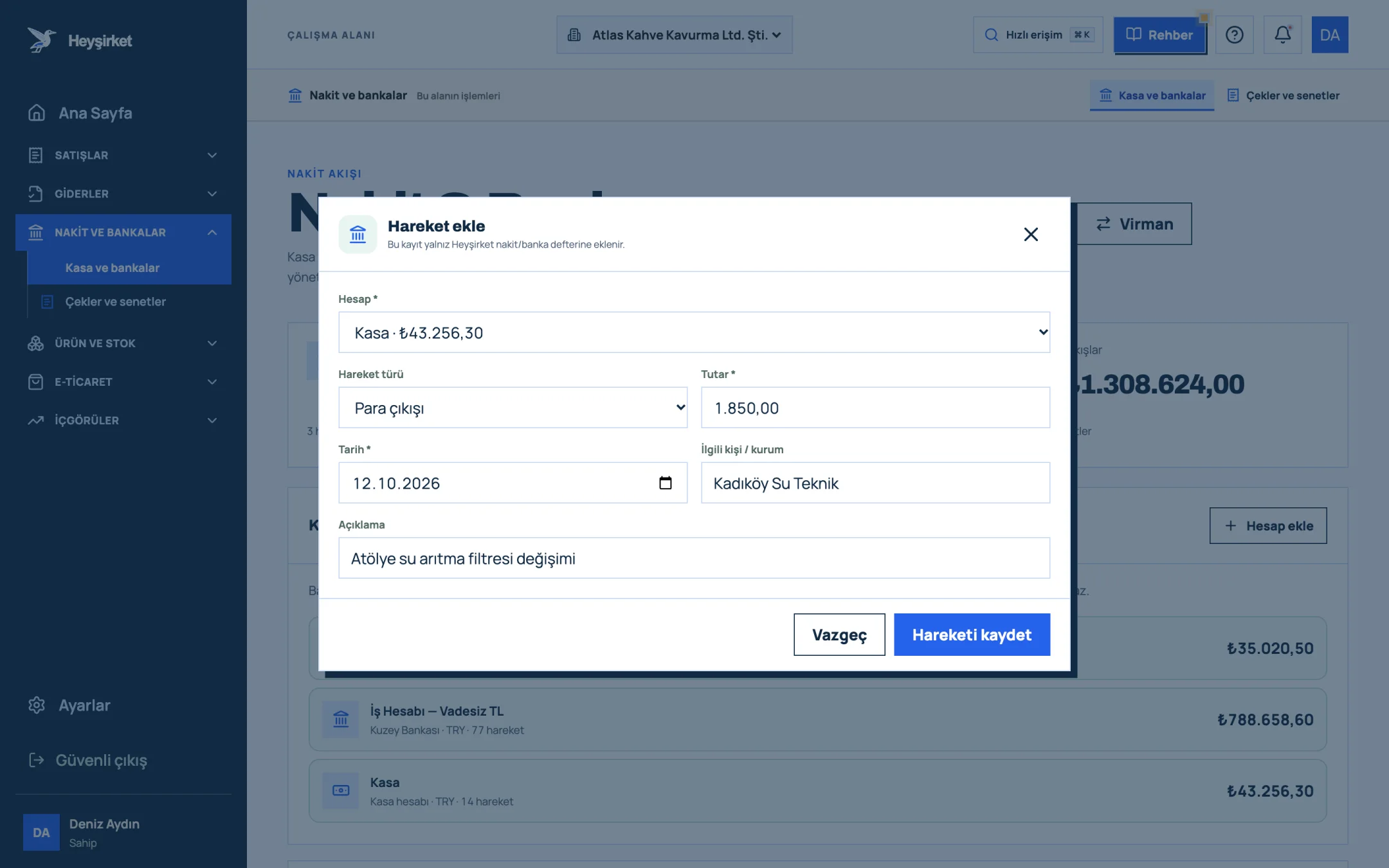
Add movements without invoices - 1. Account selection
- 2. Amount
- 3. Save button
Record bank deposits as transfers
When you deposit cash at the bank, use Virman (transfer) with the till as the source and the bank account as the target. Heyşirket creates a simultaneous outflow and inflow on the two accounts; the money doesn't look like an expense.
Compare the balance with the count at day end
Compare the cash account balance with your count. If there's a difference, record it with a separate money out or money in movement described as "cash shortage" or "cash surplus" until you find the cause.
Heyşirket doesn't have a separate cash count screen; you do the count and enter the result as a movement. At month end, the Kasa ve banka raporu (cash and bank report) gives each account's opening, inflows, outflows and closing balance with the list of movements; sending this report to your accountant is enough. Buttons for opening accounts and adding movements are only visible to users with the Owner and Manager roles.
Pre-accounting is included in the Profesyonel and Premium packages. To match bank movements by uploading a statement instead of entering them one by one, see bank statement matching; for all features, see the cash and bank page.
How do you keep a cash book?
Each cash movement is written as a line the moment it happens, with date, document number, description and amount in or out, and the balance is recalculated on every line. At the end of the day the money in the till is counted and compared with the balance; any difference is recorded on a separate line.
Is keeping a cash book a legal requirement?
A cash book isn't a separate legal ledger and doesn't replace legal books such as the business account book or journal. But cash movements must be supported by documents and correctly reflected in the legal books, and a cash book is the most practical tool for that.
What is a cash shortage and how is it recorded?
A cash shortage is when the money counted at the end of the day is less than the cash balance in the records. First, missing or wrong entries are checked. If no cause is found, the difference is recorded on a separate line described as a cash shortage and reported to the accountant; it isn't closed by changing other entries.
Is cash deposited at the bank an expense?
No. Cash deposited at the bank is a transfer between two accounts. It's recorded as money out of the till and money in at the bank, and the business's total money doesn't change.
What's the limit for cash collections and payments?
Under VUK General Communiqué No. 459, taxpayers' collections and payments over 30.000 TL must go through intermediary financial institutions such as banks or PTT and be documented. The amount applies as of 26 October 2026; confirm it's current with your accountant.
Does Heyşirket write cash collections to the till automatically?
Yes. If you choose the till as the collection account when recording the payment, the amount is written to the cash account's ledger automatically. Cash movements not tied to an invoice are entered with the Add movement button on the Cash & Bank screen.
Track your till on one screen Open your cash account, link cash collections to it and compare the end-of-day balance with your count. Open Cash & Bank
Author: Heyşirket Editorial Team