Financing · 17 min read · Updated:
SME financing options in Türkiye: bank loans, KGF, KOSGEB, factoring, leasing and supplier terms
The cheapest money is often not at the bank but on your supplier's invoice. We compare six financing routes available to businesses in Türkiye by effective cost and explain which one fits which need.

In short
- The real cost of financing isn't the advertised interest rate; it's the effective annual cost, which combines interest, taxes such as BSMV, file and commission fees, and the length of time you actually hold the money.
- Short-term working capital needs should be financed with short-term instruments, while long-lived investments such as machinery and equipment should be financed with a loan or lease whose term matches the life of the investment.
- A KGF (Credit Guarantee Fund) guarantee makes it easier for SMEs with insufficient collateral to get bank loans; KOSGEB support covers part of the loan interest or provides grant-type support under specific programmes.
- The hidden cost of not taking a supplier's early payment discount can be calculated; for example, a 2% discount for paying within 10 days on 60-day terms is equivalent to an annual return of about 15%.
- Whichever source you choose, the foundation of a financing decision is well-kept collection, expense and cash records.
When Atlas Kahve won an annual supply contract from Karaköy Pera Otel, founder Deniz was both delighted and worried. The deal was big, but the hotel would pay on 60-day terms. Meanwhile, the green bean supplier was offering a 2% discount for payment within 10 days. A loan offer from the bank, a call from a factoring company and a KOSGEB call for applications all landed on the desk the same week.
Which was the cheapest? The answer was the opposite of most business owners' first guess. By the end of this article you'll be able to turn every financing offer you receive into a single number, the effective annual cost, and put them side by side.
Part 1 · The need What question should you answer before choosing financing?
The first question in a financing decision isn't "how much money?" but "for how long, and for what, is this money needed?" Maturity matching, meaning that the term of the financing matches the duration of the need, is the basic rule of SME financing.
| Need | Duration | Suitable instruments |
|---|---|---|
| Gap between receivable terms and payment dates | 30-90 days | Factoring, supplier terms, short-term working capital loan |
| Seasonal stock build-up | 3-6 months | Working capital loan, supplier terms |
| Machinery, vehicles, equipment | 3-5 years | Leasing, investment loan |
| New branch, capacity expansion | 3-7 years | Investment loan, KGF-guaranteed loan, KOSGEB programmes |
| Ongoing losses or a persistent cash gap | Uncertain | Fix the business model and pricing first; debt isn't the solution |
You've defined the need. Now, to compare offers, we need to translate them all into the same language.
Part 2 · A common language How do you calculate the effective cost of financing?
Effective cost is the rate you get by dividing the total cost of financing, including interest, taxes, commissions and fees, by the amount you actually receive and the period you use it for, then annualising it. In its simple form: total cost ÷ net amount received × (365 ÷ number of days).
This simple formula ignores compounding, but it's good enough to compare different offers. The rates in the examples below are purely illustrative assumptions; replace them with the figures in your own offers.
| Contractual interest (assumption: 42% a year) | 420.000 TL |
|---|---|
| BSMV (banking tax) on interest (5%) | 21.000 TL |
| Loan allocation and file fee (assumption: 0.5%) | 5.000 TL |
| Total cost | 446.000 TL |
| Net amount received (1.000.000 − 5.000) | 995.000 TL |
| Effective annual cost | ≈ %44,8 |
With an equal-instalment loan the principal falls every month, so the total interest paid is lower; but the effective rate is still higher than the contractual rate. On commercial loans BSMV is applied at 5% of the interest. Add extra items such as collateral, mortgage and the KGF commission to the total cost as well.
| Discount (assumption: 3.5% a month × 2 months) | 35.000 TL |
|---|---|
| Factoring commission (assumption: 0.5%) | 2.500 TL |
| Taxes and fees (assumption: 5% of discount and commission) | 1.875 TL |
| Total cost | 39.375 TL |
| Net amount received | 460.625 TL |
| Effective annual cost (39.375 ÷ 460.625 × 365 ÷ 60) | ≈ %52 |
Factoring rates vary widely depending on your customer's creditworthiness, the term and whether the deal is with or without recourse. When you get an offer, ask for a written breakdown of all deductions.
Now let's look at the least discussed option. Your supplier says, "2% off if you pay within 10 days, otherwise 60-day terms." Not taking that discount effectively means borrowing from your supplier for 50 days.
| Discount rate ÷ (1 − discount) | 2 ÷ 98 = %2,04 |
|---|---|
| Extra term (60 − 10) | 50 days |
| Annualising (365 ÷ 50) | × 7,3 |
| Hidden annual cost of not taking the discount | ≈ %14,9 |
By the same calculation, an offer of "3% off for immediate payment, otherwise 30 days" equals roughly 37.6% a year. The higher the discount and the shorter the extra term, the faster the hidden cost rises.
This is where Atlas Kahve's decision came from: while the bank loan's effective cost was around 45%, the supplier's 60-day terms carried an opportunity cost of only 15%. Deniz passed on the discount and used the terms. She only considered the loan for the short gap between the hotel's 60-day receivable and the supplier payment.
Part 3 · Banks What does a KGF guarantee do when you take out a bank loan?
A KGF (Kredi Garanti Fonu, the Credit Guarantee Fund) guarantee is a system that lets SMEs with insufficient collateral access bank loans, with the fund guaranteeing a certain share of the loan. Because the bank transfers its risk to the fund up to the guaranteed amount, the need for a mortgage or extra collateral is reduced.
KGF guarantees are used through banks; you apply to the bank you work with, not directly to the fund. In Treasury-backed packages, the guarantee rate, limit and term change from period to period; in 2026 several packages focused on refinancing and working capital were announced. A commission is paid for the guarantee, and it should be added to the effective cost calculation.
- Working capital loan: For short-term needs such as stock, raw materials and payroll. Usually 3-24 months, with equal instalments or revolving.
- Revolving credit: A loan you can draw within a set limit and reuse as you repay. It suits seasonal swings; a commission may be charged on the unused limit.
- Investment loan: A longer-term loan, often with a grace period, for machinery, facilities and capacity expansion.
- KGF-guaranteed loan: Any of the above, with part of the collateral provided by the fund's guarantee.
A bank loan is a familiar route. So how does the support the state offers SMEs fit into this picture?
Part 4 · Support Which financing needs does KOSGEB support cover?
KOSGEB (the Turkish SME Development Organization) support consists of repayable or non-repayable support and loan interest support provided to SMEs registered in the KOSGEB database under specific programmes and calls. Each type of support is tied to a programme and a periodic call; there's no permanently open "KOSGEB loan".
Highlights in 2026 include the Entrepreneur Support Programme for newly established businesses, loan financing support in which KOSGEB covers part of the interest and commission on working capital loans, and business development and capacity development programmes. Support caps, interest support rates and application dates change from call to call.
Interest support has a big impact on effective cost. For example, in a programme where half of the loan cost is covered by support, a loan with a 45% effective cost drops to roughly 22-23% for you. So if you're planning an investment, checking whether there's an open call should be your first step.
Part 5 · Receivables When does factoring make sense, and when is it expensive?
Factoring means transferring a receivable from a sale on credit (an invoice or cheque) to a factoring company and turning it into cash before it's due, in exchange for a discount. Instead of your credit limit at the bank, your customer's ability to pay is what counts as security.
| Type | What it means | Who it's for |
|---|---|---|
| With recourse | If the customer doesn't pay, the risk comes back to you | Those looking for a lower cost |
| Without recourse | The risk of non-collection passes to the factoring company | Those who want to transfer their risk; it's more expensive |
| Supplier finance | Invoices approved by a large buyer are financed on the strength of that buyer's credit rating | SMEs selling to corporate customers |
Factoring is useful if you sell to a strong corporate customer and can't shorten the payment terms. But as in the example above, its effective cost can easily exceed that of a bank loan. Before turning to factoring, trying ways to shorten your receivable terms is always cheaper; we cover this in detail in our article on speeding up collections.
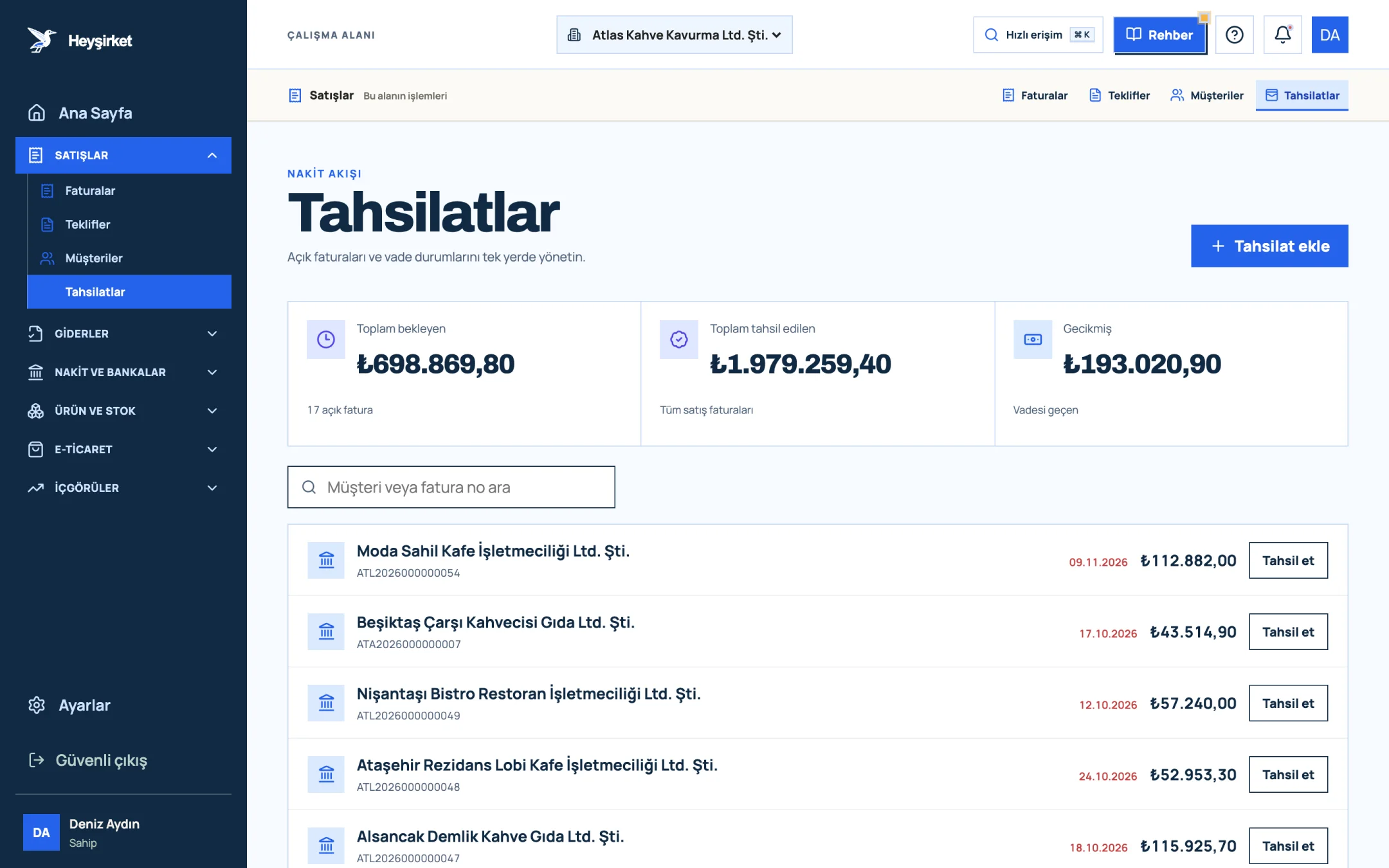
- 1. Add collection button
- 2. Total pending receivables
- 3. Total overdue receivables
- 4. Per-row Collect button
Part 6 · Equipment Leasing or an investment loan?
Leasing (financial leasing) means that a leasing company buys a machine or piece of equipment and lets you use it under a lease agreement, with ownership usually passing to you for a nominal price at the end of the contract. With a loan the machine is yours and so is the debt; with leasing the machine belongs to the leasing company until the contract ends.
- Collateral: In leasing the asset itself acts as collateral; the need for extra collateral is often lower than with a loan.
- Payment plan: Lease payments can be planned seasonally or with a grace period, in line with the cash the machine will generate.
- Tax: The accounting and tax treatment of lease payments differs from a loan; work out the VAT and depreciation impact with your mali müşavir.
- Flexibility: You can't sell or transfer the asset during the contract; early termination terms are set out in the agreement.
The same scale is used to decide: convert the total lease payments and fees in the leasing offer, and the interest, taxes and fees of the loan, into an effective annual rate using the same term and down payment assumptions. Choose whichever is lower and whose payment plan fits your cash flow.
Part 7 · Decision table Which financing should you choose in which situation?
The right financing is the source with the lowest effective cost, chosen according to the duration of the need, your collateral position and how quickly you need the money. The table below summarises the six options from these angles.
| Option | Typical term | Collateral | Speed | Relative cost | Best use |
|---|---|---|---|---|---|
| Supplier terms | 30-90 days | None, trading relationship | Immediate | Low (the discount you forgo) | Raw materials and stock purchases |
| KOSGEB-supported loan | Depends on programme, usually 1-3 years | Bank's conditions | Depends on calls, slow | Low (with interest support) | Start-up, capacity, working capital |
| KGF-guaranteed loan | 1-5 years | Partly the fund's guarantee | Medium | Medium (incl. guarantee commission) | Growth with insufficient collateral |
| Bank loan | 3 months - 5 years | Guarantee, mortgage, cheques | Medium | Medium | Working capital, investment |
| Leasing | 2-5 years | The asset itself | Medium | Medium | Machinery, vehicles, equipment |
| Factoring | 30-120 days | The receivable itself | Fast | High | Corporate customer receivables, urgent cash |
- Measure the need — Amount, duration, purpose
- Internal sources — Speed up collections, reduce stock
- Trade sources — Supplier terms
- Supported sources — KOSGEB, KGF
- Market sources — Loans, leasing, factoring
The first two steps are about freeing up your own cash before borrowing. Shortening receivable terms by 10 days means several hundred thousand lira of interest-free financing for most SMEs. The way to measure it is the cash conversion cycle calculation in our cash flow management article.
Part 8 · In practice How do you prepare for financing with your Heyşirket data?
Preparing for financing means being able to show in numbers how much money you need and when, and which collections you'll repay it from. Three screens in Heyşirket answer these questions.
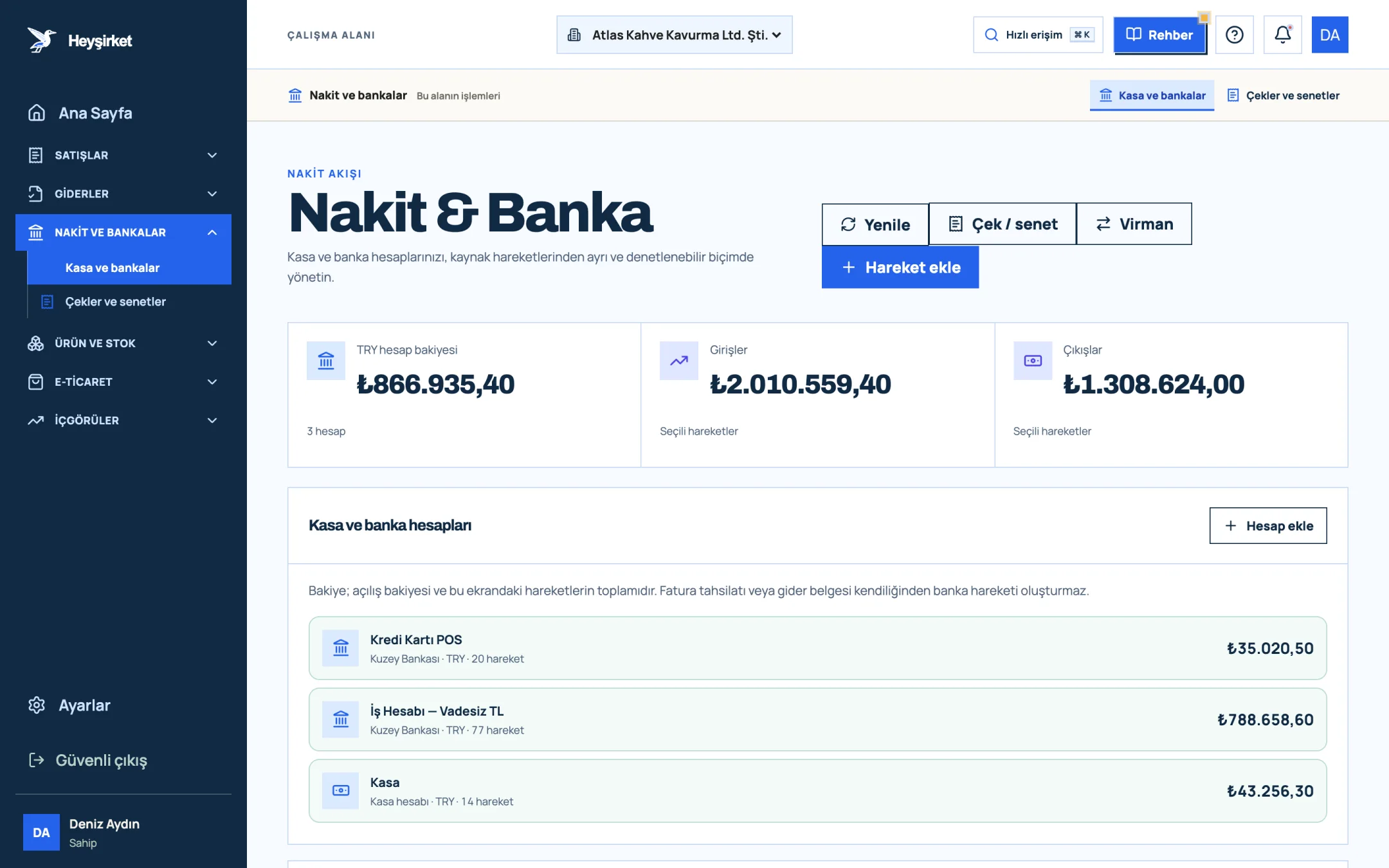
- 1. Add transaction button
- 2. Transfer between accounts
- 3. Total TRY balance
- 4. Cash and bank account list
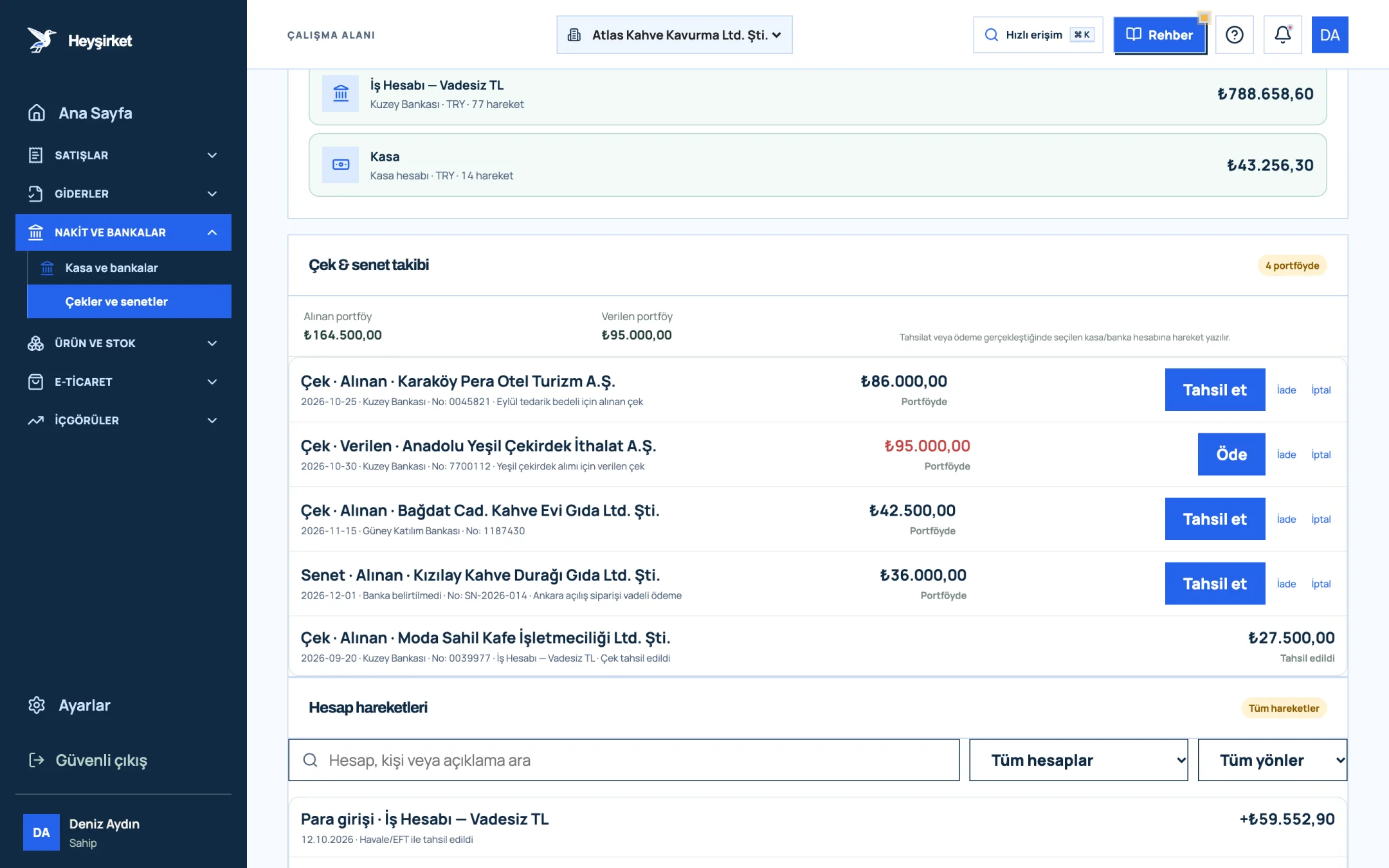
- 1. Received and issued portfolio summary
- 2. Received check in portfolio and Collect
- 3. Issued check and Pay
- 4. Collected check
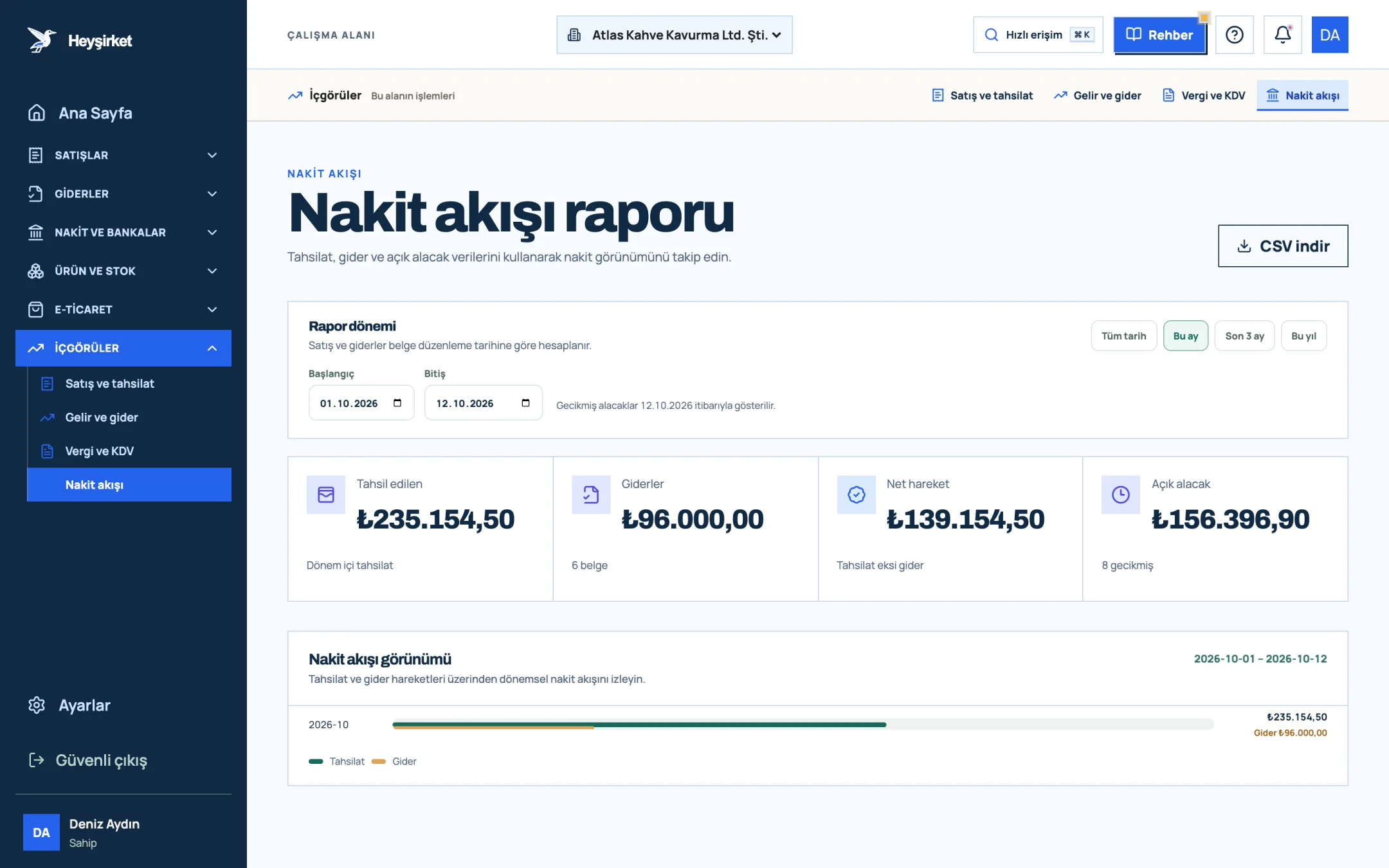
- 1. Collected and expenses
- 2. Cash flow view
To use supplier terms well, you also need to see your payment dates. The due date and remaining amount in the expense documents list are the basis for planning which payment to make early with the discount and which to make on the due date; details are in the how to record an expense and cheque and promissory note tracking guides.
Before applying for financing
- I've written down the amount, duration and purpose of the need in one sentence.
- I've tried speeding up collections and using supplier terms first.
- I've converted every offer into an effective annual rate using total cost, net amount and number of days.
- I've checked whether there's an open KOSGEB call or KGF package.
- I've made sure my cash, bank and cheque records are up to date and match the statements.
- I've placed the repayment instalments into a 13-week cash table.
- I've agreed a date with my mali müşavir for preparing the financial statements.
There's no such thing as cheap financing; there's only financing taken on the right term, for the right purpose, with its cost worked out.
In the end Atlas Kahve used three sources together: it bought green beans on the supplier's 60-day terms and the second roasting machine through leasing, and opened a small revolving limit for the two-week gap between the hotel receivable and the supplier payment. It politely turned down the factoring offer.
What's the cheapest way for SMEs to get financing?
Most often it's freeing up the business's own cash: shortening receivable terms, reducing stock and using supplier terms. Among external sources, KOSGEB programmes with interest support and KGF-guaranteed loans are generally cheaper than market loans and factoring.
What's the difference between the effective interest rate and the contractual rate?
The contractual rate is the interest rate written in the contract. The effective rate also takes into account all other costs on top of interest, such as BSMV, file fees, commissions and guarantee fees, as well as the net amount you receive. Always use the effective rate when comparing offers.
Where do I apply for a KGF guarantee?
KGF guarantees are provided through banks. You tell the bank you work with that you'd like a KGF-guaranteed loan; the bank carries out the assessment and takes the guarantee application to the fund.
Is factoring or a bank loan more advantageous?
There's no single answer. If your bank limit is used up and you've made a sale on credit to a strong corporate customer, factoring is a quick solution. However, its effective cost is often higher than a bank loan; convert both offers into an annual rate with the same formula and decide.
Does leasing or a loan make more sense?
Leasing stands out if your collateral is limited and you want to plan payments around the cash the machine will generate. A loan suits you if owning the asset straight away and flexibility matter. Work out the VAT and depreciation impact together with your mali müşavir.
Does Heyşirket offer loans or factoring?
No. Heyşirket isn't a financial institution; by keeping your cash, collection, expense and cheque records in order, it helps you measure your financing needs and prepare the data you'll share with your bank or mali müşavir.
See your repayment capacity in numbers Check the balance of collections and expenses over the last three months in the cash flow report. Your monthly net movement is the most honest indicator of the instalment you can carry. Open cash flow report
Author: Heyşirket Editorial Team