Financial management · 16 min read · Updated:
Annual budget planning for SMEs: from a one-page plan to monthly variance tracking
A budget isn't a contest to predict the future; it's a yardstick that helps you spot early what isn't going to plan during the year. In this article we build an SME budget in five steps, then compare it with the actuals every month.
In short
- An annual budget has three parts: the revenue forecast, the expense budget and the cash budget, and each becomes a management tool once it's split into months.
- A revenue forecast built from drivers such as number of customers, order frequency, quantity and price, rather than adding a percentage to last year's turnover, is both more accurate and easier to discuss.
- The profit budget and the cash budget can give different results for the same month; a business that sells on credit terms can lose cash in a profitable month.
- Preparing three scenarios, base, pessimistic and optimistic, shows which assumption has the biggest impact on profit and cash.
- A budget's value comes from monthly variance tracking: comparing actuals with the budget and writing down the cause of any difference above 5-10% is a good enough start.
Last March, while reviewing the first quarter, Atlas Kahve's founder Deniz Hanım noticed something: sales were "going well", but she didn't know well compared to what. There was no target and no plan, only the same month last year. And because of inflation, the same month last year said almost nothing.
A budget is exactly the answer to that "compared to what?" question. October and November are the best months to build next year's budget: you have most of the year's actuals in hand and enough time to start January ready. By the end of this article you'll have a template you can copy into a spreadsheet and a variance routine you'll repeat every month.
Part 1 · Definition What is an annual budget, and why does an SME need one?
An annual budget is a numerical plan that shows, month by month, the income a business expects over the next 12 months, the expenses it will incur and its cash inflows and outflows. Unlike the thick binders of large corporations, an SME budget can, and should, fit in a single table.
A budget's real job isn't forecasting, it's comparison. If your sales in March are 8% below budget, you know it in March, not in December. You make pricing, campaign, hiring or investment decisions with that early warning.
| Part | Question it answers | Main source |
|---|---|---|
| Revenue forecast | How much will we sell? | Customer, order and price assumptions |
| Expense budget | How much will we spend to make these sales, and how much profit will be left? | Last year's expenses, planned hiring and investments |
| Cash budget | In which month will money come in, and in which month will it go out? | Payment terms, collection habits, payment schedule |
- October — Gather this year's actuals
- November — Assumptions and scenarios
- December — Split the budget into months, approve
- Every month — Compare with actuals
- Every quarter — Update the forecast
The first step is gathering this year's actuals. The best forecast starts from an honest reading of the past.
Part 2 · Preparation What data should you gather before you start the budget?
The first step in budget preparation is extracting the last 12 months of sales, expense and collection data, month by month and line by line. This data is both the starting point for your assumptions and the only source that shows seasonality.
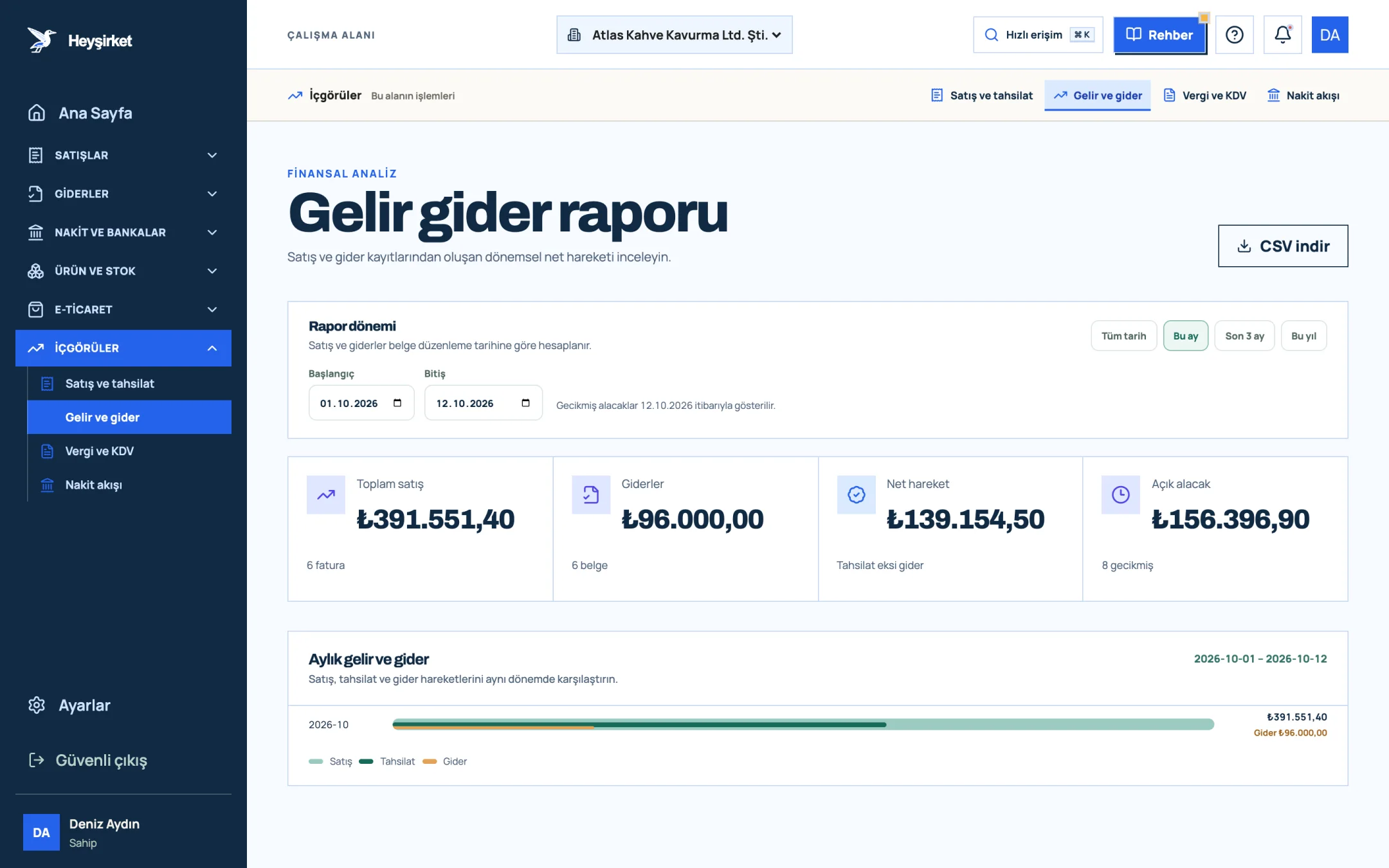
- 1. Total sales and expenses
- 2. Monthly income and expense chart
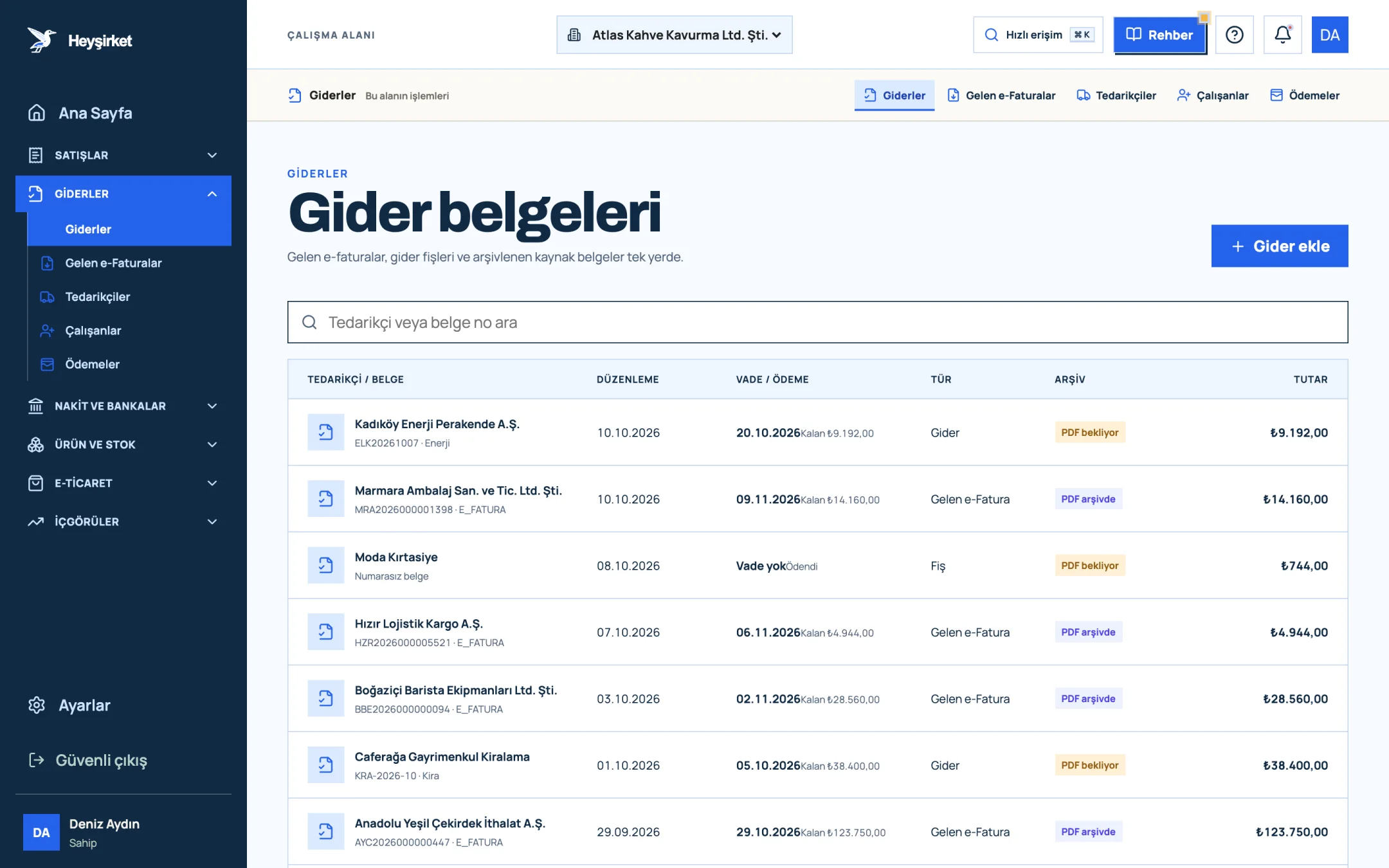
- 1. Add expense button
- 2. Due date and remaining payment
- 3. Document type (Expense, Incoming e-Fatura, Receipt)
- 4. Expense document row
Data preparation before budgeting
- Extract the last 12 months' monthly sales by customer group or product group.
- Extract the last 12 months' expenses by category; classify any uncategorised documents.
- Note the average collection period and the payment habits of your 10 largest customers.
- Pin down headcount and the monthly cost per employee.
- Write down the new-year amounts and increase dates of contract-based expenses such as rent, insurance and loans.
- List the investments, hires and new products planned for the new year.
The data is ready. Now on to the hardest and most important line of the budget: revenue.
Part 3 · Revenue How do you forecast revenue?
A revenue forecast calculates next year's sales by breaking them down into drivers such as number of customers, order frequency, order size and price. The "last year plus 30%" method is quick but doesn't tell you what will change; the driver method lets you see month by month which assumption is holding and which isn't.
| Active café customers | 42 |
|---|---|
| Average monthly purchase per café | × 18 kg |
| Number of months | × 12 |
| Annual sales volume (42 × 18 × 12) | 9,072 kg |
| Average price per kg for 2027 (excluding VAT, with planned updates) | × 1,050 TL |
| Annual revenue forecast for the café wholesale channel | 9,525,600 TL |
Each driver can be discussed on its own: the sales team owns the new café target, operations owns consumption per café and the founder owns pricing policy. When a variance appears during the year, it's immediately clear which driver didn't hold.
The same method applies to every sales channel. For Atlas Kahve's four channels, the table looked like this:
| Channel | Main drivers | Annual forecast |
|---|---|---|
| Café wholesale | 42 cafés × 18 kg/month × 1,050 TL | 9,525,600 TL |
| Hotels and corporate | 8 contracted customers, quarterly price updates | 2,400,000 TL |
| Online store and marketplaces | Average 350 orders a month × 400 TL basket | 1,680,000 TL |
| Barista training | 2.5 sessions a month × 12,000 TL | 360,000 TL |
| Total | 13,965,600 TL |
Once the revenue figure is on the page, most business owners breathe a sigh of relief. But the real question is how much of that revenue you'll keep.
Part 4 · Expenses How do you build an expense budget? A template table
An expense budget plans variable expenses, which rise and fall with sales, separately from fixed expenses, which are paid regardless of sales. Variable expenses are written as a percentage of revenue, fixed expenses as amounts based on contracts and headcount.
- Variable expenses: raw materials, packaging, shipping, marketplace commission. For Atlas Kahve, cost of goods sold was taken as roughly 60% of revenue.
- Fixed expenses: salaries and SGK (social security) contributions, rent, software, insurance, accounting services. They're entered by month along with their increase dates.
- Semi-fixed expenses: energy, maintenance, marketing. Known changes are added to last year's average.
- Financing costs: loan interest and fees, according to the loan schedule.
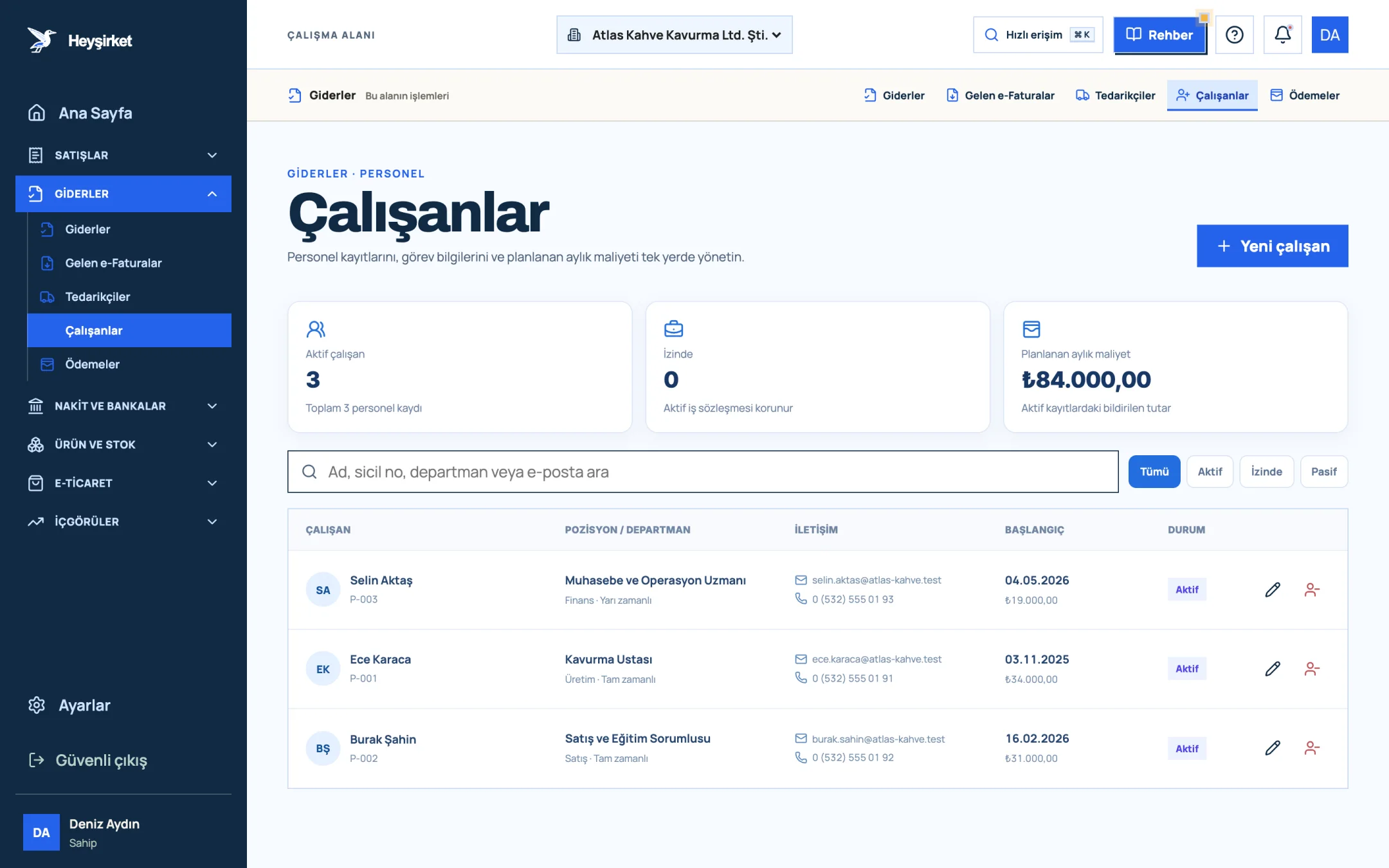
- 1. New employee
- 2. Planned monthly cost
- 3. Employee list
| Line | Annual | January | February | March |
|---|---|---|---|---|
| Sales revenue | 13,965,600 | 1,020,000 | 1,060,000 | 1,150,000 |
| Cost of goods sold (60%) | − 8,379,360 | − 612,000 | − 636,000 | − 690,000 |
| Gross profit | 5,586,240 | 408,000 | 424,000 | 460,000 |
| Staff (salaries and SGK) | − 1,260,000 | − 105,000 | − 105,000 | − 105,000 |
| Rent | − 420,000 | − 35,000 | − 35,000 | − 35,000 |
| Other operating expenses | − 1,620,000 | − 135,000 | − 135,000 | − 135,000 |
| Operating profit | 2,286,240 | 133,000 | 149,000 | 185,000 |
Notice two things in the table. First, sales weren't split evenly across the months: in coffee, the winter months are quieter and spring and autumn busier. Take the seasonality from last year's monthly breakdown. Second, "Other operating expenses" is a single line; starting this simple in the first year is better than not starting at all.
Operating profit shows 133,000 TL in January. But will there be 133,000 TL more in the bank at the end of January? This is exactly where most businesses' budgets go wrong.
Part 5 · Cash Why are the profit budget and the cash budget different?
A cash budget places the amounts in the revenue and expense budget not in the month the invoice is issued, but in the month the money actually comes in or goes out. Credit sales, supplier payment terms, tax and SGK payment schedules and loan instalments are what separate the two budgets.
| Opening balance (1 January) | 520,000 TL |
|---|---|
| Collections from November-December sales | + 1,140,000 TL |
| Supplier payments (including December purchases) | − 680,000 TL |
| Staff and rent | − 140,000 TL |
| Other operating expenses | − 135,000 TL |
| KDV (VAT), muhtasar (withholding return) and other tax payments | − 160,000 TL |
| Loan instalment | − 40,000 TL |
| Closing balance (31 January) | 505,000 TL |
While January is budgeted at 133,000 TL operating profit, cash falls by 15,000 TL. The reason is that December purchases and tax payments fall due in January. The figures are illustrative; confirm tax payment dates with your mali müşavir (certified financial advisor).
Keeping the cash budget monthly is enough for the annual plan. If you want to see the next few months in weekly detail, put the 13-week table from the cash flow management article next to this budget.
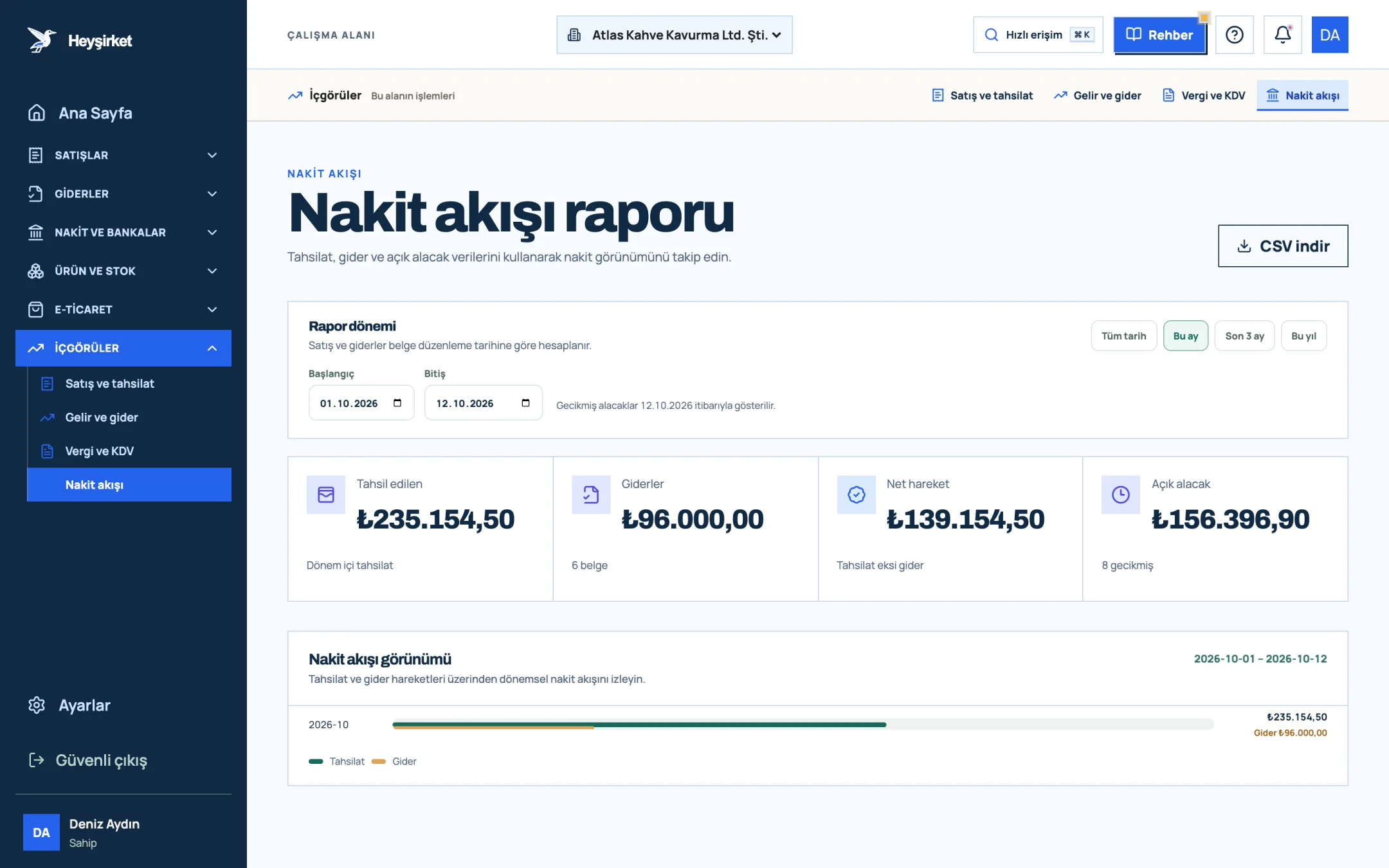
- 1. Collected and expenses
- 2. Cash flow view
Part 6 · Scenarios What if sales fall short? A three-scenario budget
A scenario budget shifts the main assumptions in a pessimistic and an optimistic direction and shows how profit and cash are affected. The aim isn't to know which scenario is right, but to decide today what you'll do if the pessimistic one plays out.
| Scenario | Assumption | Annual revenue | Operating profit | Ready action |
|---|---|---|---|---|
| Pessimistic | Café volume 10% lower, collection period 15 days longer | ≈ 13,013,000 TL | ≈ 1,905,000 TL | Postpone the new hire, discuss instalments with suppliers |
| Base | The assumptions in this article | 13,965,600 TL | 2,286,240 TL | Carry out the plan |
| Optimistic | Revenue 8% higher with new hotel contracts | ≈ 15,083,000 TL | ≈ 2,733,000 TL | Bring forward the second roasting machine investment |
The most valuable column in the table is the last one. If what you'll do when the pessimistic scenario starts to materialise is written down in advance, you have a checklist instead of panic when it's time to decide. Also decide when you'll pull the trigger: for example, "if sales are 8% below budget for two months in a row".
Part 7 · Tracking How do you track budget variances every month?
Budget variance tracking means comparing actual figures with the budget at the end of each month, calculating the difference as an amount and a percentage, and writing down the cause and the action for any difference above a set threshold. For SMEs, a threshold of 5-10% is a good starting point.
| Line | Budget | Actual | Variance | Variance % | Cause and action |
|---|---|---|---|---|---|
| Sales | 1,180,000 | 1,092,000 | − 88,000 | − 7.5% | Two cafés under renovation; their return to be confirmed in October |
| Operating expenses | 275,000 | 296,000 | + 21,000 | + 7.6% | Roasting machine maintenance brought forward; one-off |
| Collections | 1,150,000 | 1,010,000 | − 140,000 | − 12.2% | A hotel's payment is late; to be called this week |
Every line in the table has a one-sentence explanation. The value of a variance report isn't in the numbers but in those sentences: when you look back a year later, these notes tell you which assumption was systematically wrong.
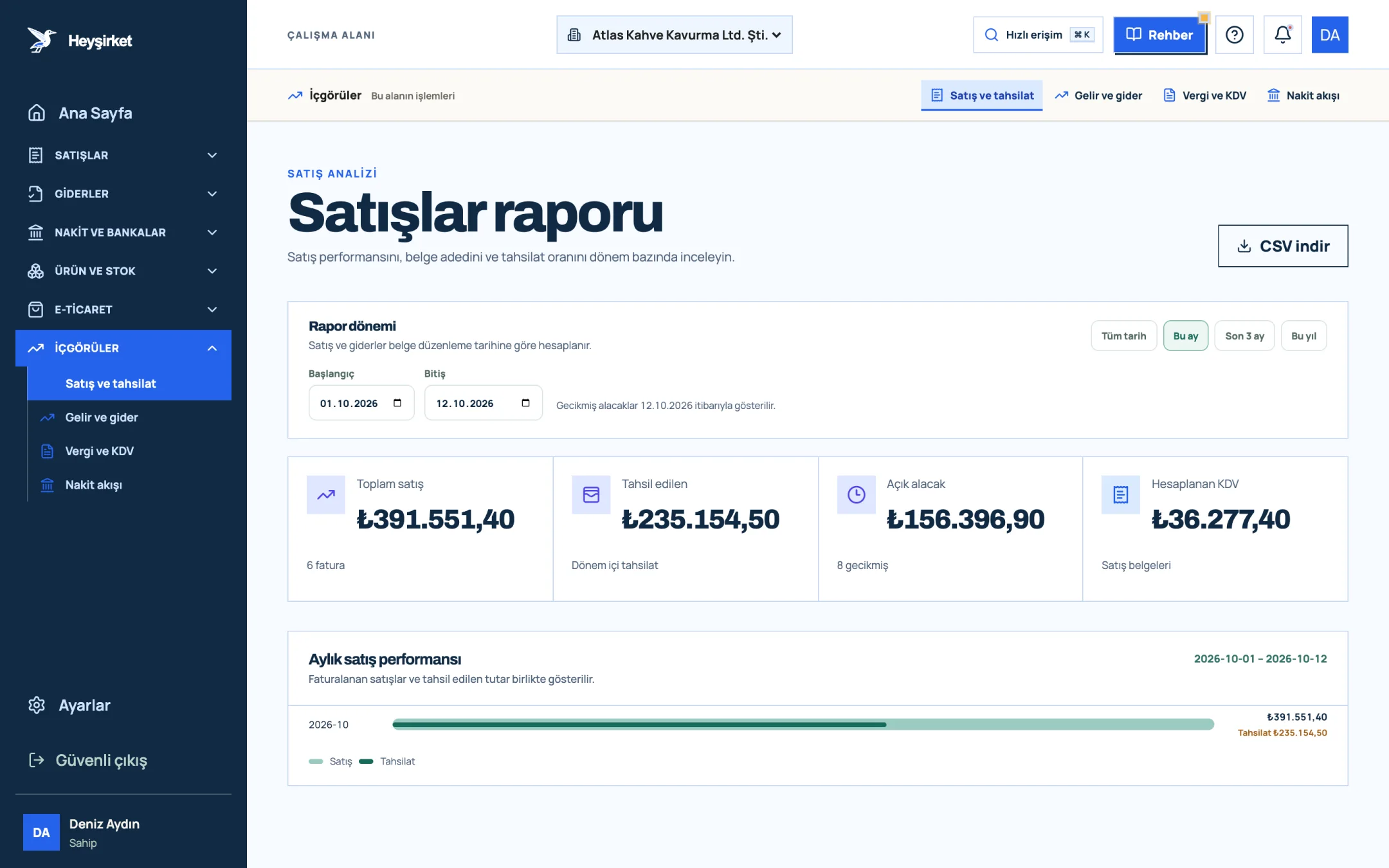
- 1. Report period selection
- 2. Total sales
- 3. Collected
- 4. Monthly sales performance chart
- 5. Download CSV
A 30-minute monthly variance routine
Close the month
First make sure invoices, expenses and collections have all been entered. Variance analysis on incomplete data produces false alarms. We explained the order in the month-end closing checklist article.
Pull the actuals
Set the period to the relevant month in the Sales, Income and expense and Cash flow reports; bring the sales and expense data into your table with Download CSV.
Pull the actuals - 1. Total sales and expenses
- 2. Monthly income and expense chart
Calculate the difference
Write down the amount and percentage variance for each line. Flag the ones above the threshold.
Write down the cause and the action
Add a one-sentence cause and an owner to every flagged line. Separate one-off variances from lasting ones.
Update the forecast at quarter-end
Reflect lasting variances in the "year-end forecast" column and check whether any pessimistic-scenario actions have been triggered.
A budget isn't measured by whether it holds at year-end, but by how many decisions it helps you make early during the year.
This year, for the first time, Deniz Hanım will start with a target in the first week of January, not in March. While preparing the budget, don't forget to put the year-end close on the same calendar: the counts and reconciliations in the year-end closing guide article make your new budget's opening figures accurate.
Does a small business really need a budget?
Yes, but it doesn't have to be complicated. A one-page table made up of revenue, the main expense lines and a monthly cash plan is enough to see early during the year what isn't going to plan.
When should the annual budget be prepared?
Ideally it's prepared in October-November and approved in December. That way you have most of the year's actuals in hand and start January ready. If you're starting mid-year, budgeting the remaining months is useful too.
Is there any point in budgeting when inflation is high?
Even more so. When you write your price assumption down explicitly, you can see right away which line of the budget is affected when inflation differs from what you expected. A quarterly year-end forecast update is a practical way to manage that uncertainty.
At what percentage should a budget variance trigger an alarm?
There's no fixed rule. For SMEs, a threshold of 5-10% is a common starting point. For small lines, using an amount threshold (for example 10,000 TL) instead of a percentage cuts down on unnecessary alarms.
Does Heyşirket create a budget table?
Heyşirket doesn't have a separate budget module. You keep the budget in a spreadsheet, then pull actual sales, expense, collection and cash data from Heyşirket reports with Download CSV and compare them.
What's the difference between a budget and a cash flow forecast?
A budget usually plans 12 months in monthly detail and also covers revenue, expenses and profit. A cash flow forecast shows a few weeks or months purely in terms of money in and out, usually in weekly detail. The two complement each other.
Pull the first line of your budget today Select the last 12 months in the income and expense report, download the monthly sales and expense breakdown as CSV and fill in the actuals column of your 2027 budget template. Open the income and expense report
Author: Heyşirket Editorial Team