Financial management · 17 min read · Updated:
Managing a business during inflation in Türkiye: don't shrink while you think you're profitable
Inflation makes your profit statement look brighter and your cash box look fuller than they really are. In this article we show how to break that illusion with four decisions: payment terms, pricing, stock and cash, using figures for businesses in Türkiye.
In short
- In high inflation, nominal profit overstates real earnings because it ignores the rising cost of replacing the goods sold and the purchasing power that erodes over payment terms.
- At roughly 1,8% monthly inflation, a 100.000 TL receivable on 90-day terms carries the purchasing power of only about 94.700 TL in today's money on the day it's collected.
- Updating prices on a scheduled, pre-announced rhythm loses fewer customers than quietly paying for cost increases out of your margin for months.
- Holding stock can protect against inflation, but the decision should be weighed against the financing cost of the cash tied up in stock and how fast the goods sell.
- Under Law No. 7571, financial statements won't be adjusted for inflation for the 2025, 2026 and 2027 accounting periods, so businesses need to calculate real profit themselves for management purposes.
At the end of September, Deniz, the founder of Atlas Kahve, looked at her income statement and smiled: revenue was clearly up on the same period last year, and gross profit had hit a record. Then the green coffee supplier's new price list arrived. With the same profit, she could buy only part of the sacks she could have bought a year earlier.
This is high inflation's most insidious effect: it can shrink a company while making it look like it's growing. By the end of this article you'll have a simple method for calculating your business's "real" profit and a checklist to repeat every month.
- %29,73 Year-on-year change in CPI (TÜFE) in September 2026 (TÜİK, Turkish Statistical Institute)
- %1,84 Month-on-month change in CPI in September 2026
- %24,32 Change in CPI as of September 2026 compared with December of the previous year
Even though annual inflation has dropped below 30% for the first time since November 2021, 1,8% a month still means this: 100 lira sitting in your cash box today will buy about 98 lira's worth of goods a month from now. This seemingly small loss works separately on every one of your decisions about payment terms, stock and pricing.
Part 1 · The illusion What's the difference between nominal profit and real profit?
Nominal profit is the sale price minus the cost originally paid for the goods; real profit is what remains after deducting from that the extra cost of buying the goods again at today's price and the purchasing power that erodes until payment arrives. When inflation is low, the two are close; when it's high, the gap between them decides the future of the business.
Accounting uses the historical cost of goods. That's a correct and legal measurement. But from a management perspective, it answers an incomplete question: "After this sale, do I have enough money to do the same job again?"
| Sale (100 kg × 1.200 TL, 60-day terms) | 120.000 TL |
|---|---|
| Historical cost (100 kg × 800 TL, bought two months ago) | − 80.000 TL |
| Nominal gross profit | 40.000 TL |
| Replacement difference (today's purchase price 864 TL/kg) | − 6.400 TL |
| Purchasing power lost over the terms (120.000 − 120.000 / 1,02²) | ≈ − 4.660 TL |
| Real gross profit from a management view | ≈ 28.940 TL |
The example uses assumptions: raw material prices rose 8% in two months and general prices rose 2% a month. Taxes are calculated on historical cost; this table is for management decisions only.
A profit of 40.000 TL on paper is worth about 29.000 TL in terms of the ability to do the same job again. That's a gap of almost 28%. And tax is still due on the 40.000 TL nominal profit.
Of the two losses in the table, the first relates to price and the second to payment terms. Let's start with the less noticeable one: every day of credit you give your customer.
Part 2 · Payment terms How much does offering payment terms cost during inflation?
During inflation, offering payment terms means giving your customer an interest-free loan; for every day you give, your receivable's purchasing power falls by that period's price increase. A 30-day term was a negligible gesture when inflation was a few percent; at 1,8% a month, it's a cost that comes straight out of your margin.
| Terms | Amount collected | Equivalent purchasing power today | Loss |
|---|---|---|---|
| Upfront | 100.000 TL | 100.000 TL | 0 TL |
| 30 days | 100.000 TL | ≈ 98.190 TL | ≈ 1.810 TL |
| 60 days | 100.000 TL | ≈ 96.420 TL | ≈ 3.580 TL |
| 90 days | 100.000 TL | ≈ 94.680 TL | ≈ 5.320 TL |
For a business with a 25% gross margin, 90-day terms take more than a fifth of the profit. And this table assumes the customer pays on time. Late payment keeps growing the loss at the same pace.
- Tie terms to price. Set separate upfront and credit prices; explain the difference as the cost of credit, not a "discount."
- Fix the default payment term on the customer card. Instead of negotiating on every invoice, the decision is made once and applied.
- Set a credit limit. The limit is the maximum a customer can "borrow" from you.
- Address late payments the same week. During inflation, every week of waiting shrinks your receivable a little more.
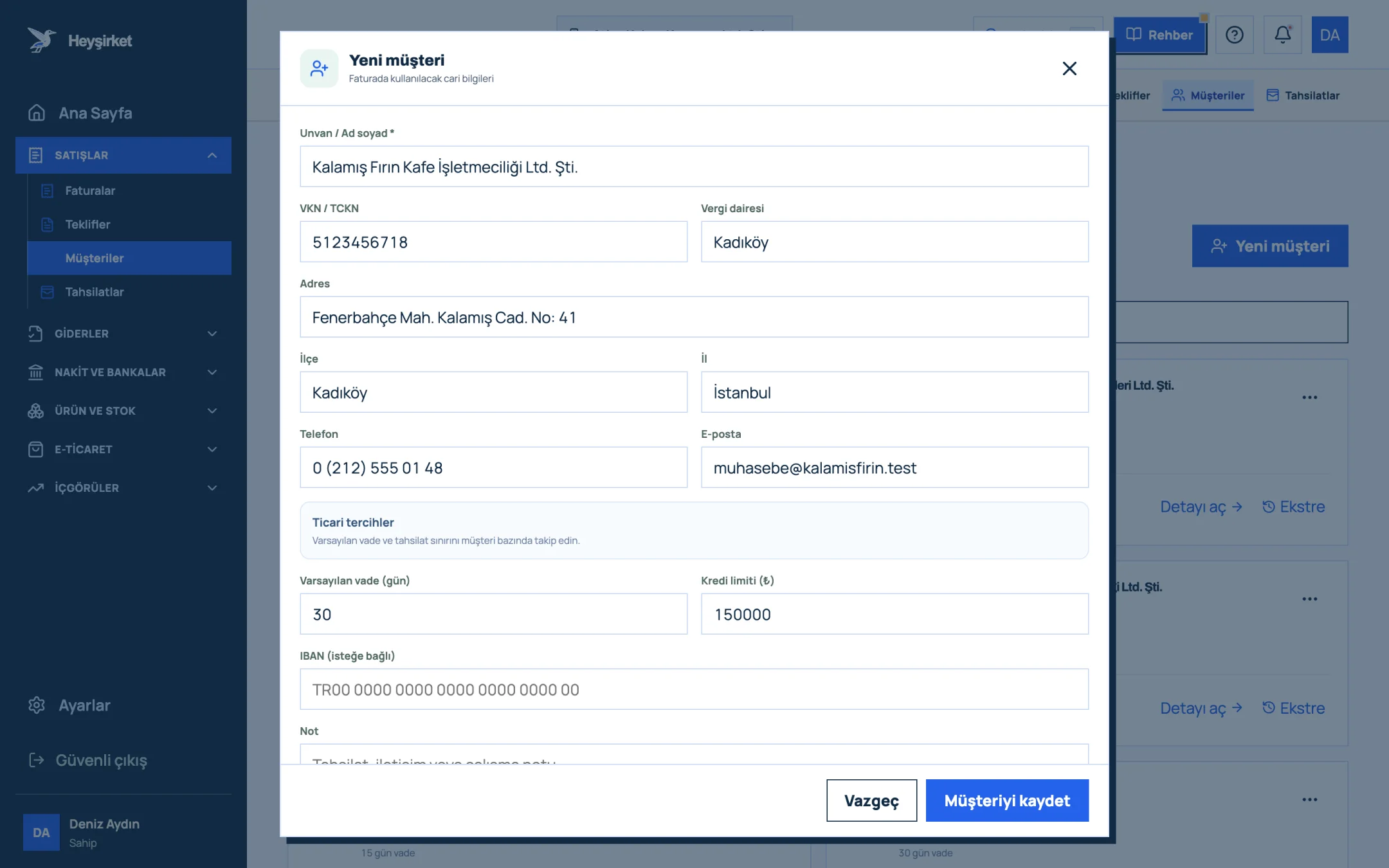
- 1. Company name field
- 2. Tax ID / national ID and tax office
- 3. Payment terms and credit limit
- 4. Save button
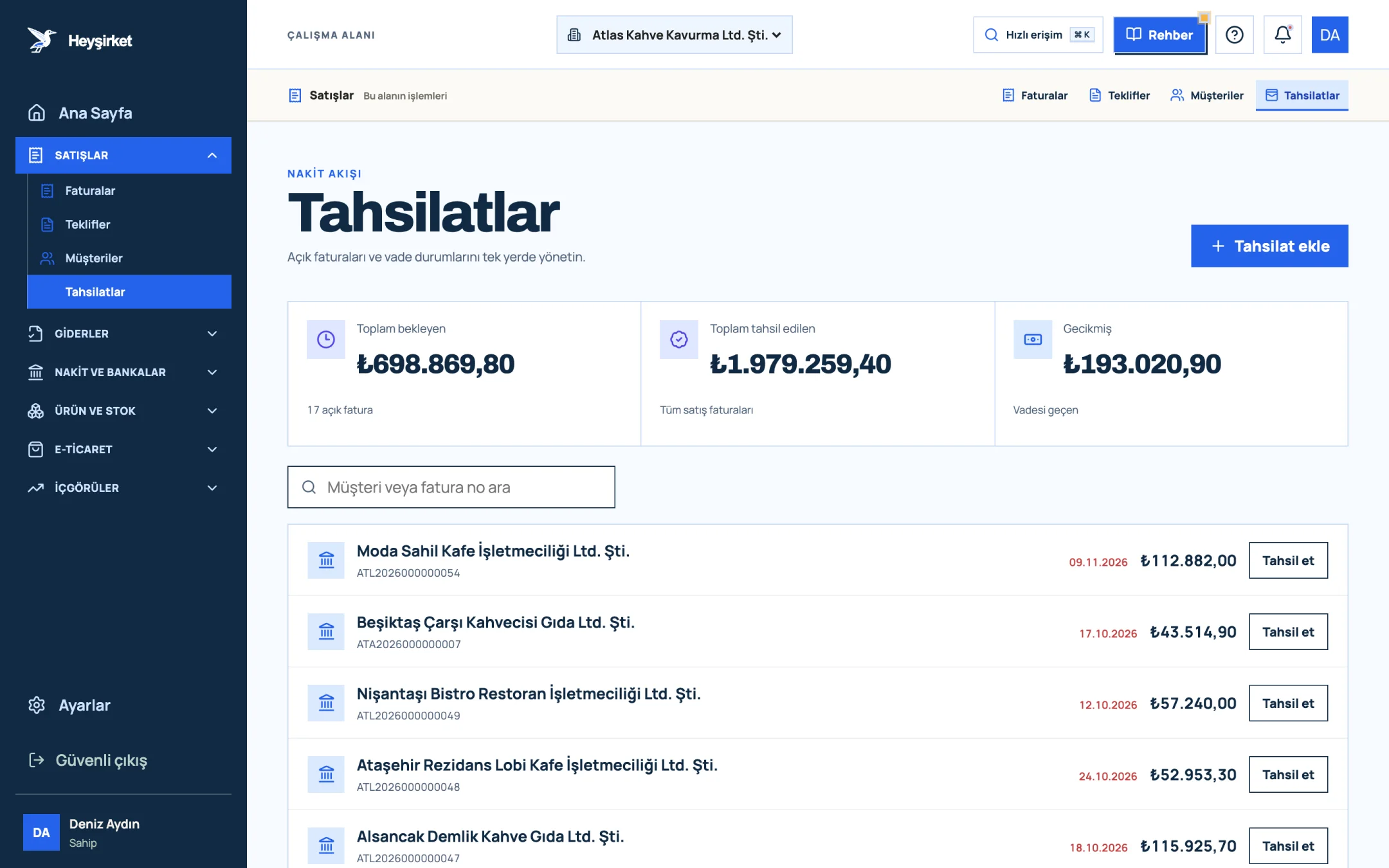
- 1. Add collection button
- 2. Total pending receivables
- 3. Total overdue receivables
- 4. Per-row Collect button
We cover tactics for speeding up collections in detail in our article on speeding up receivables collection. But shortening payment terms is only half the problem. The other half is whether your selling price keeps up with today's cost.
Part 3 · Pricing How often should you update your prices?
A pricing rhythm is a routine for reviewing your selling prices at set intervals, based on cost data. During inflation, the real risk isn't raising prices; it's delaying the increase and quietly paying the cost difference out of your own margin for months.
Many businesses update prices "when the supplier raises theirs." With this reactive approach, every week before the increase reaches the customer is a loss, and every update feels like a surprise. A scheduled rhythm makes planning easier for both you and your customer.
- Gather costs — Latest purchase invoices
- Replacement cost — If you bought it again today
- Apply target margin — By product group
- Notify customers — Before it takes effect
- Update the list — On the set date
| Approach | How it works | Pros | Risk |
|---|---|---|---|
| Reactive | Prices change when the supplier raises theirs | Little workload | Margin erodes during the delay, customers get surprised |
| Scheduled | Reviewed on a set day each month or quarter | Predictable, customers can prepare | Sudden shocks may need an interim update |
| Indexed | The contract ties the price to an index or cost item | Fair for long contracts | Requires calculation and explanation |
Atlas Kahve chose the scheduled model: the wholesale café price list is reviewed on the first business day of every month, and any changes are announced to customers in writing a week in advance. Annual contracts with hotels now include a quarterly update clause.
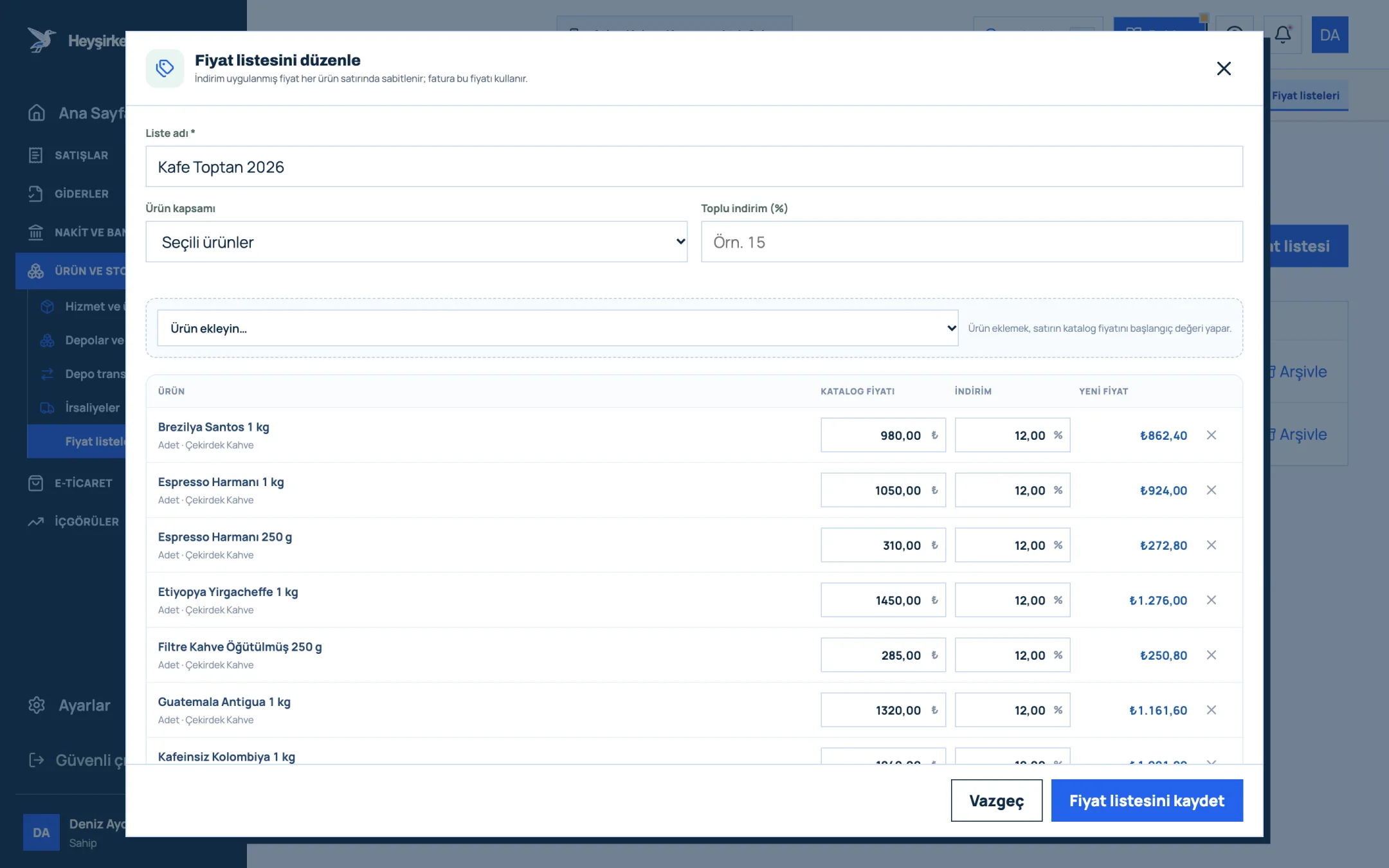
- 1. List name and scope
- 2. Discount rate and new price
- 3. Save button
We covered which margin to price with, and how to structure discounts and credit pricing, in our pricing strategy article. Now let's turn to inflation's most debated question: should you turn your cash into stock?
Part 4 · Stock Does it make sense to hold extra stock during inflation?
The decision to hold stock during inflation means weighing the cost advantage of buying early at today's price against the cost of the cash tied up in that stock and the risk of not selling it. Stock isn't always a shield against inflation; slow-moving stock is a burden that locks up cash.
The right question isn't "will prices go up?" but "how long will it take me to sell, and what does this money cost me over that time?" For fast-moving products whose cost is tied to foreign currency or commodities, buying early can make sense. For slow-moving, perishable or dated products, or ones that can go out of fashion, the same move can turn into a loss.
| Question | Supports buying early | Argues against buying early |
|---|---|---|
| How fast does the product sell? | Turns over within a few weeks | Sits on the shelf for months |
| What drives the cost? | Currency, commodities, a supplier who raises prices often | Domestic product with stable prices |
| Does the product spoil or become outdated? | Durable, standard | Dated, seasonal, fashion-driven |
| How are you financing the purchase? | Idle equity | A loan, or by delaying supplier payments |
| Do you have storage capacity? | No extra cost | Extra rent, insurance, wastage |
For Atlas Kahve, green beans are close to the first column: tied to foreign currency, durable and selling steadily. But roasted coffee sits in the second column because of freshness. The founder's decision was to buy two months' worth of green beans in advance and roast to order.
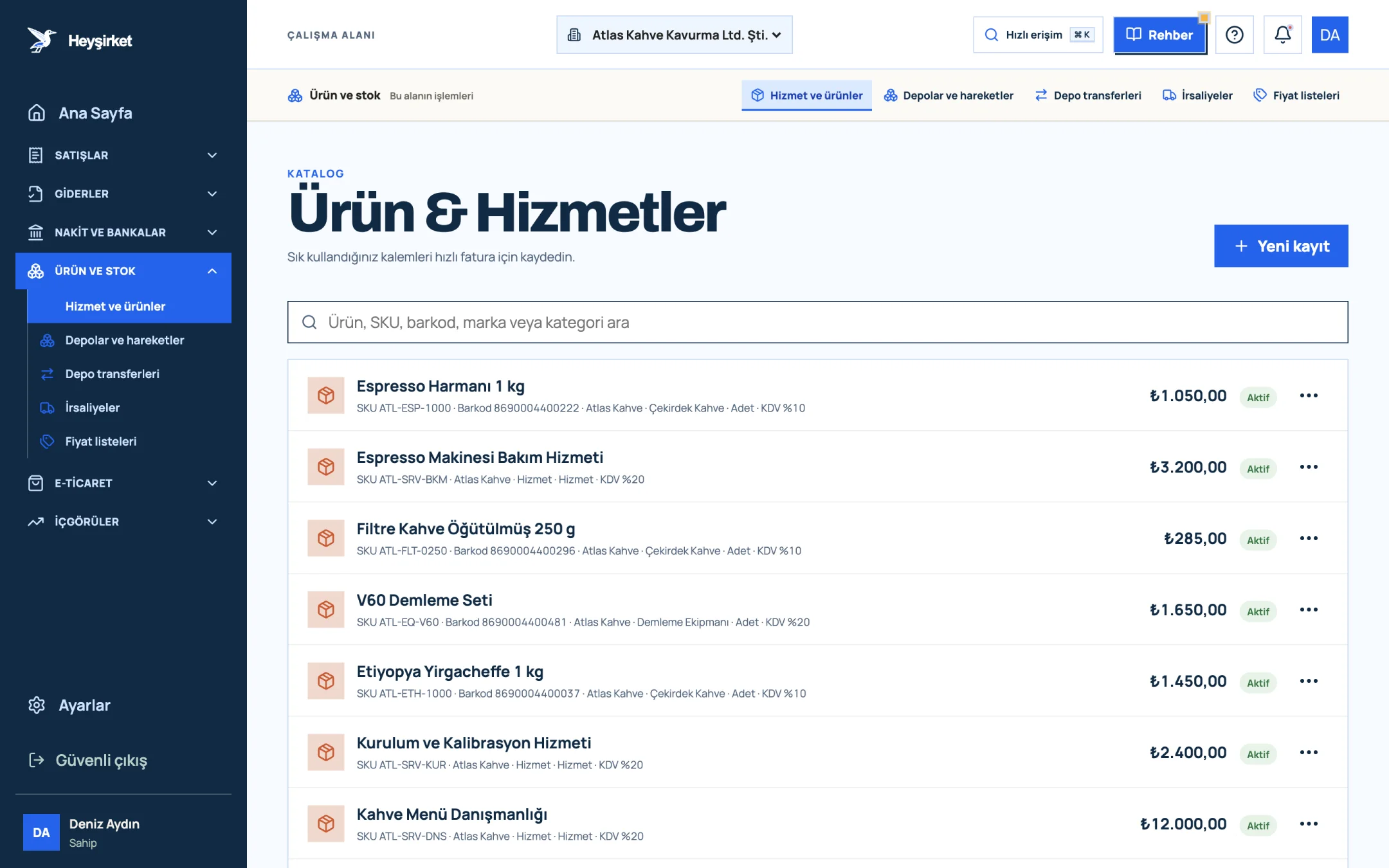
- 1. New item button
- 2. Product search (SKU, barcode, brand)
- 3. Product row: SKU, category, VAT, price
The stock decision inevitably leads to the final question: the cash sitting in your cash box.
Part 5 · Cash How much cash should you keep during inflation?
Cash management during inflation means keeping enough cash to cover essential payments without letting the rest sit idle. Idle TL loses purchasing power every month; but keeping no buffer at all forces you into expensive borrowing at the first late payment.
Two extreme mistakes show up here. The first is leaving amounts you won't use for months in a current account "just in case." The second is tying up all your cash in stock or other assets and then leaning on a credit card on payday. The right amount lies somewhere in between, and it can be calculated.
- Find your essential fixed costs: salaries, SGK (social security) contributions, rent, loan installments, essential subscriptions.
- Set a buffer: keep a few weeks' worth of these costs ready in your account. We worked through the calculation in our cash flow management article.
- Plan the next 13 weeks: see which week your large payments fall in.
- Put the surplus to deliberate use: talk to your accountant and your bank about how to use the amount left over after the buffer and planned payments; this isn't investment advice, just a reminder not to leave cash idle.
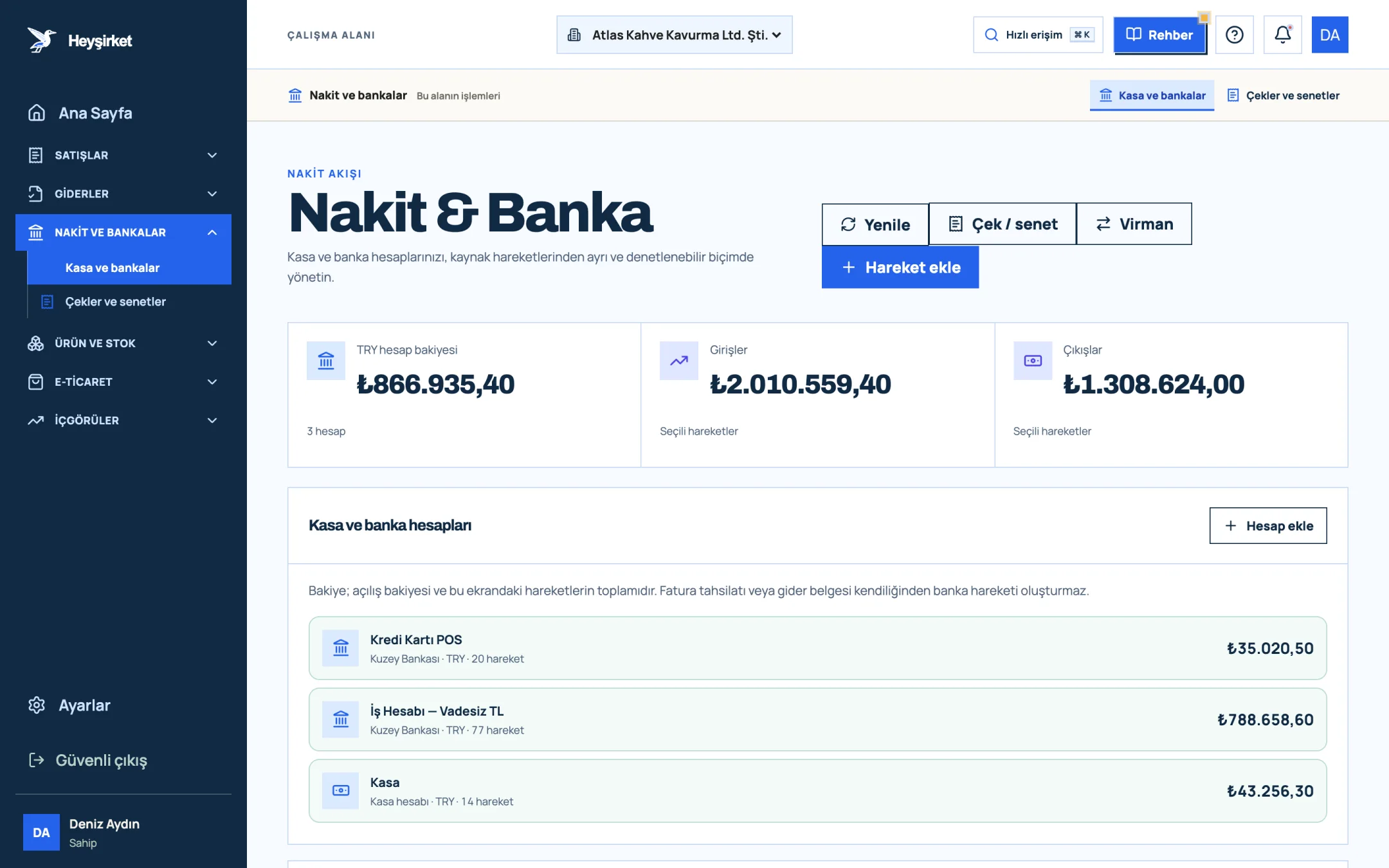
- 1. Add transaction button
- 2. Transfer between accounts
- 3. Total TRY balance
- 4. Cash and bank account list
Part 6 · Measurement Are you really growing? Measuring real growth
Real growth is revenue growth with price increases stripped out; it's calculated approximately with the formula (1 + nominal growth) / (1 + inflation) − 1. This single ratio answers the question: "Are we selling more, or selling the same thing at a higher price?"
| Last year's January-September revenue | 6.400.000 TL |
|---|---|
| This year's January-September revenue | 7.900.000 TL |
| Nominal growth (7.900.000 / 6.400.000 − 1) | ≈ %23,4 |
| Price increase over the same period (annual CPI assumption) | %29,7 |
| Real growth (1,234 / 1,297 − 1) | ≈ − %4,9 |
| Result | Real contraction |
For your own business, you can use the average increase in your selling prices instead of general CPI; it gives a more accurate result. Comparing with kilos or units sold is the simplest cross-check.
Deniz's record revenue suddenly took on a new meaning. Looking at kilos sold, she saw that the number of customers had stayed almost the same but two large cafés had cut back their orders. That insight changed the sales team's focus for the next quarter.
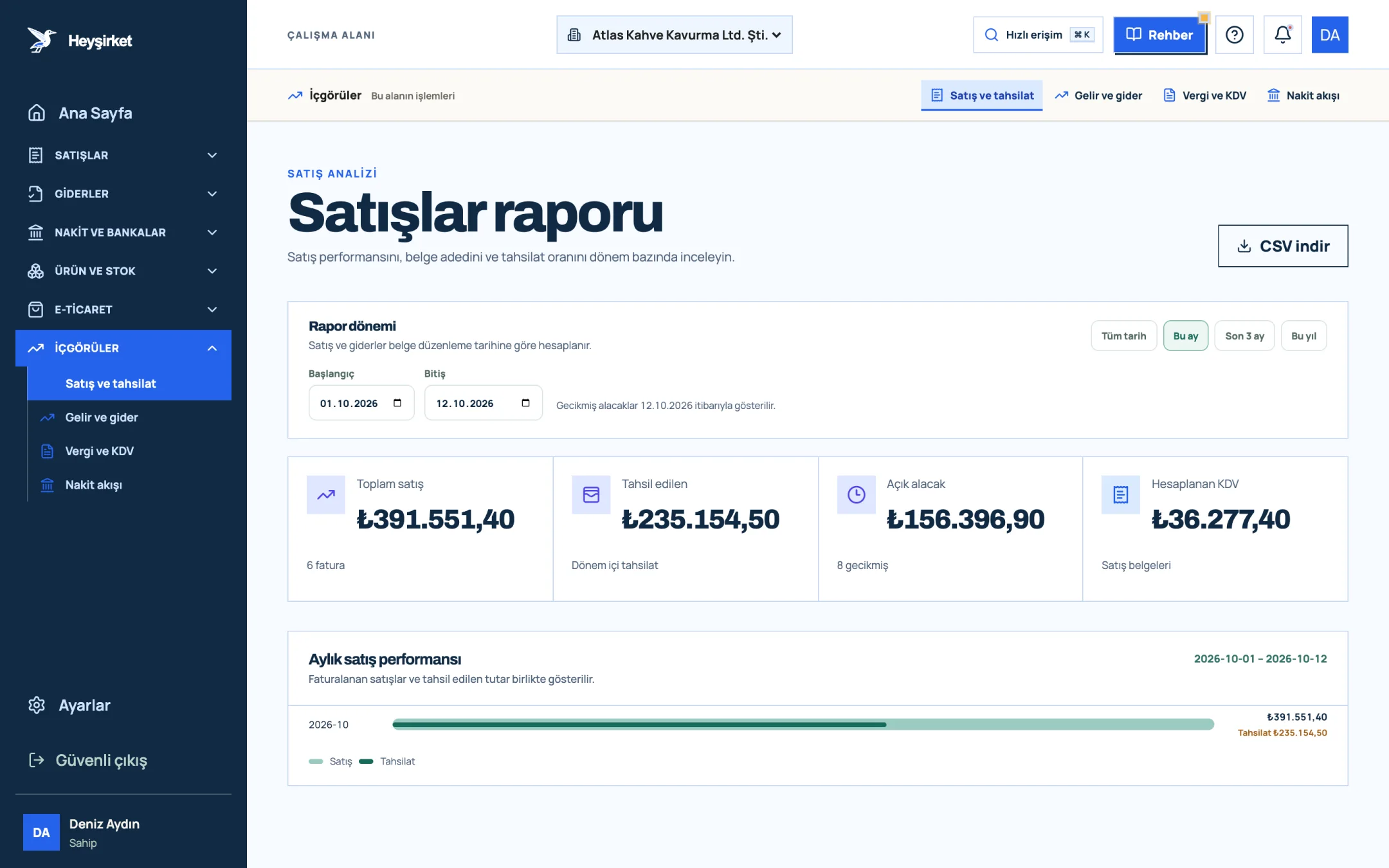
- 1. Report period selection
- 2. Total sales
- 3. Collected
- 4. Monthly sales performance chart
- 5. Download CSV
We explain how to read reports in our article on reading financial reports. Now let's turn all these decisions into a routine you can repeat every month.
Part 7 · Routine A 20-minute monthly inflation check
Managing a business during inflation is less about big one-off decisions and more about small checks repeated every month. The list below is designed to be completed in about 20 minutes on the first business day of the month.
First-business-day-of-the-month checklist
- Note the price change in your five largest cost items over the last month.
- Recalculate the margin on your main products based on replacement cost.
- If a price update is needed, set the date for notifying customers.
- Check your average collection period and the total of overdue receivables.
- Plan calls this week with customers whose payments are more than 60 days overdue.
- List slow-moving stock items, and either stop new purchases or plan a promotion.
- Compare your cash and bank balance with your buffer amount and decide how to use any surplus.
- Compare nominal and real revenue growth with the same month last year.
During inflation, profit isn't locked in on the day you issue the invoice, but on the day you can do the same job again.
As the year end approaches, take this routine a step further with our annual budget planning article, where we explain why the inflation assumption belongs at the very top of your budget.
Why is nominal profit misleading during inflation?
Because it's calculated using the older, cheaper cost of the goods sold. The extra cost of buying the same goods again today and the purchasing power lost on credit sales don't show up in that calculation. As a result, profit looks higher than the business's real ability to do the same job again.
Will my financial statements be adjusted for inflation?
Under provisional Article 37 added to VUK by Law No. 7571, there will be no inflation adjustment for the 2025, 2026 and 2027 accounting periods, apart from some exceptions. Ask your accountant about your own situation.
Will updating prices every month cost me customers?
Updates that are announced in advance, follow a schedule and can be explained by costs are usually received better than surprise price hikes. Giving customers written notice a week ahead and including an update clause in contracts from the start makes things easier.
Is it right to charge more for credit sales?
During inflation, payment terms are a real cost. Setting separate upfront and credit prices, or offering a discount for upfront payment, are common ways of sharing that cost visibly and fairly. Clarify the tax side of invoicing and late-payment differences with your accountant.
Does Heyşirket calculate real profit automatically?
No. Heyşirket reports your sales, collections, expenses and cash data and lets you export it with Download CSV. You calculate real profit and real growth yourself from this data, like the examples in this article.
Review your price lists this month Open the price lists linked to your customer groups, check your margin against replacement cost and set the effective date for new prices. Go to price lists
Author: Heyşirket Editorial Team