e-Documents · 17 min read · Updated:
e-Defter and e-Dönüşüm in Türkiye: which e-document becomes mandatory when, and how to prepare your business
One day you switch to e-Fatura, the next year to e-Defter, then to e-İrsaliye. e-Dönüşüm (Türkiye's digital transformation of tax documents) is really a staircase; if you know which step you're on, you can climb to the next one without surprises.

In short
- Since 1 January 2025, every taxpayer keeping books on the balance sheet basis must keep an e-Defter (e-ledger); balance sheet basis taxpayers starting business after that date also keep their books as e-Defter from day one.
- With monthly uploads, e-Defter berats (GİB receipts) are uploaded to GİB (Turkish Revenue Administration) by the 10th (income tax payers) or the 14th (corporate tax and other taxpayers) of the fourth month after the month concerned; the December period follows the annual return calendar.
- As a general rule, taxpayers whose gross sales revenue exceeds 3 million TL switch to e-Fatura on 1 July of the following year, and e-Fatura taxpayers whose revenue exceeds 10 million TL switch to e-İrsaliye.
- Books and documents are kept for 5 years under the VUK (Tax Procedure Law) and 10 years under the Turkish Commercial Code; in practice, it's safest to work with 10 years.
- Pre-accounting software doesn't keep the e-Defter; your accountant (mali müşavir) does. The job of pre-accounting is to prepare the documents that go into the books completely and on time.
Deniz Hanım, the founder of Atlas Kahve, remembers that in the company's first year a ledger was certified by a notary, bound and put on a shelf. Today the same company's journal doesn't sit on any shelf; every month it's created electronically, signed, and its berat is uploaded to GİB.
This change didn't happen with a single decision. First came e-Fatura, then e-Arşiv, then e-Defter. The next step may be e-İrsaliye. By the end of this article, a few questions will tell you where your business stands on this staircase and how far it is from the next requirement.
Part 1 · The map What is e-Dönüşüm, and which documents does it cover?
e-Dönüşüm (e-transformation) is the umbrella term for issuing and storing tax documents and records, from invoices to ledgers, electronically instead of on paper, and sending them to the Gelir İdaresi Başkanlığı (GİB, the Turkish Revenue Administration) when required. Each document has its own rule for when it becomes mandatory, but they're all connected by the same logic.
- e-İrsaliye — Goods are dispatched
- e-Fatura / e-Arşiv — The sale is documented
- Pre-accounting — Payments and customer accounts
- e-Defter — The accountant records it
- Berat — Uploaded to GİB
Each link in this chain feeds on the one before. If your e-Fatura records are incomplete, the ledger is incomplete; if the ledger is incomplete, the tax return is wrong. So let's look at the whole map first.
| Document | What it's for | Who must use it? | When to switch |
|---|---|---|---|
| e-Fatura | Sales invoices between e-Fatura taxpayers | Those with gross sales revenue of 3 million TL or more; 500 thousand TL or more in e-commerce, real estate and motor vehicle businesses | 1 July of the year after the threshold is exceeded |
| e-Arşiv invoice | Invoices issued to buyers who aren't e-Fatura taxpayers | e-Fatura taxpayers; other taxpayers too for invoices above a certain amount | Together with e-Fatura, or under the amount rule |
| e-İrsaliye | The electronic version of the dispatch note | e-Fatura taxpayers with gross sales revenue of 10 million TL or more; no revenue condition in some sectors | 1 July of the year after the threshold is exceeded |
| e-SMM | The electronic version of the self-employment receipt | Self-employed professionals who aren't tax exempt | For new starters, shortly after starting business |
| e-Müstahsil receipt | The receipt issued when buying produce from farmers | e-Fatura taxpayers who need to issue producer receipts | Linked to the switch to e-Fatura |
| e-Defter | The electronic version of the journal and general ledger | All taxpayers keeping books on the balance sheet basis; those required to switch to e-Fatura | From 1 January 2025 for balance sheet basis |
The bottom row of the table is the least known but widest-reaching for most small businesses: e-Defter.
Part 2 · e-Defter Who must keep an e-Defter?
e-Defter means creating the journal (yevmiye defteri) and general ledger (büyük defter, or kebir) electronically, signing them with a financial seal (mali mühür) or e-signature, and uploading their berat to GİB. With the amendment to the Electronic Ledger General Communiqué published in the Official Gazette on 8 November 2024, all taxpayers keeping books on the balance sheet basis were brought into the e-Defter system from 1 January 2025.
- Those keeping books on the balance sheet basis: Anyone keeping books on the balance sheet basis, whether required to or by choice, keeps an e-Defter. Almost all limited and joint-stock companies fall into this group.
- Newly founded companies: Balance sheet basis taxpayers starting business on or after 1 January 2025 keep their books as e-Defter from their start date; paper ledgers can't be used.
- Those required to switch to e-Fatura: The e-Fatura requirement brings the e-Defter requirement with it.
- Those keeping books on the business account basis and self-employed professionals: As a rule, they keep their records through GİB's Defter-Beyan System; don't confuse this with e-Defter.
There's good news in this change too: for taxpayers keeping an e-Defter, the notary opening and closing certification of the journal and general ledger has been abolished. The certification requirements under the Turkish Commercial Code for books such as the inventory book, share ledger, board resolution book and general assembly meeting and minutes book, however, still apply.
Who has to switch is now clear. The real calendar, though, lies in a process that repeats every month: the berat.
Part 3 · The berat What is an e-Defter berat, and when is it uploaded?
A berat is an electronic document that carries a summary of a period's e-Defter file and comes back approved by GİB. The ledger itself stays with the taxpayer; the berat proves that the ledger was created for that period and hasn't been changed.
| Period | Income tax payers | Corporate tax and other taxpayers |
|---|---|---|
| January | End of 10 May | End of 14 May |
| June | End of 10 October | End of 14 October |
| September | End of 10 January | End of 14 January |
| November | End of 10 March | End of 14 March |
| December | End of the 10th of the month after the income tax return is due | End of the 14th of the month after the corporate tax return is due |
In short, the rule is: with monthly uploads, the berat is uploaded by the 10th (income tax payers) or the 14th (corporate tax and other taxpayers) of the fourth month after the month concerned. For those who choose to upload by provisional tax period, the deadlines are set by three-month periods.
Although the berat deadline looks like four months, the ledger itself is kept during the month. For your accountant to close a month, all of that month's sales, expenses and bank transactions need to reach them. Every late document means either a correcting entry or a delayed berat.
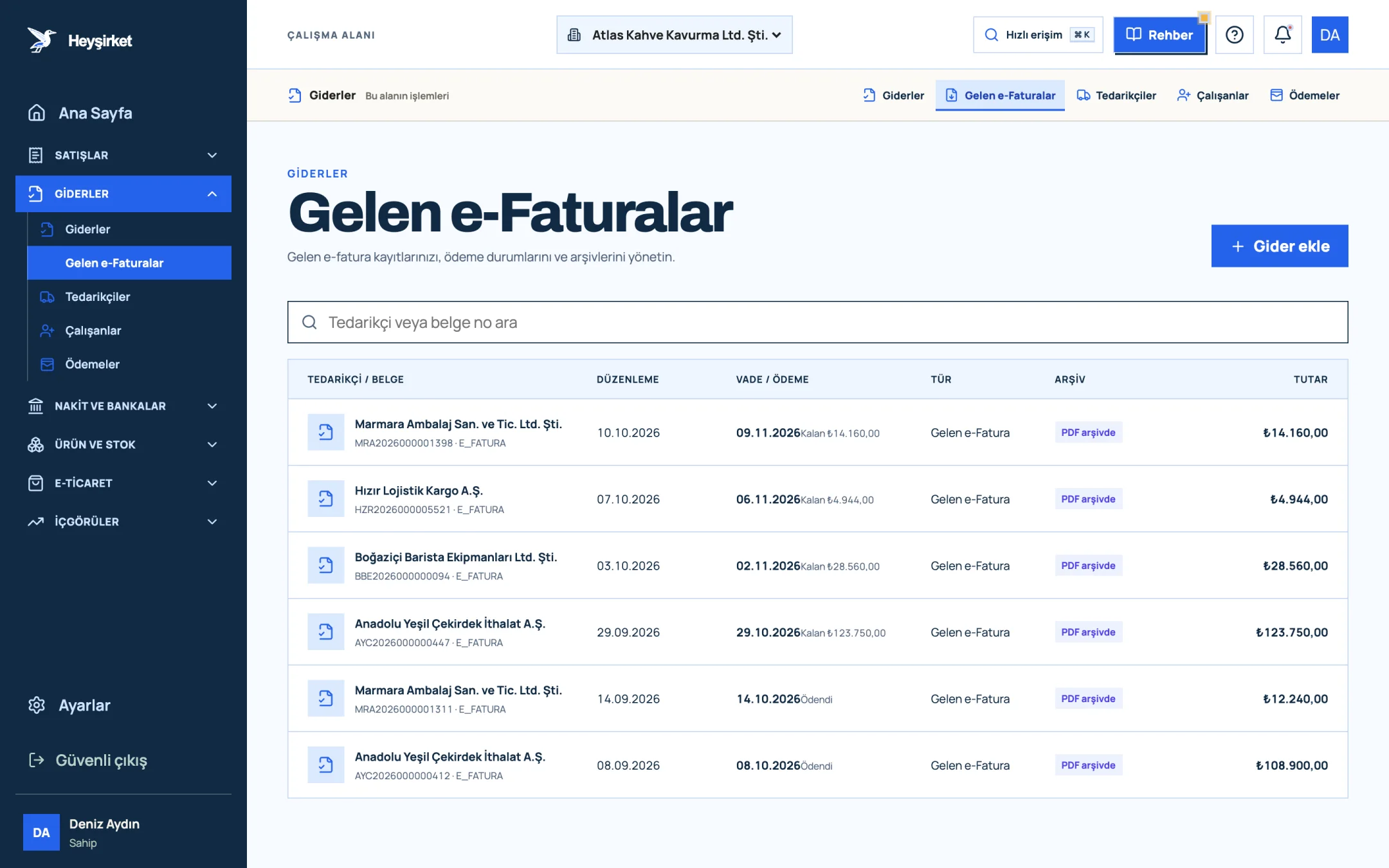
- 1. Incoming e-Faturas tab
- 2. Supplier and document number
- 3. Remaining payment amount
- 4. PDF archive status
The ledger is kept and its berat is uploaded. So how long should these files be kept?
Part 4 · Retention How many years are e-Defter files and e-documents kept?
Under Article 253 of the Tax Procedure Law, books and documents are kept for 5 years starting from the calendar year after the year they relate to. Article 82 of the Turkish Commercial Code, on the other hand, sets a 10-year retention period for commercial books and documents. In practice, the period companies should work with is 10 years.
- 5 years VUK Art. 253 · retention for tax purposes
- 10 years TTK Art. 82 · commercial books and documents
- 4th month Monthly berat upload · after the period
Electronic storage is easier than paper storage, but less forgiving. It's hard to lose a shelf; it's easy to lose a server account, a USB stick or access to your e-document provider. Remember that GİB's free portals keep documents for a limited time, and that permanent archiving is your responsibility.
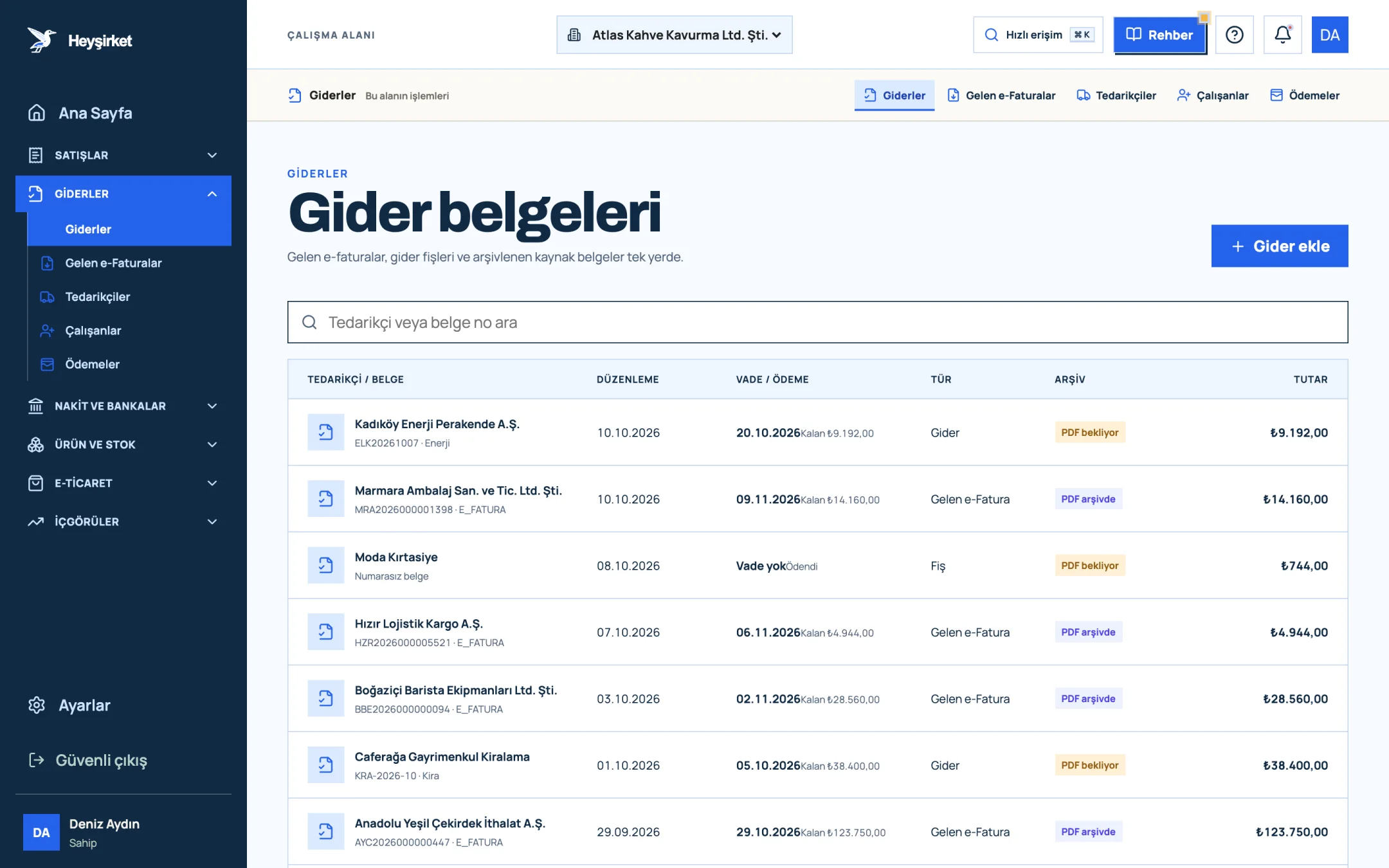
- 1. Add expense button
- 2. Due date and remaining payment
- 3. Document type (Expense, Incoming e-Fatura, Receipt)
- 4. Expense document row
Once your retention setup is in place, the real question becomes: when will the next requirement come knocking?
Part 5 · Thresholds When do you switch to e-Fatura and e-İrsaliye?
As a general rule, the obligation to switch to e-Fatura (Turkish e-invoice) arises when gross sales revenue in an accounting period exceeds 3 million TL, and the switch happens on 1 July of the year after the threshold is exceeded. For e-İrsaliye (e-dispatch note), the threshold is 10 million TL, provided you're an e-Fatura taxpayer.
The revenue calculation includes not only sales from your main activity but also sales of fixed assets. It's based on gross invoiced sales, not profit or the amount collected. That's why a year in which you sell the company car can push you over the threshold when you least expect it.
| Coffee and equipment sales | 2.640.000 TL |
|---|---|
| Barista training income | 210.000 TL |
| Sale of a vehicle registered to the business | 380.000 TL |
| General e-Fatura threshold | 3.000.000 TL |
| 2025 gross sales revenue | 3.230.000 TL |
Without the vehicle sale, revenue would have been 2.850.000 TL, below the threshold. In this example the business becomes an e-Fatura taxpayer from 1 July 2026. If the business sells online, the 500 thousand TL sector threshold may apply; confirm your own situation with your accountant.
The moment you switch to e-Fatura, two things change. First, you now issue e-Fatura, not paper or e-Arşiv invoices, to e-Fatura taxpayers. Second, the e-Defter obligation comes into play; if you're on the balance sheet basis, you're already keeping an e-Defter. We explain the difference between these two document types in detail in our article on the difference between e-Fatura and e-Arşiv.
Part 6 · Who does what Where does Heyşirket fit on the e-Dönüşüm staircase?
Heyşirket is pre-accounting software; it doesn't keep the e-Defter or file tax returns. Its job is to produce the information that goes into the books accurately and on time: issuing invoices, recording expenses, tracking payments received and made, and then getting all of it to your accountant without gaps.
| Task | Heyşirket | e-Document provider | Accountant |
|---|---|---|---|
| Issuing e-Fatura and e-Arşiv invoices | Prepares the invoice and sends it to the provider | Transmits the document to GİB, numbers and stores it | Records it |
| Incoming e-Invoices | Lists them and tracks them as expenses | Receives the document | Records it |
| Dispatch slips | Tracks stock and shipments; doesn't send them as e-İrsaliye | Issues the e-İrsaliye (for those required) | Checks it |
| e-SMM | Doesn't issue it | Issues it | Records it |
| e-Defter and berat | Doesn't keep it | May offer a storage service | Keeps and signs it, uploads the berat |
| KDV (VAT) and other returns | Provides a pre-check report | - | Prepares and files them |
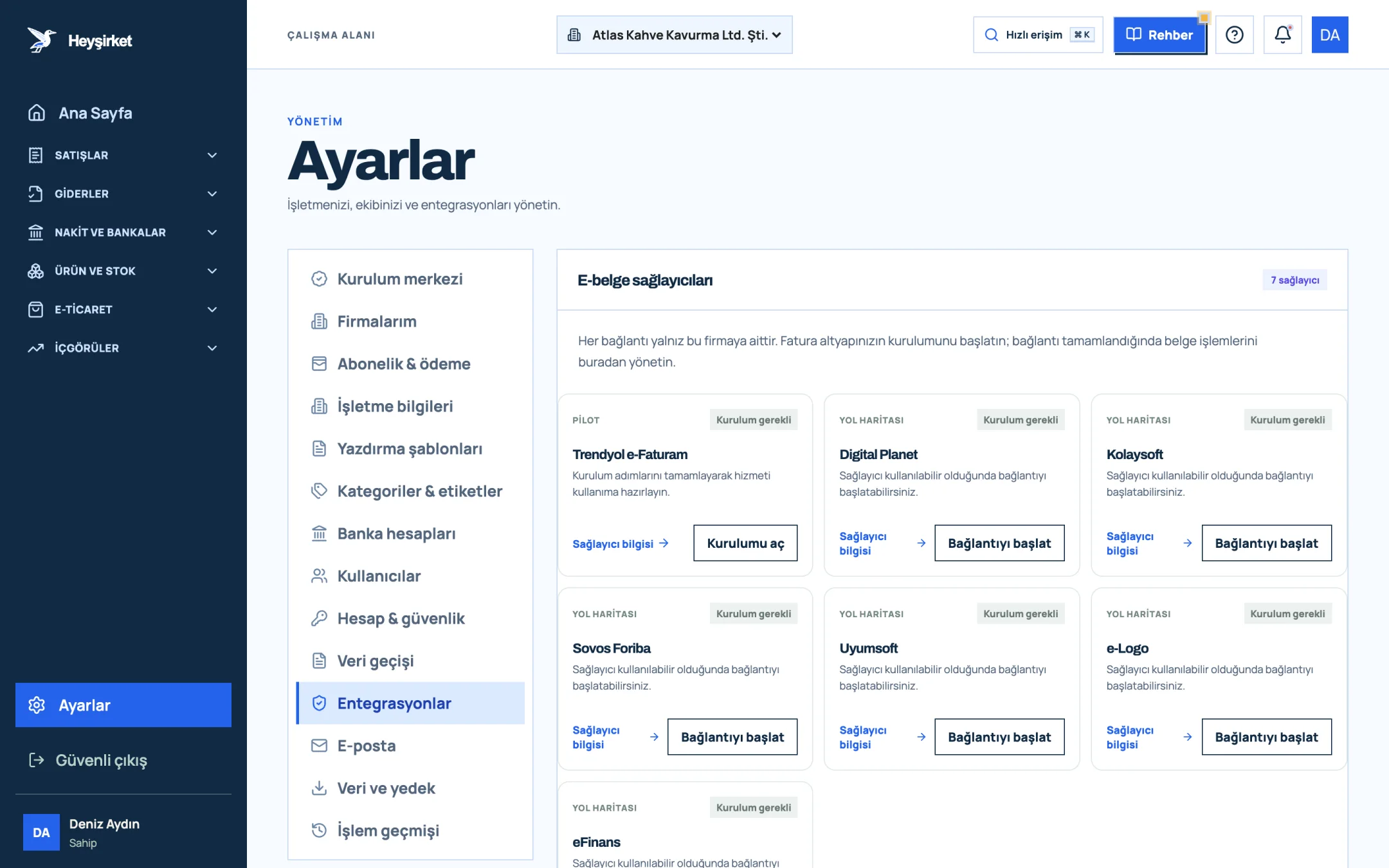
- 1. Integrations tab
- 2. Trendyol e-Faturam card
- 3. Open setup button
- 4. Other e-document providers
In Heyşirket, e-Fatura and e-Arşiv invoices are issued through the e-document provider you connect. The provider currently open for setup is Trendyol E-Faturam, which is in the pilot stage. We explain the setup steps in the e-document connection guide; note too that e-document credits are separate from your subscription and priced by the provider.
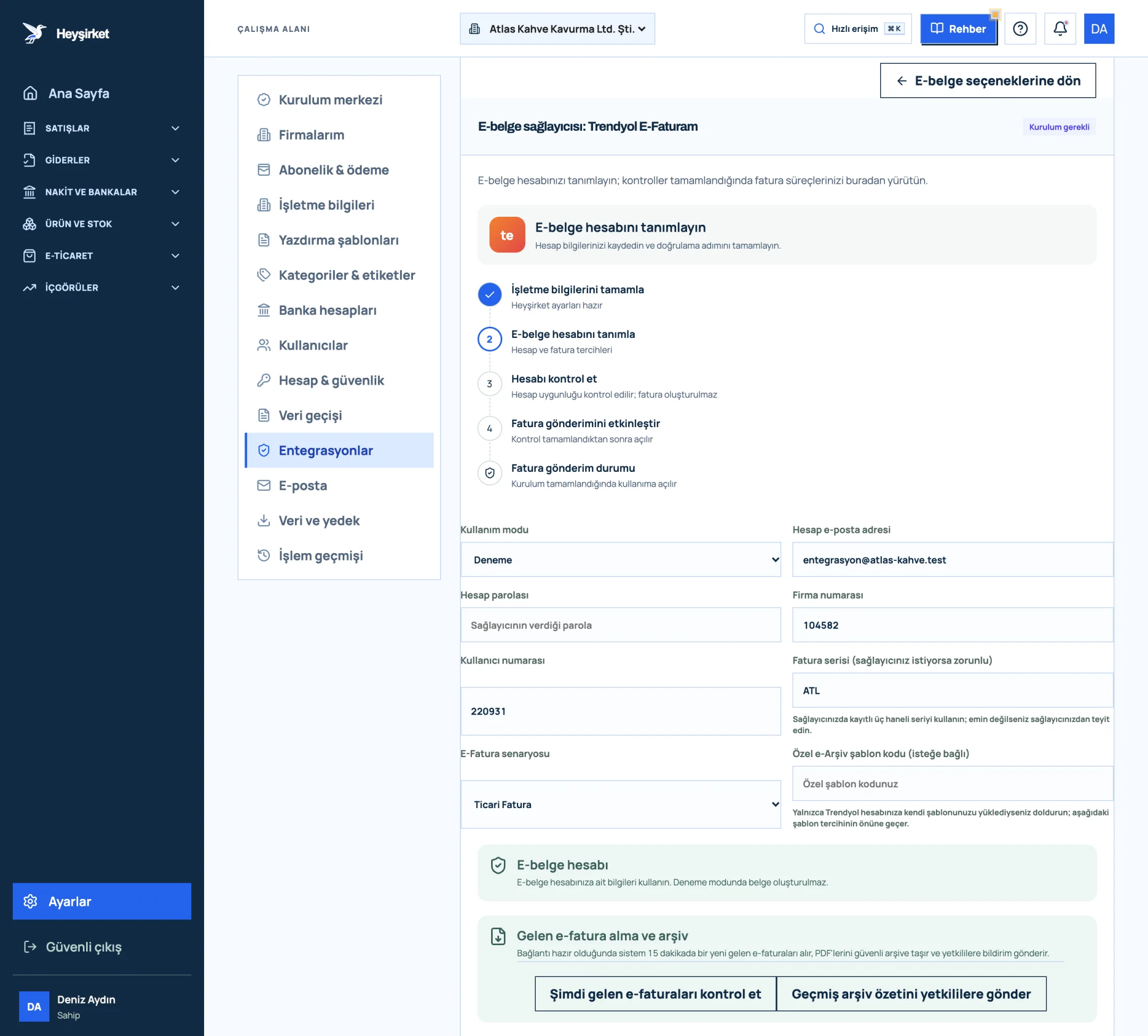
- 1. Setup steps
- 2. Usage mode (Trial / Live)
- 3. Provider account details
- 4. Invoice series
- 5. Receiving incoming e-Faturas and archive
To let your accountant close the books on time, giving them their own access to the portal is far more orderly than shuttling files by email. Heyşirket has a separate permission role for accountants.
Bring your accountant into your e-Dönüşüm setup
Invite them as a user
In Settings › Users, press the Invite user button and enter their first name, last name and email address.
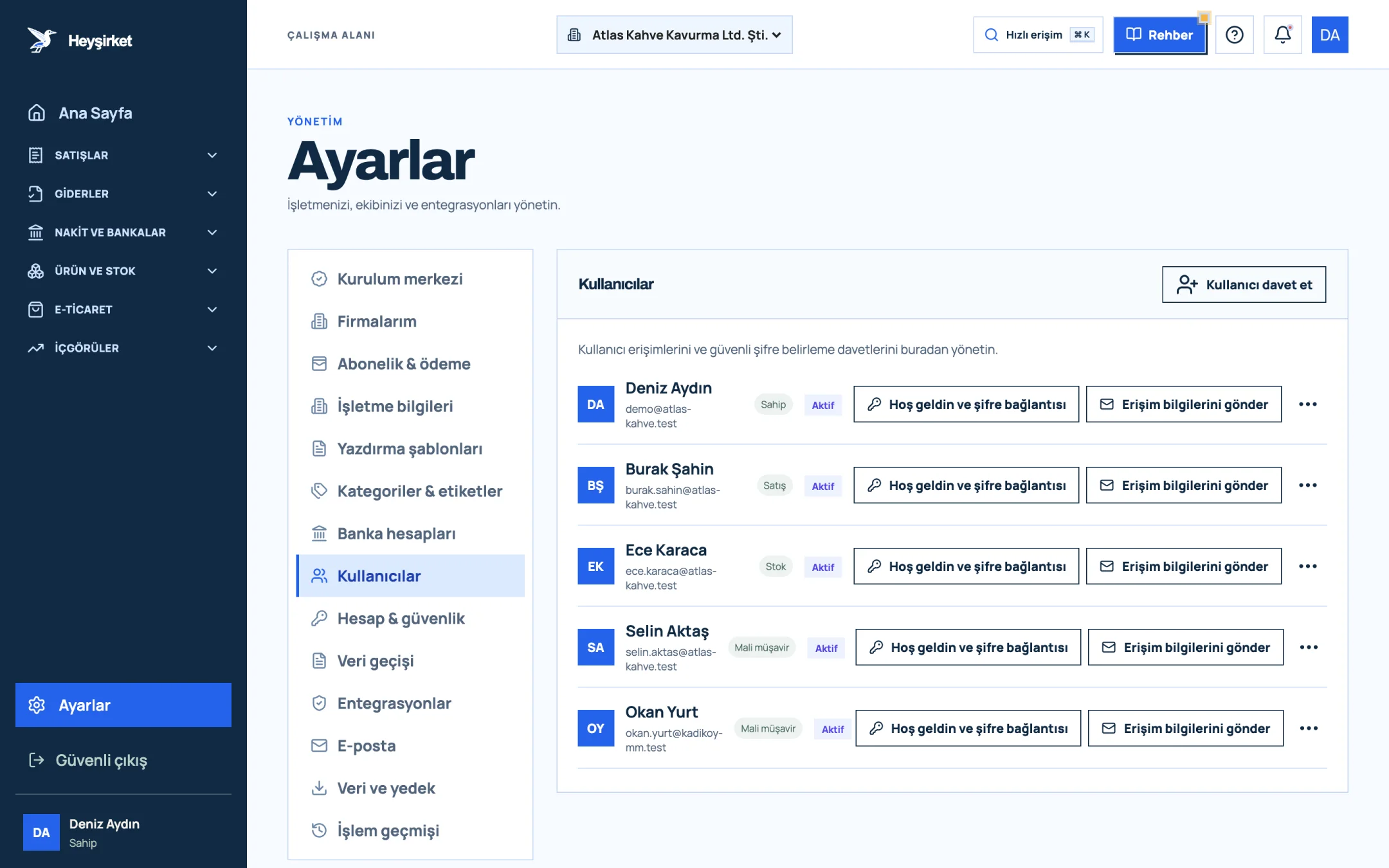
Invite them as a user - 1. Invite user
- 2. User role (Owner, Sales, Stock, Accountant)
- 3. Send access details
Choose the right role
Choose the Accountant role in the Permission role field and send the invitation with Send invitation. The user sets their own password; passwords are never sent by email.
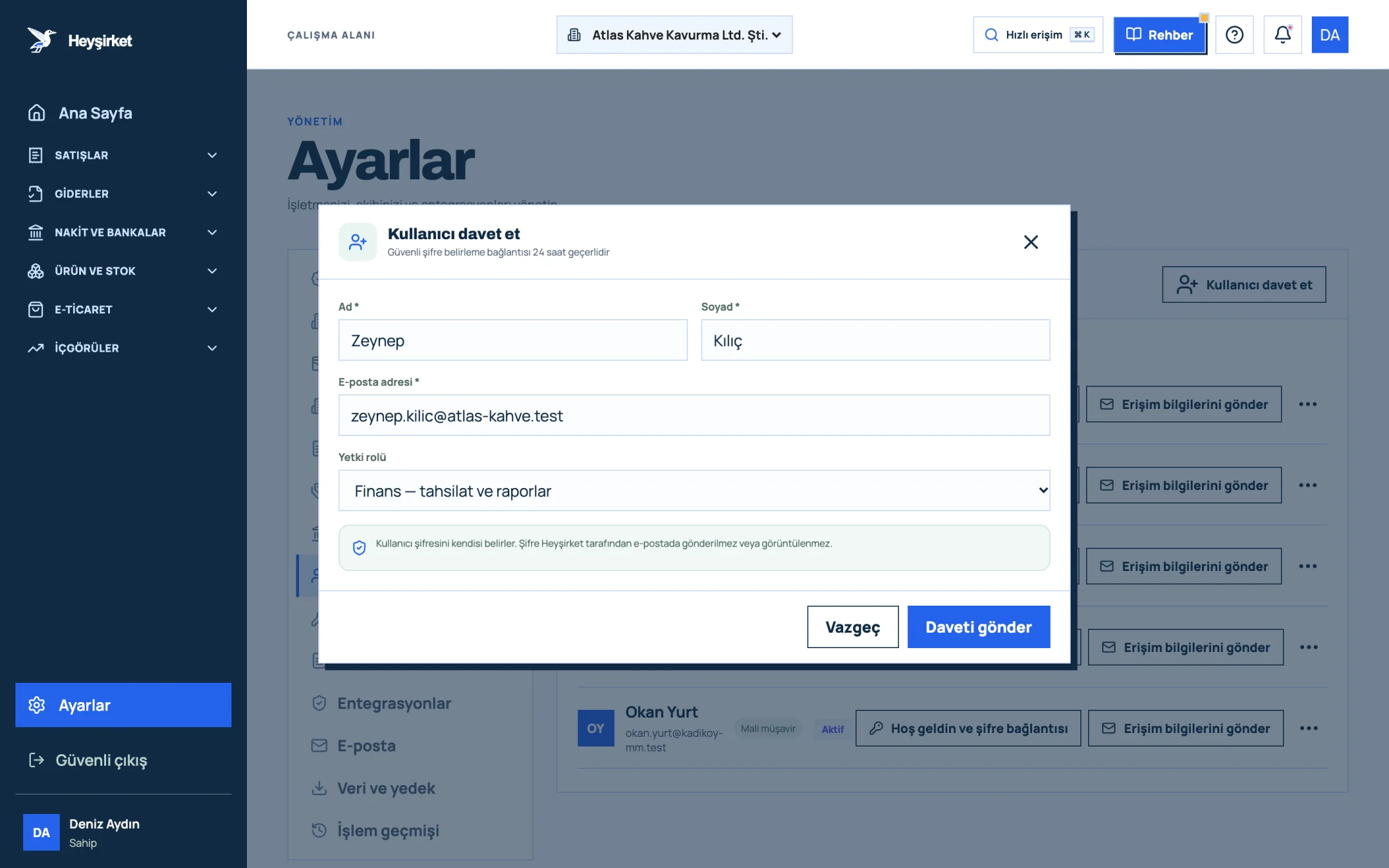
Choose the right role - 1. Invitation form
- 2. Permission role selection
- 3. Send invitation
Share the month-end reports
In the income and expense and VAT reports, choose the period and export the summaries with Download CSV; your accountant can compare these summaries with their own records when closing the books.
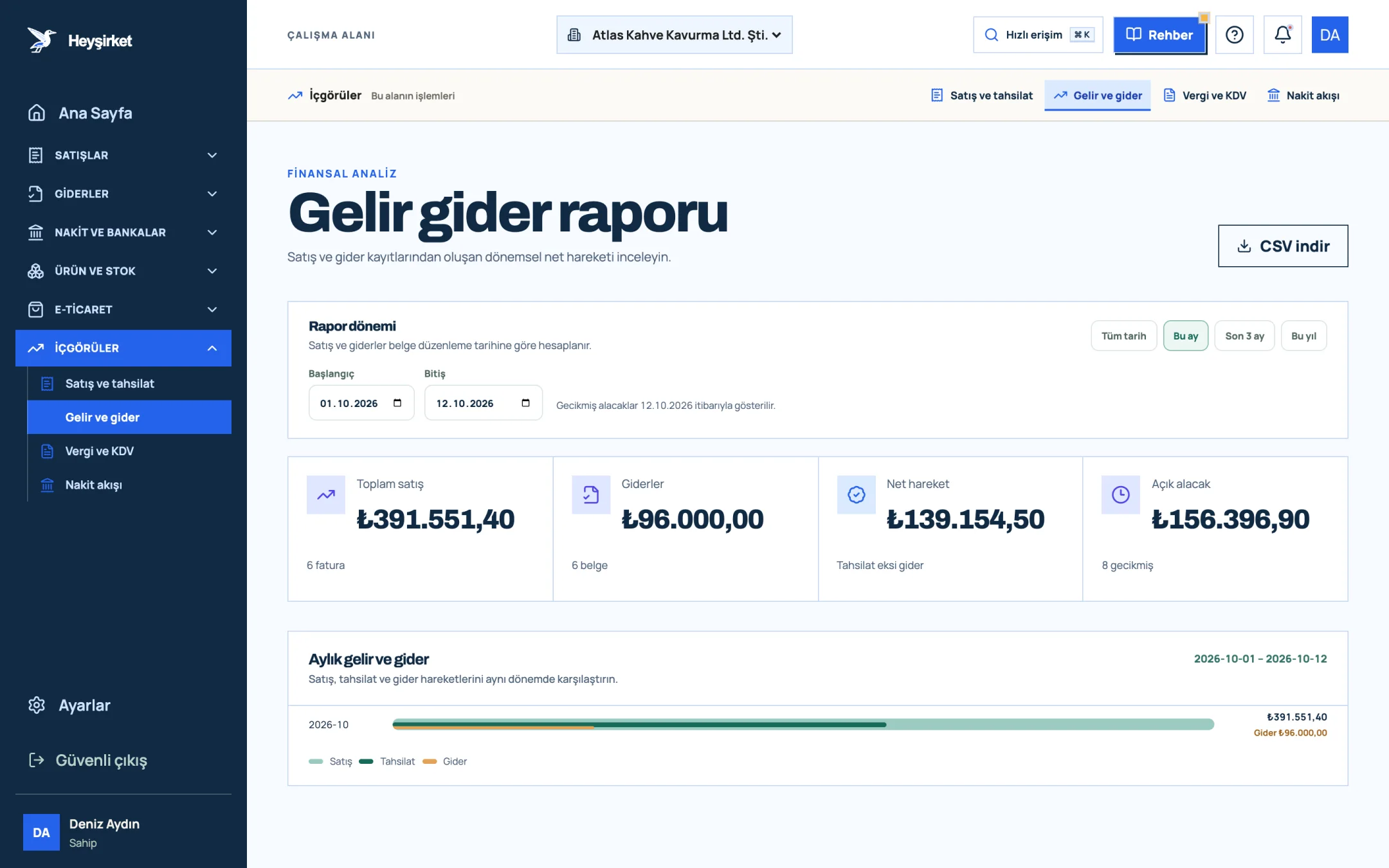
Share the month-end reports - 1. Total sales and expenses
- 2. Monthly income and expense chart
For more on this setup, see our articles on working with your accountant and the month-end closing checklist, and for team access, the team and roles guide.
Part 7 · Self-assessment Which step of the staircase are you on?
The answers to the questions we promised at the start are in the list below. Answer each item honestly with “yes” or “no”; every item you answer “I don't know” is a question to ask your accountant.
e-Dönüşüm readiness checklist
- Does my company keep books on the balance sheet basis, i.e. is it covered by e-Defter?
- I know my gross sales revenue for the last two years (including fixed asset sales).
- Is my sector subject to the 500 thousand TL e-Fatura threshold (e-commerce, real estate, motor vehicles)?
- Am I an e-Fatura taxpayer, and is my revenue approaching 10 million TL (e-İrsaliye)?
- I buy services from self-employed professionals and collect their e-SMMs regularly.
- My e-Defter berat calendar is recorded in my accountant's calendar.
- Invoices, expense documents and e-Defter files are in an archive that stays accessible for at least 10 years.
- My accountant has access to my pre-accounting records with their own user account.
When a company falls behind on e-Dönüşüm, the problem isn't technology, it's the calendar. A company that sees the threshold a year ahead makes the switch calmly on a Monday morning.
Atlas Kahve's accountant
I have a limited company; do I have to keep an e-Defter?
As a rule, limited and joint-stock companies keep books on the balance sheet basis. All taxpayers keeping books on the balance sheet basis have been covered by e-Defter since 1 January 2025. So your limited company's books are very likely already kept as an e-Defter; confirm with your accountant.
Who uploads the e-Defter berat?
In practice, your accountant keeps the e-Defter and uploads the berat to GİB through the e-Defter software or integrator they use. The obligation, however, belongs to the taxpayer, i.e. your company, so you should track the deadlines too.
Does Heyşirket keep an e-Defter?
No. Heyşirket is pre-accounting software; it doesn't keep the e-Defter or file tax returns. By keeping your invoices, expenses, and payments received and made in order, it helps your accountant close the books completely and on time.
Do I also need to use e-Arşiv in the year I switch to e-Fatura?
Yes. Once you're an e-Fatura taxpayer, you issue e-Fatura invoices to buyers registered in the e-Fatura system, and e-Arşiv invoices to unregistered buyers and end consumers. In Heyşirket, this distinction is made based on the buyer's e-document status.
Does a dispatch slip in Heyşirket replace an e-İrsaliye?
No. Outgoing dispatch slips in Heyşirket are for stock and shipment tracking and aren't sent to GİB as e-İrsaliye. If you're required to use e-İrsaliye, you need to issue the dispatch note through your e-document provider.
Does an e-Defter need notary certification?
No notary opening or closing certification is needed for a journal and general ledger kept as an e-Defter. The certification requirements under the TTK (Turkish Commercial Code) for the inventory book, share ledger, board resolution book and general assembly meeting and minutes book still apply.
Check your e-document connection Complete your provider setup for e-Fatura and e-Arşiv, and add your accountant to the team with their own role. Open e-document settings
Once e-Dönüşüm is set up, it becomes a system that runs on its own. What's left for you is to watch the thresholds a year in advance and close every month on time.
Author: Heyşirket Editorial Team