Tax · 17 min read · Updated:
Türkiye tax calendar 2026: VAT, muhtasar, provisional tax and annual returns month by month
A company's tax year is really just four fixed dates and a few annual stops on repeat. Once you've memorised them, month end stops being a scramble and becomes part of your cash plan.

In short
- The monthly routine rests on four dates: KDV (VAT) Return No. 2 on the 25th of the following month, the Muhtasar ve Prim Hizmet Beyannamesi and stamp duty on the 26th, KDV Return No. 1 on the 28th, and SGK (social security) premiums paid by the last day of the following month.
- Geçici vergi (provisional tax) is declared and paid on the 17th of the second month after each quarter; because Law No. 7566 brought back the fourth period, it is filed four times a year.
- The annual income tax return is filed by the end of March and paid in two instalments, at the end of March and July; the corporate tax return and payment are due at the end of April.
- The Ba and Bs forms were abolished from the September 2024 period by VUK General Communiqué No. 565; they are not part of the 2026 calendar.
- If a deadline falls on an official holiday, it moves to the next working day; the Ministry of Treasury and Finance can also extend deadlines by circular, so follow GİB (Turkish Revenue Administration) announcements for the exact date.
In the company's second year, Atlas Kahve's founder Deniz Hanım noticed something: tax payments were never really a “surprise”, yet every time they felt like one. Because her accountant (mali müşavir) knew the dates, and she didn't.
Yet the monthly rhythm of the Turkish tax system is surprisingly fixed. A handful of dates repeat in the same order all year. In this article we gather every important filing and payment date of 2026 into a month-by-month table.
At the end of the article, you'll also find a simple way to turn these dates into something more useful than a calendar reminder: your cash plan.
Part 1 · Basics What is a tax calendar, and why isn't “the 28th” enough on its own?
A tax calendar is the list, ordered across the year, of the legal deadlines by which a business must file returns and pay taxes. Most of these deadlines are written into tax laws as general rules; the Gelir İdaresi Başkanlığı (GİB, Turkish Revenue Administration) then turns these rules into concrete dates each year.
Many business owners only know that VAT is due on “the 28th”. But in the same month there's withholding VAT on the 25th, muhtasar and stamp duty on the 26th, and SGK premiums at month end. Every three months, provisional tax is added to these.
- 25 KDV Return No. 2 (as responsible party) filing and payment day
- 26 Muhtasar ve prim hizmet, stamp duty
- 28 KDV Return No. 1 filing and payment day
- 17 Provisional tax (2nd month after the quarter)
These four numbers carry almost the entire year's calendar. Let's look at what each one is in turn, starting with the one you'll meet most often.
Part 2 · The monthly rhythm Which returns are filed every month?
Monthly returns are those whose tax period is a calendar month and which are filed during the month after the period. For a limited company or a business keeping books on a balance-sheet basis, these are typically the VAT, muhtasar ve prim hizmet and stamp duty returns.
| Return | What does it cover? | Deadline | Payment |
|---|---|---|---|
| KDV Return No. 2 | VAT paid by the buyer as the responsible party (withholding, services from abroad) | 25th | Same day |
| Muhtasar ve prim hizmet (MPHB, combined withholding & social security return) | Income tax withheld from wages, rent and freelance payments, plus the SGK declaration | 26th | Tax on the 26th; SGK premiums by the last day of the month |
| Stamp duty | Stamp duty arising on documents such as contracts and payrolls | 26th | Same day |
| KDV Return No. 1 | The difference between output VAT on your sales and deductible VAT on your purchases | 28th | Same day |
If you're curious about how VAT works in detail, our VAT guide explains output, deductible and carried-forward VAT with examples. You'll find why tevkifat (VAT withholding) and stopaj (income tax withholding) create the 25th and 26th in our tevkifat and stopaj article.
There's a small exception for the muhtasar return. Many small employers who don't know about it think they have to declare tax withholding every month unnecessarily.
Who can file the muhtasar quarterly?
Employers with between 1 and 10 employees can choose to declare their tax withholding once every three months. In that case the SGK declaration is still made every month; only the tax side is declared together for the March, June, September and December periods. Clarify the conditions for this option and how to notify the tax office with your accountant.
Part 3 · Quarters Why is provisional tax filed four times a year in 2026?
Geçici vergi (provisional tax) is the tax that income and corporate tax payers pay in advance on their quarterly profits during the year, and which is offset on the annual return at year end. It is declared by the 17th of the second month after each quarter and paid the same day.
In 2021, Law No. 7338 abolished the fourth provisional tax period. Law No. 7566, published in the Resmî Gazete (Official Gazette) on 19 Aralık 2025, brought this period back; the return for the last quarter of 2025 was filed on 17 Şubat 2026. So in 2026 there are four provisional tax stops on your company's calendar.
| Period | Months covered | Filing and payment |
|---|---|---|
| 2025 Q4 | Ekim - Aralık 2025 | 17 Şubat 2026 |
| 2026 Q1 | Ocak - Mart | 18 Mayıs 2026 (17 Mayıs is a Sunday) |
| 2026 Q2 | Nisan - Haziran | 17 Ağustos 2026 |
| 2026 Q3 | Temmuz - Eylül | 17 Kasım 2026 |
| 2026 Q4 | Ekim - Aralık | 17 Şubat 2027 (under the general rule) |
For a quarter-end estimate, Heyşirket's income and expenses report is a good starting point. But note: this report shows your recorded sales, collections and expenses, not accounting profit.
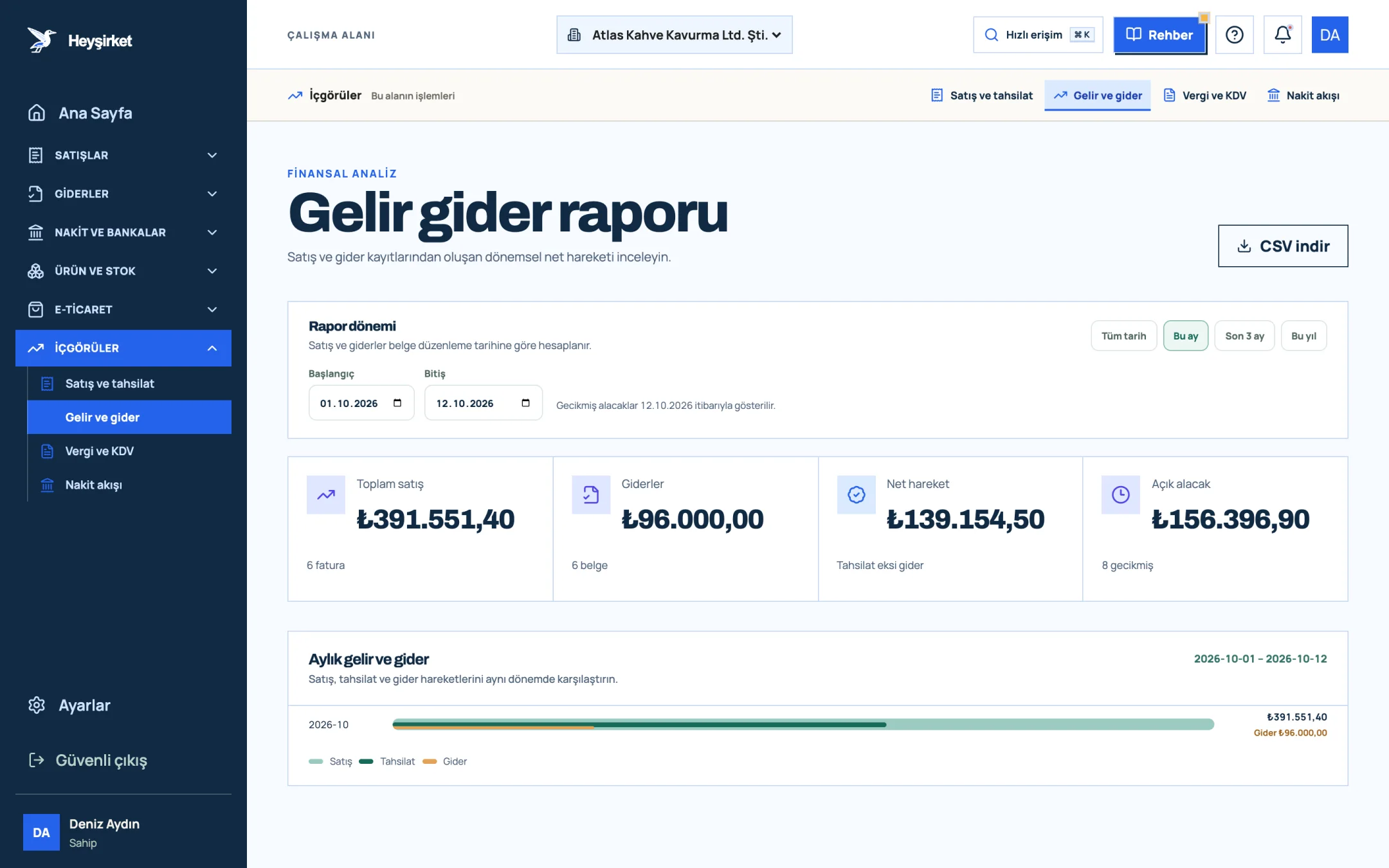
- 1. Total sales and expenses
- 2. Monthly income and expense chart
We've worked out the monthly and quarterly rhythm. So when are the returns that come only once a year, but carry the largest amounts?
Part 4 · Annual stops When are annual income tax and corporate tax returns filed?
The annual income tax return is the return on which sole proprietorships and other income tax payers declare the previous year's profit; it is filed by the end of March. The corporate tax return is the return on which capital companies declare their annual profit, and it is filed by the end of April.
| Tax | Who files? | Filing | Payment |
|---|---|---|---|
| Annual income tax | Sole proprietorships, self-employed professionals, those declaring rental income | 1-31 Mart 2026 | Two instalments: end of March and July |
| Corporate tax | Limited and joint-stock companies | 1-30 Nisan 2026 | In one go, end of April |
| Motor vehicle tax (MTV) | Owners of vehicles registered in the company's name | No return | End of January and July, two instalments |
| Property tax | Property owners (to the municipality) | Return only on changes | End of May and November, two instalments |
On annual returns, the provisional taxes and withholdings paid during the year are offset against the amount due. So paying provisional tax regularly is also your guarantee against facing one large payment in April.
If you're curious about the tax difference between a sole proprietorship and a limited company, our sole proprietorship or limited company article compares the calendars of both structures.
Part 5 · Off the calendar Are Ba-Bs forms still filed in 2026?
No. The Form Ba and Form Bs notifications were abolished by VUK General Communiqué No. 565, published in the Resmî Gazete on 25 Eylül 2024, and haven't been filed since the September 2024 period. So the month-end Ba-Bs date no longer appears on the 2026 calendar.
The reasoning is simple: as e-Fatura and e-Arşiv have become widespread, the administration already sees electronically which company sold what to whom. That's a convenience, but also a warning: inconsistencies in your documents can now be spotted without waiting for a notification.
Part 6 · The table What does the 2026 tax calendar look like month by month?
The table below shows which obligations fall due in each month of 2026 for a typical limited company. The returns in each row relate to the previous month's period; dates follow the general rule, and holidays and extensions apply separately.
| Month | 25th | 26th | 28th | Extra stop |
|---|---|---|---|---|
| January | KDV-2 (December) | MPHB, stamp duty (December) | KDV-1 (December) | MTV 1st instalment, month end |
| February | KDV-2 (January) | MPHB, stamp duty (January) | KDV-1 (January) | 17 February: 2025 Q4 provisional tax |
| March | KDV-2 (February) | MPHB, stamp duty (February) | KDV-1 (February) | 31 March: annual income tax return and 1st instalment |
| April | KDV-2 (March) | MPHB, stamp duty (March); quarterly muhtasar | KDV-1 (March) | 30 April: corporate tax |
| May | KDV-2 (April) | MPHB, stamp duty (April) | KDV-1 (April) | 18 May: Q1 provisional tax; property tax 1st instalment |
| June | KDV-2 (May) | MPHB, stamp duty (May) | KDV-1 (May) | — |
| July | KDV-2 (June) | MPHB, stamp duty (June); quarterly muhtasar | KDV-1 (June) | Income tax 2nd instalment and MTV 2nd instalment, month end |
| August | KDV-2 (July) | MPHB, stamp duty (July) | KDV-1 (July) | 17 August: Q2 provisional tax |
| September | KDV-2 (August) | MPHB, stamp duty (August) | KDV-1 (August) | — |
| October | KDV-2 (September) | MPHB, stamp duty (September); quarterly muhtasar | KDV-1 (September) | — |
| November | KDV-2 (October) | MPHB, stamp duty (October) | KDV-1 (October) | 17 November: Q3 provisional tax; property tax 2nd instalment |
| December | KDV-2 (November) | MPHB, stamp duty (November) | KDV-1 (November) | Year-end stock count and closing preparation |
One look at the table reveals something: February, May, August and November are the “heavy” months. In these months provisional tax is added to the monthly taxes, and cash needs rise noticeably.
Knowing the dates is half the job. The other half is knowing in advance how much you'll pay on those dates. That's where the real difference is made.
Part 7 · Estimating How do you estimate the amount due before the 28th?
A tax estimate means working out the approximate payment from your own sales and expense records without waiting for the filing period. Your accountant calculates the exact figure; your aim is for that figure not to be a surprise.
- Throughout the month — Invoices and expenses are recorded
- The 15th — Interim VAT estimate
- Month end — Documents completed and sent to the accountant
- The 22nd of the following month — Tax money set aside
- 25-26-28 — Returns filed, payments made
In Heyşirket, this cycle has two screens. The first is the overview screen you see when you open the portal: you see the month's sales, collections and expenses at a glance.
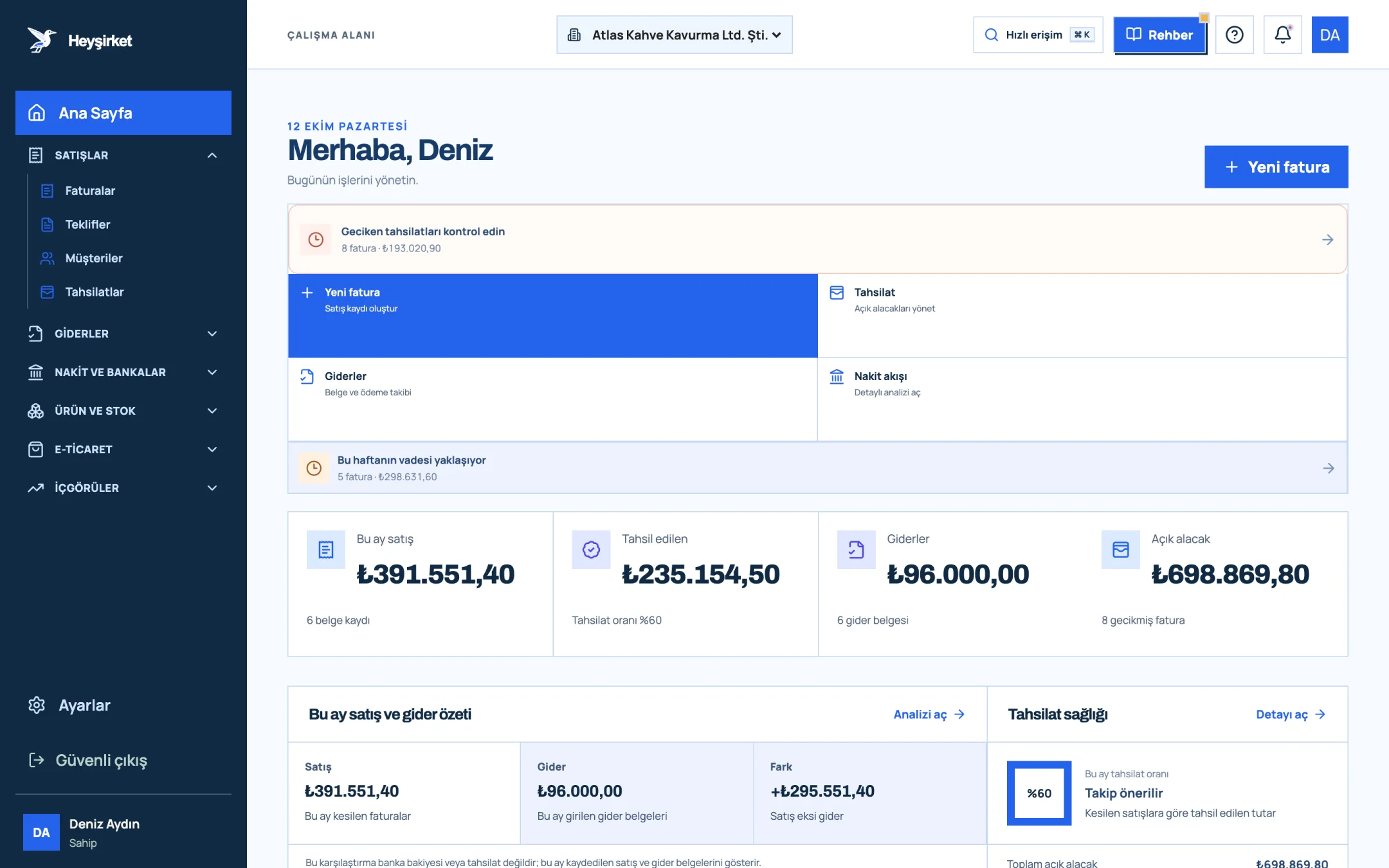
- 1. Create new invoice button
- 2. Overdue collections alert
- 3. Sales invoiced this month
- 4. Total open receivables
The second is the Tax and VAT report in the Insights group. This screen totals the output VAT calculated from your sales documents and the deductible VAT from your expense documents, and shows the result on the Net VAT card.
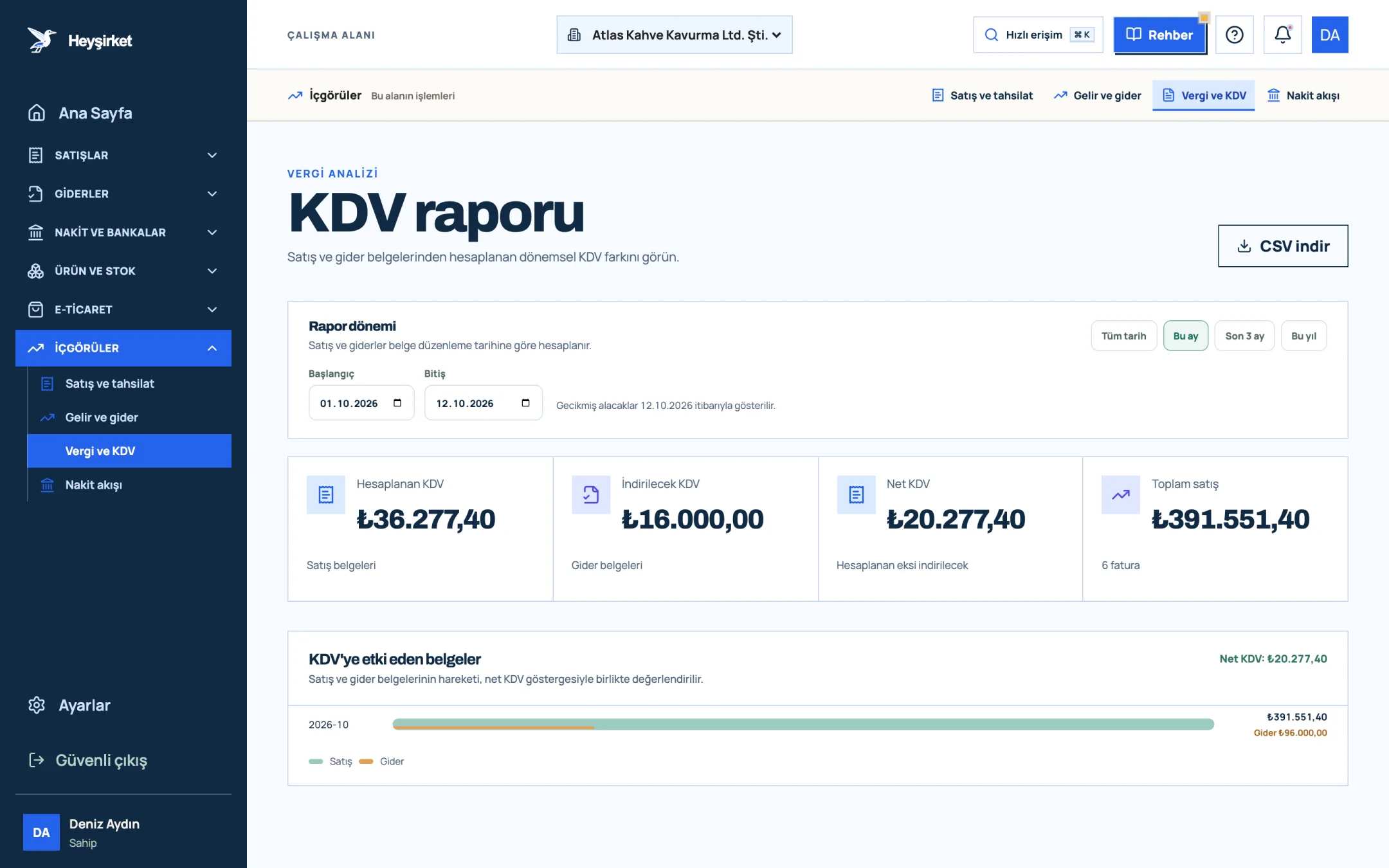
- 1. Output VAT
- 2. Deductible VAT
- 3. Net VAT
| Output VAT (sales documents) | 36.277,40 TL |
|---|---|
| Deductible VAT (expense documents) | − 16.000,00 TL |
| Net VAT in the report | 20.277,40 TL |
| VAT carried forward from the previous period (from the accountant) | − 0,00 TL |
| Estimated amount to set aside for 28 November | ≈ 20.300 TL and rising |
Because the month isn't over yet, the amount will change with sales and expenses over the rest of the month. The report doesn't separately strip out carried-forward VAT, withholding or non-deductible VAT, so the result is an estimate; the return sets the exact amount.
For a screen-by-screen walkthrough of the report, see the VAT report guide. To add this estimate to your cash plan, the cash flow report is a good companion.
Part 8 · The system What routine should you set up so you never miss a deadline?
The way to never miss a tax deadline is to get the documents ready on time, not the return. Accountants usually prepare returns in the last few days; a late expense document means VAT you didn't deduct, or an amended return.
If a return isn't filed on time, an irregularity penalty (usulsüzlük cezası) applies; if tax isn't paid on time, late payment interest (gecikme zammı) accrues. In some cases, a VAT return not filed on time can also call the right to deduct into question. In short, the cost of being late can exceed the tax due.
Monthly tax preparation checklist
- As of the last day of the month, have all sales invoices been issued, with cancellations and returns separated?
- Have expense documents and receipts been entered on the Expenses screen with the correct VAT rate?
- Has the Incoming e-Invoices list been checked against supplier invoices?
- Have purchases with withholding and payments with stopaj (rent, freelance fees) been reported separately to your accountant?
- Were staff starters, leavers and wage details sent in the first week of the month?
- Has the Net VAT estimate in the VAT report been compared with your accountant's figure?
- Is the amount set aside for the 25th, 26th and 28th ready in the bank?
- In quarter-end months (March, June, September, December), has a provisional tax estimate been requested?
We explained in detail in what order and when to send documents to your accountant in working with an accountant, and the month-end closing steps in our month-end closing checklist.
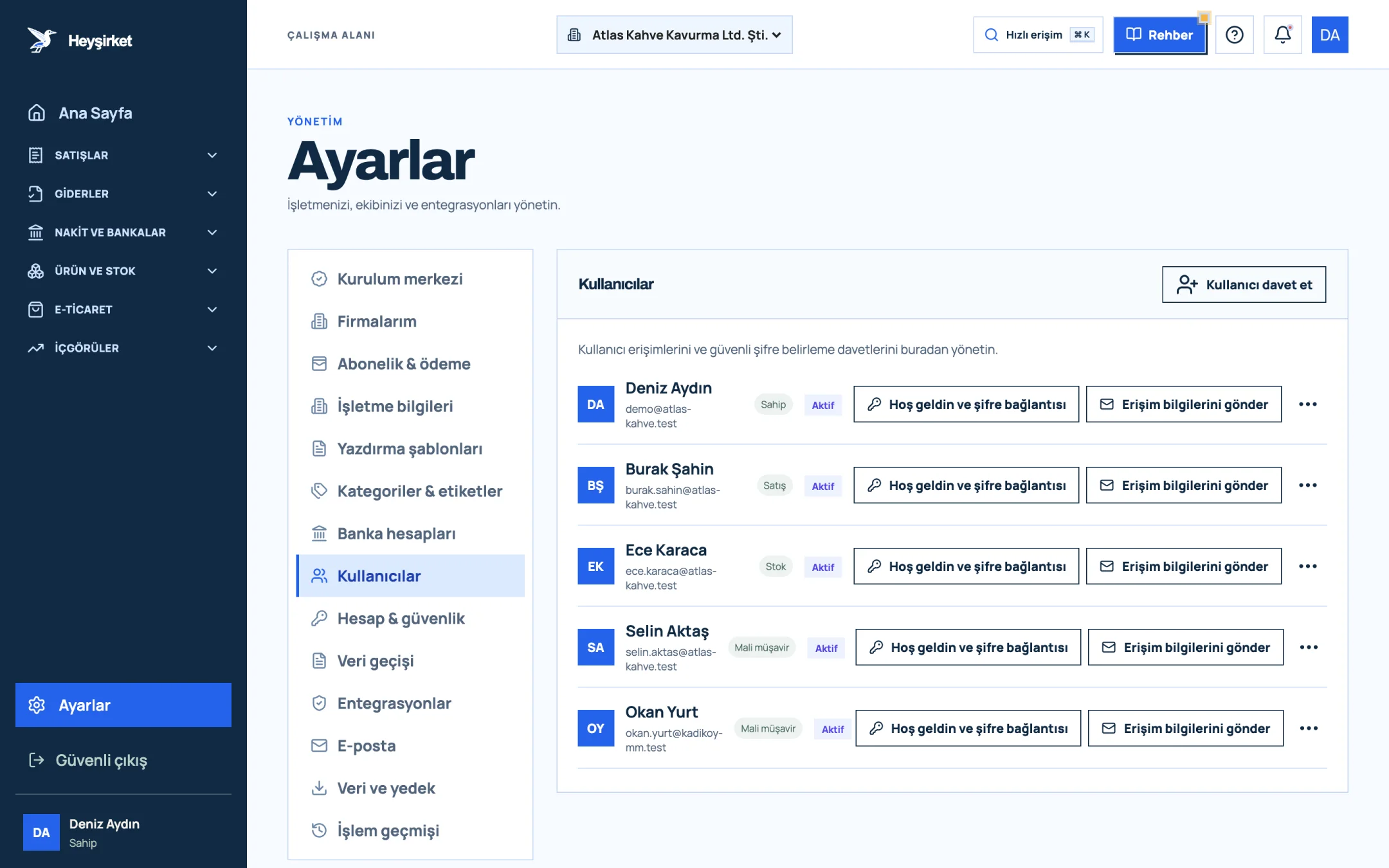
- 1. Invite user
- 2. User role (Owner, Sales, Stock, Accountant)
- 3. Send access details
The tax calendar isn't a list of burdens; it's the skeleton of your cash plan. A business that knows the dates also sets its money aside in advance.
Heyşirket knowledge center
Is the VAT return filed every month, even with no sales?
Yes. For VAT taxpayers the tax period is, as a rule, monthly, and KDV Return No. 1 is filed by the 28th of the following month even if there were no transactions that month. There may be nothing to pay, but if the return isn't filed, an irregularity penalty applies.
Are the SGK premiums on the muhtasar ve prim hizmet return also paid on the 26th?
No. The return and the payment of withheld income tax are due on the 26th of the following month; SGK premiums are paid by the last day of the following month. Track the two payments as separate lines in your cash plan.
Wasn't fourth-period provisional tax abolished?
It was abolished in 2021 by Law No. 7338. It was brought back by Law No. 7566, published in the Resmî Gazete on 19 Aralık 2025; the return for the last quarter of 2025 was filed on 17 Şubat 2026. For the last quarter of 2026, filing is also expected on 17 Şubat 2027 under the general rule.
What happens if the deadline falls on a weekend?
Under VUK Article 18, the period is extended to the end of working hours on the next working day. For example, because 17 Mayıs 2026 was a Sunday, the first-period provisional tax was filed on 18 Mayıs. The Ministry can also extend deadlines by circular, so checking GİB announcements towards month end is a good habit.
Will I be penalised for not filing the Ba-Bs form?
Since Ba-Bs notifications were abolished for September 2024 and later periods, no penalty applies. Missing notifications for periods before September 2024, however, may still matter within the statute of limitations; check these periods with your accountant.
Does Heyşirket remind me of tax deadlines?
Heyşirket doesn't have a tax calendar reminder. Instead, you can estimate the VAT due in advance with the Tax and VAT report and add your accountant to your team so documents are visible on time. Use your calendar app for date reminders.
See this month's VAT estimate now Open the Tax and VAT report with the This month range; the Net VAT card gives a first estimate of the amount to set aside for the 28th. Open VAT report
Author: Heyşirket Editorial Team