Tax · 10 min read · Updated:
Calculating VAT-inclusive and VAT-exclusive prices in Türkiye: formulas and examples for 2026
Taking VAT out of a price isn't the same operation as adding it. We show both directions with their formulas, the 2026 rates and real figures.
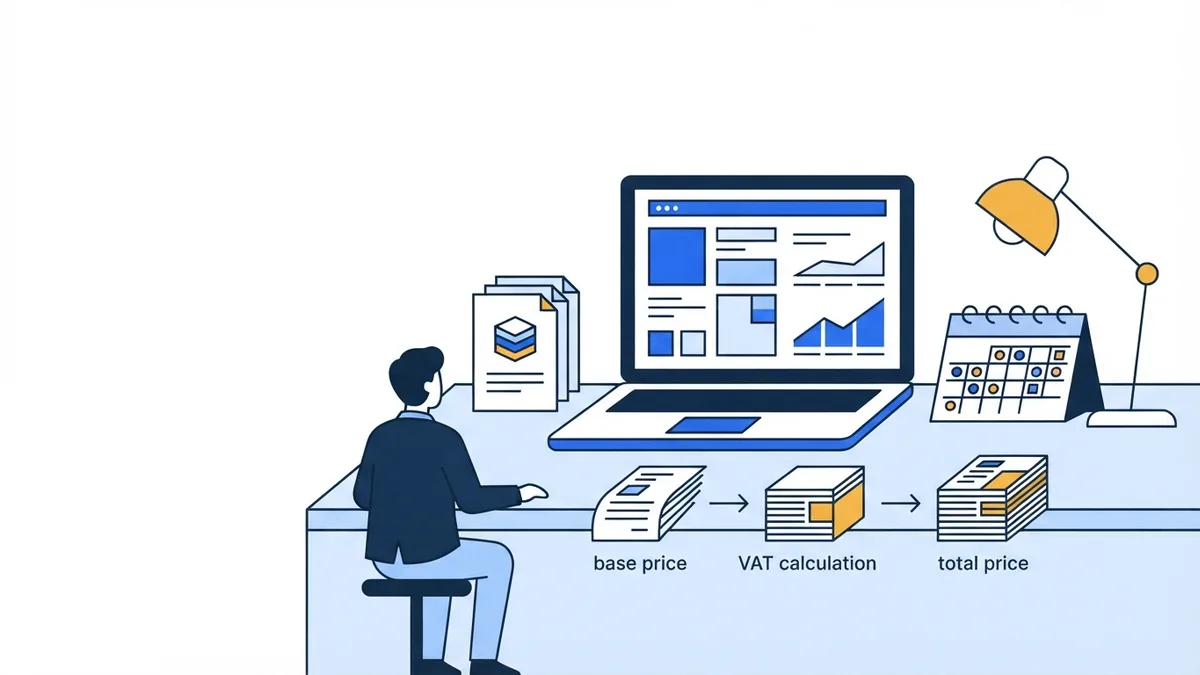
In short
- In 2026 Türkiye applies three KDV (VAT) rates: the standard rate of 20% and reduced rates of 10% and 1%.
- A VAT-inclusive price is found by multiplying the VAT-exclusive price by (1 + rate): for 20%, VAT-exclusive price × 1.20.
- A VAT-exclusive price is found by dividing the VAT-inclusive price by (1 + rate): for 20%, VAT-inclusive price ÷ 1.20; multiplying the inclusive price by 0.80 gives the wrong result.
- The VAT inside a VAT-inclusive amount is one sixth of it at 20%, one eleventh at 10% and one hundred-and-first at 1%.
- Discounts are applied before VAT: VAT is calculated on the taxable amount left after the discount.
A customer asks "How much is it including VAT?", a supplier quotes excluding VAT, and you work out whether the two figures say the same thing. VAT calculation looks simple, but done in reverse it often comes out wrong.
The most common mistake is multiplying a VAT-inclusive price by 0.80 to take the VAT out. This overstates the VAT every time. In this article we give the formulas for both directions, ready-made multipliers for the 2026 rates and step-by-step examples.
- VAT-exclusive price — Taxable amount
- × (1 + rate) — VAT added
- VAT-inclusive price — What the customer pays
- ÷ (1 + rate) — VAT separated
Part 1 · Rates What are the VAT rates in 2026?
In 2026 Türkiye applies three KDV (Turkish VAT) rates: the standard rate of 20%, and reduced rates of 10% and 1%. These rates haven't changed since 10 July 2023. Which product falls under which rate is set by the lists attached to the VAT Law and by presidential decisions.
- 20% Standard rate · most goods and services
- 10% Reduced · e.g. food and drink services
- 1% Reduced · e.g. some basic foods
Part 2 · Adding VAT How do you calculate a VAT-inclusive price?
Adding VAT to a VAT-exclusive price is the easy direction. The VAT amount is the exclusive price times the rate, and the inclusive price is the sum of the two. To do it in one step, multiply the exclusive price by (1 + rate).
- VAT amount = VAT-exclusive price × rate
- VAT-inclusive price = VAT-exclusive price × (1 + rate)
- The multiplier is 1.20 for 20%, 1.10 for 10% and 1.01 for 1%
| VAT-exclusive price | 2,500.00 TL |
|---|---|
| VAT (2,500 × 0.20) | 500.00 TL |
| VAT-inclusive price (2,500 × 1.20) | 3,000.00 TL |
| VAT-exclusive price | 1,500.00 TL |
|---|---|
| VAT (1,500 × 0.10) | 150.00 TL |
| VAT-inclusive price (1,500 × 1.10) | 1,650.00 TL |
Part 3 · Separating VAT What is the VAT-exclusive formula?
To find the VAT-exclusive price from a VAT-inclusive one, you divide the price by (1 + rate). You don't multiply. That's because VAT is a percentage of the exclusive price, not the inclusive one. VAT's share inside the inclusive price is smaller than the rate itself.
- VAT-exclusive price = VAT-inclusive price ÷ (1 + rate)
- VAT amount = VAT-inclusive price − VAT-exclusive price
- The divisor is 1.20 for 20%, 1.10 for 10% and 1.01 for 1%
| VAT-inclusive price | 3,000.00 TL |
|---|---|
| VAT-exclusive price (3,000 ÷ 1.20) | 2,500.00 TL |
| VAT included (3,000 − 2,500) | 500.00 TL |
| VAT-inclusive price | 505.00 TL |
|---|---|
| VAT-exclusive price (505 ÷ 1.01) | 500.00 TL |
| VAT included (505 − 500) | 5.00 TL |
Part 4 · Shortcut Ready-made multipliers by rate
Instead of typing the formula into a calculator each time, you can use the multipliers below. The last column lets you find the VAT inside a VAT-inclusive amount in one operation.
| Rate | Exclusive to inclusive | Inclusive to exclusive | VAT inside an inclusive amount |
|---|---|---|---|
| 20% | × 1.20 | ÷ 1.20 | Inclusive amount ÷ 6 (i.e. 20/120) |
| 10% | × 1.10 | ÷ 1.10 | Inclusive amount ÷ 11 (i.e. 10/110) |
| 1% | × 1.01 | ÷ 1.01 | Inclusive amount ÷ 101 (i.e. 1/101) |
For example, the VAT inside a 1,200 TL invoice including 20% VAT is 1,200 ÷ 6 = 200 TL; the VAT-exclusive amount is 1,000 TL. The VAT inside 1,650 TL including 10% VAT is 1,650 ÷ 11 = 150 TL.
Part 5 · In practice Real-life examples: subscriptions, discounts and rounding
Once the formula sticks, everyday calculations speed up. The three examples below show the situations you'll meet most often.
| Monthly subscription fee (VAT included) | 699.99 TL |
|---|---|
| VAT-exclusive amount (699.99 ÷ 1.20) | 583.33 TL |
| 20% VAT included (699.99 − 583.33) | 116.66 TL |
The figures are the monthly price of Heyşirket's Professional plan. The exact result is 583.325 TL, so it's rounded to the nearest kuruş.
With a discount, the order matters. VAT is calculated on the amount left after the discount, i.e. the taxable amount. Adding VAT first and discounting afterwards shows a different taxable amount on the invoice.
| List price (VAT excluded) | 1,000.00 TL |
|---|---|
| Discount (10%) | −100.00 TL |
| Taxable amount | 900.00 TL |
| VAT (20% × 900) | 180.00 TL |
| Invoice total | 1,080.00 TL |
Kuruş (cent) differences are common too. On a multi-line invoice, VAT is calculated and rounded on each line separately, then added up. Compared with VAT calculated once on the total, there can be a 1-2 kuruş difference. It isn't an error, but knowing this avoids arguments when reconciling with the other party.
Which figure do you use to calculate profit?
Always calculate your profit with VAT-exclusive amounts. The VAT you collect from customers isn't your income; you declare and pay it. The VAT you pay on purchases, if it can be deducted, isn't your cost either. Subtracting a VAT-inclusive purchase price from a VAT-inclusive sale price overstates your profit.
| Sale price (VAT included, 20%) | 1,200.00 TL |
|---|---|
| Sale price (VAT excluded, 1,200 ÷ 1.20) | 1,000.00 TL |
| Purchase cost (VAT excluded) | 700.00 TL |
| Gross profit | 300.00 TL |
Calculated with VAT-inclusive figures (1,200 − 840), the profit would look like 360 TL. Figures are an example.
Part 6 · Exception Does the VAT calculation change on an invoice with withholding?
For some services and supplies, part of the VAT is declared and paid by the buyer, not the seller. This is called VAT withholding (KDV tevkifatı). The VAT is still calculated with the same formula, but part of the VAT on the invoice is withheld, and the amount the buyer pays you is lower than the invoice total.
Withholding rates vary by type of work and change often. We explain where it applies and why the invoice amount doesn't match what's paid, with examples, in VAT withholding and stopaj.
Part 7 · Product How is VAT calculated in Heyşirket?
In Heyşirket, pre-accounting is a module of your company panel, and you don't calculate the VAT on an invoice yourself. On the new invoice screen you enter each line's unit price excluding VAT and choose the VAT rate on the line. The line total, total VAT and grand total are calculated automatically, and items with different rates can sit side by side on the same invoice.
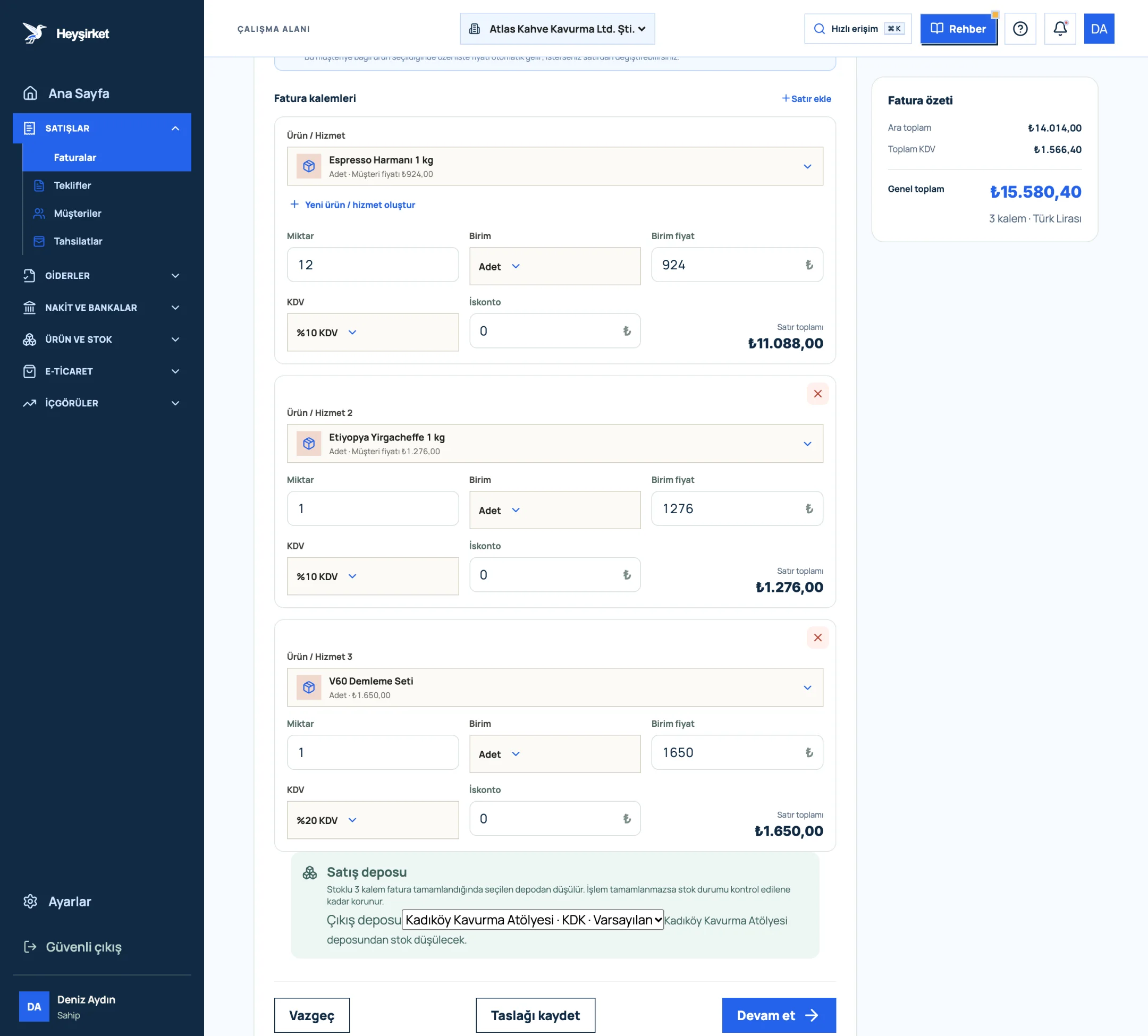
- 1. First invoice line item
- 2. VAT rate selection
- 3. Add row
- 4. Invoice summary and VAT total
- Product card: when adding a product or service, you enter its unit price and VAT rate once; when you pick the product on an invoice, both come in automatically.
- If you have a VAT-inclusive price: divide it by (1 + rate) using the formula in this article and enter the result as the VAT-exclusive unit price.
- VAT report: shows the period's output VAT (sales), input VAT (expenses) and the net VAT between them before the filing date.
The steps for issuing an invoice are in how to issue an invoice, and seeing the VAT you'll pay in advance is covered in the VAT report guide. The whole pre-accounting module is described on the e-Fatura and invoicing and collections pages.
How do you calculate a VAT-inclusive price?
Multiply the VAT-exclusive price by (1 + VAT rate). At 20% the exclusive price is multiplied by 1.20, at 10% by 1.10, and at 1% by 1.01. For example, 2,500 TL plus 20% VAT is 3,000 TL.
What is the VAT-exclusive formula?
VAT-exclusive price = VAT-inclusive price ÷ (1 + VAT rate). At 20% the inclusive price is divided by 1.20. For example, a 3,000 TL price including 20% VAT is 2,500 TL excluding VAT, with 500 TL of VAT inside.
How do you take VAT out of a VAT-inclusive price?
Divide the inclusive price by (1 + rate) to find the exclusive amount, then subtract it from the inclusive price. As a shortcut, the VAT is one sixth of the inclusive amount at 20%, one eleventh at 10% and one hundred-and-first at 1%.
Why is multiplying the inclusive price by 0.80 wrong?
Because VAT is a percentage of the exclusive price, not the inclusive one. Multiplying 3,000 TL by 0.80 gives 2,400 TL, whereas the correct exclusive amount is 3,000 ÷ 1.20 = 2,500 TL. The multiplication method always overstates the VAT.
What are the VAT rates in Türkiye in 2026?
In 2026 Türkiye's standard VAT rate is 20%, with reduced rates of 10% and 1%. These rates have applied since 10 July 2023. Confirm which rate applies to a product from the VAT legislation or your mali müşavir.
On what amount is VAT calculated for a discounted sale?
VAT is calculated on the amount left after the discount. For example, if a 10% discount is applied to a VAT-exclusive price of 1,000 TL, the taxable amount is 900 TL; 20% VAT is 180 TL and the invoice total is 1,080 TL.
Let the invoice handle the VAT Enter the lines and VAT rates; the subtotal, total VAT and grand total are calculated automatically. Create a new invoice
Pre-accounting is included in the Professional plan and above. If you don't have an account yet, start for free and turn on pre-accounting with your plan when you need it.
Author: Heyşirket Editorial Team