Tax · 18 min read · Updated:
Preparing for a tax audit in Türkiye: yoklama, vergi incelemesi and the 15-day deadline
When the tax audit letter arrives, it's too late to start preparing, but there's no reason to panic either. For a business whose documents are in order, an audit is a chance to prove its records are correct.

In short
- A yoklama (on-site inspection) is the tax administration checking on the spot whether a business is actually operating and whether its taxpayer details are correct; a vergi incelemesi (tax audit) examines books and documents to establish whether the tax due was paid correctly.
- Under VUK (Tax Procedure Law) Article 253, books and documents must be kept for 5 years starting from the year after the year they relate to, and under Article 82 of the Turkish Commercial Code (TTK) for 10 years.
- The taxpayer is given at least 15 days to submit books and documents; full audits are, as a rule, completed within 1 year at most and other audits within 6 months at most, with up to 6 months' extra time if needed.
- The most common findings are undocumented or non-business expenses, inflated balances in the cash and shareholder current accounts, stock differences and purchases whose genuineness can't be proven.
- The essence of audit preparation is that every sale and purchase is backed up by its invoice, payment record and delivery document, each confirming the others.
One Tuesday morning, a notice arrived at Atlas Kahve: “Submit your books and documents for the 2024 accounting period within 15 days.” Deniz Hanım's first reaction was to try to remember where the receipts from two years ago were.
The good news: all the invoices were electronic, collections were recorded and supplier invoices were in the archive. The bad news was a balance in the cash account that had been carried forward for years and that nobody could explain.
In this article we explain the difference between a yoklama and an audit, which documents are requested, how long records must be kept and the accounts where inspectors most often find issues. At the end, there's a preparation list you can start using today.
Part 1 · Concepts What's the difference between a yoklama and a tax audit?
A yoklama is the tax administration investigating and recording, on the spot, the taxpayer and the material facts, records and matters relating to their tax obligations (VUK 127). A vergi incelemesi (tax audit), by contrast, is the examination of books and documents in order to investigate, establish and ensure the accuracy of the taxes due (VUK 134).
| Yoklama (on-site inspection) | Vergi incelemesi (tax audit) | |
|---|---|---|
| Purpose | Is the business really operating, and are the address and details correct? | Is the declared tax correct? |
| Who carries it out? | Tax office inspection officers, revenue specialists | Tax inspectors (VDK, Tax Inspection Board), authorised tax office staff |
| Where? | At the business premises, usually unannounced | As a rule at the business premises; at the office when necessary |
| Duration | Usually the same day, ending with an official report | Up to 1 year for a full audit, 6 months for others; up to 6 months' extension if needed |
| Outcome | Yoklama fişi (inspection report) | Tax audit report; assessment and penalties if needed |
A yoklama is like taking a photo; an audit is like watching a film. A yoklama asks “What's here today?”; an audit asks “Were the figures you declared in past years correct?”
So why is a business selected for an audit? These days, the answer is mostly decided not on a person's desk but by an algorithm.
Part 2 · Risk Why is a business selected for a tax audit?
Selection for a tax audit is mostly determined by risk analysis. e-Fatura and e-Arşiv data, bank transactions and tax returns are assessed together; businesses that look unusual may be referred for an audit or first receive an izaha davet (invitation to explain).
- Long-running VAT carried forward: VAT carried forward for years, far above the sector average.
- VAT refund claims: Refund applications linked to exports or reduced rates are, as a rule, subject to review or audit.
- Risky suppliers: Having bought from a company at risk of issuing fake invoices.
- Profitability out of line with the sector: Declaring very low profits or continuous losses compared with similar businesses.
- Inflated balances: Large amounts in the cash, receivables from shareholders or stock accounts that don't match the business's reality.
- Tip-offs: A report to the tax administration by an employee, customer or competitor.
What is KURGAN, and why does it matter to you?
KURGAN (Kuruluş Gözetimli Analiz) is the risk analysis system developed by the Vergi Denetim Kurulu (Tax Inspection Board) to fight fake invoices, announced to the public with a taxpayer guide on 1 Ekim 2025. It assesses purchase and sales records, payment and shipment trails transaction by transaction. A risk score on a transaction doesn't make you a user of fake invoices, but you may be asked to document that the purchase was genuine.
There's an important window of opportunity here: the “izaha davet”. Before an audit starts, the administration may ask you about a matter it considers suspicious.
Izaha davet and pişmanlık: two doors before an audit
Izaha davet (VUK 370) is the tax administration asking the taxpayer, before any audit, to explain a matter suspected of causing a tax loss; if an adequate explanation is given in time, an audit may not be needed. Pişmanlık (voluntary disclosure, VUK 371) is when the taxpayer corrects their own mistake before the administration notices it and so avoids the penalty. Once an audit has started, the voluntary disclosure door closes for that matter.
Part 3 · Submission Which documents are requested in a tax audit?
In a tax audit, you're asked for the statutory books for the period under review and all documents proving the transactions recorded in them. You're given at least 15 days in writing to submit them; failing to submit the books and documents within this period can have serious consequences.
| Document group | Examples | From whom / where? |
|---|---|---|
| Statutory books | e-Defter (e-ledger) certificates, journal and general ledger, inventory book | Your accountant (mali müşavir) |
| Sales documents | e-Fatura, e-Arşiv, return invoices, delivery notes | Your e-document provider, your pre-accounting records |
| Purchase and expense documents | Incoming e-invoices, receipts, freelance professional receipts | Your expense archive |
| Bank and cash | Bank statements, POS reports, cash transactions | Banks, pre-accounting |
| Current accounts | Customer and supplier statements, reconciliation letters | Pre-accounting, the other party |
| Staff | Payrolls, SGK (social security) declarations, employment contracts | Your accountant, human resources |
| Contracts | Lease, distribution and loan agreements | Company archive |
| Stock | Stock count reports, warehouse movements, cost calculations | Warehouse records |
The sales, expense, cash and current account items on this list come from your pre-accounting records. Let's now look at why keeping them in order every month, not after the audit letter arrives, is critical.
Part 4 · Archive How many years must books and documents be kept?
Under Article 253 of the Tax Procedure Law, books and documents are kept for 5 years starting from the calendar year after the year they relate to. Article 82 of the Turkish Commercial Code, on the other hand, sets a 10-year retention period for commercial books and documents. For companies, the practical rule is to work to 10 years.
| Year the documents relate to | 2024 |
|---|---|
| Start of the retention period (following year) | 1 Ocak 2025 |
| Under VUK 253 (5 years) | 31 Aralık 2029 |
| The tax statute of limitations follows the same logic | 31 Aralık 2029 |
| Safe retention under TTK 82 (10 years) | 31 Aralık 2034 |
If you're offsetting a prior-year loss in later years, you may need the documents from the year the loss arose for as long as the limitation period of the offset year runs. So documents from loss years may need to be kept longer.
Electronic documents are subject to the same periods. Your e-Fatura and e-Arşiv invoices are held by your e-document provider and in GİB (Turkish Revenue Administration) systems, but you also need to be able to find them quickly and in one place if necessary. In Heyşirket, the Archive column in the expense documents list is a good checkpoint for this.
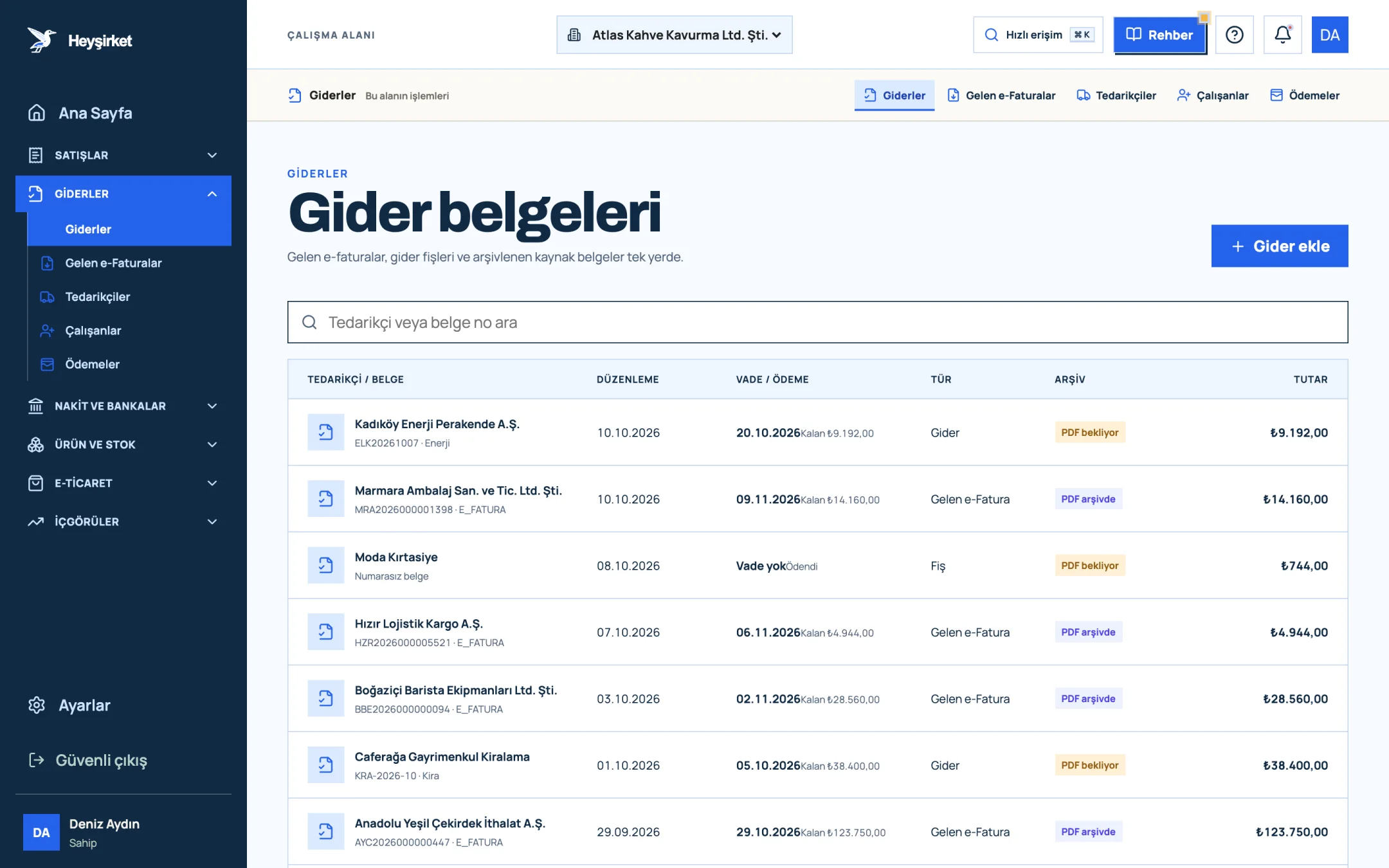
- 1. Add expense button
- 2. Due date and remaining payment
- 3. Document type (Expense, Incoming e-Fatura, Receipt)
- 4. Expense document row
Part 5 · Findings What are the most common findings in tax audits?
Most tax audit findings arise not from elaborate schemes but from everyday record-keeping habits. The table below summarises the issues found most often in SME audits and how to prevent them.
| Finding | Why is it a problem? | How to prevent it |
|---|---|---|
| Inflated cash balance | Money that isn't physically in the till raises suspicion of disguised profit distribution or unrecorded spending | Match the cash account to a physical count every month |
| Payables to / receivables from shareholders | Interest (adat) may need to be calculated on money made available to a shareholder | Record shareholder withdrawals and review them with your accountant |
| Non-business expenses | The expense and VAT deduction are rejected | Keep personal spending off the company card |
| Purchases whose genuineness can't be proven | Allegation of fake or misleading-content invoices | Keep the invoice, delivery note and bank payment together |
| Stock differences | Mismatch between recorded and physical stock, suspicion of unrecorded sales | Count stock at period ends and document any differences |
| Late invoices | Exceeding the invoicing deadline triggers a special irregularity penalty | Issue the invoice within the legal period after delivery |
| Current account mismatches | Customer and supplier records don't agree with the other party's | Reconcile at least once a year |
What this list has in common is simple: every transaction is confirmed by more than one document. When a sales invoice matches a collection record and, where needed, a delivery document, the inspector's questions are quickly answered.
- Quote / order — What, for how much, to whom?
- Delivery document — The goods really left
- Invoice — Within the legal period
- Collection — A bank or cash trail
- Account statement — Balance matches the other party
In Heyşirket, the links in this chain are kept in one place. A customer's account statement brings their invoices and collections side by side in date order, so the answer to the audit question “what happened with this customer over the year?” is on a single screen.
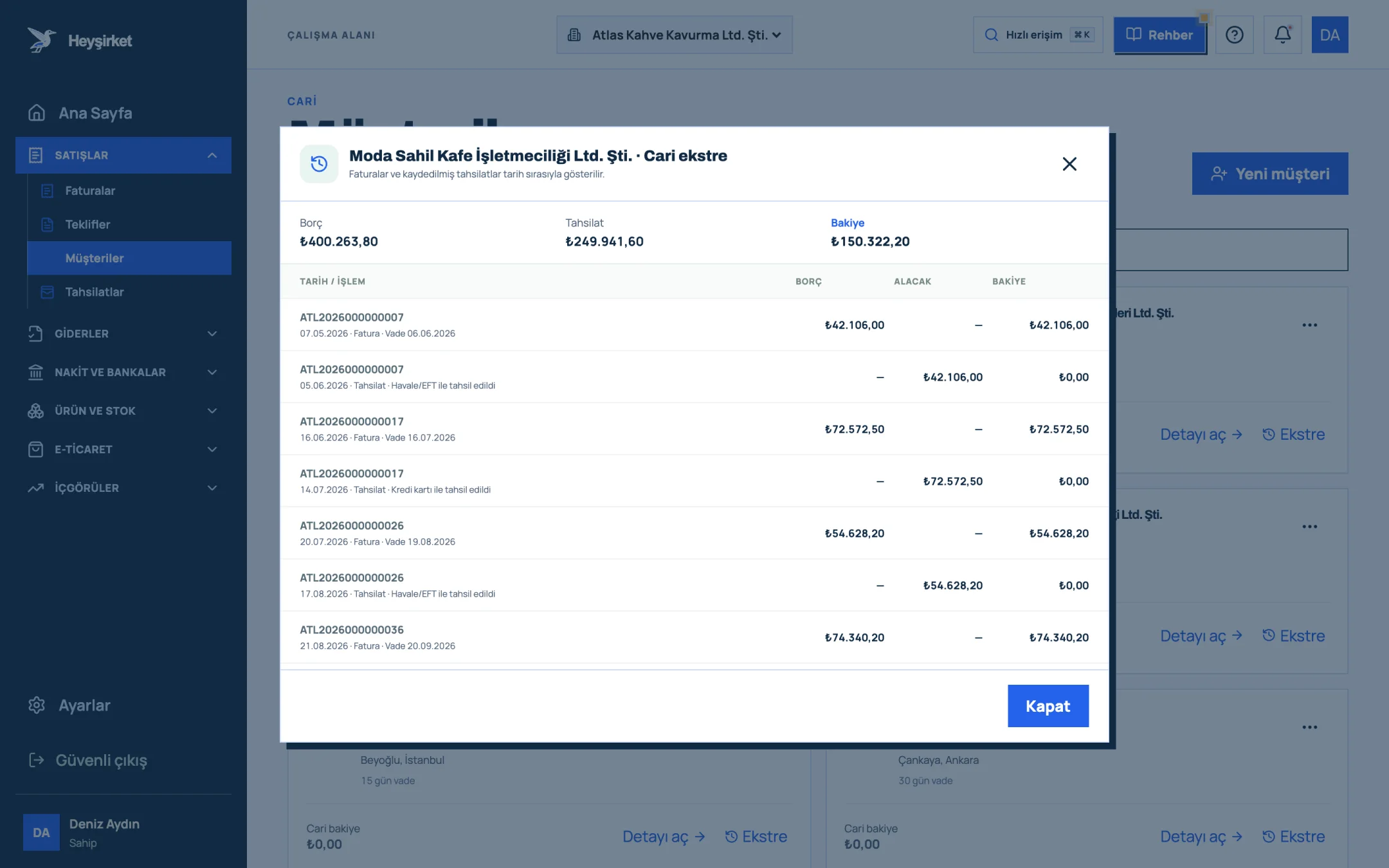
- 1. Account statement window
- 2. Statement transactions and balance
We explained how to reconcile in our current account reconciliation article, and how to document expenses in an audit-proof way in expense management and document organisation.
Part 6 · Audit day How should you act once the audit starts?
The right attitude during an audit is calm, cooperative and based on backing up every explanation with documents. The inspector's job is to establish whether the return was correct; yours is to show it with documents.
The first 15 days after the audit letter arrives
Call your accountant the same day
Share the letter, the periods requested and the document list with your accountant. Decide together who will handle communication with the inspector. If your accountant is on your team in Heyşirket, they can access the records directly.
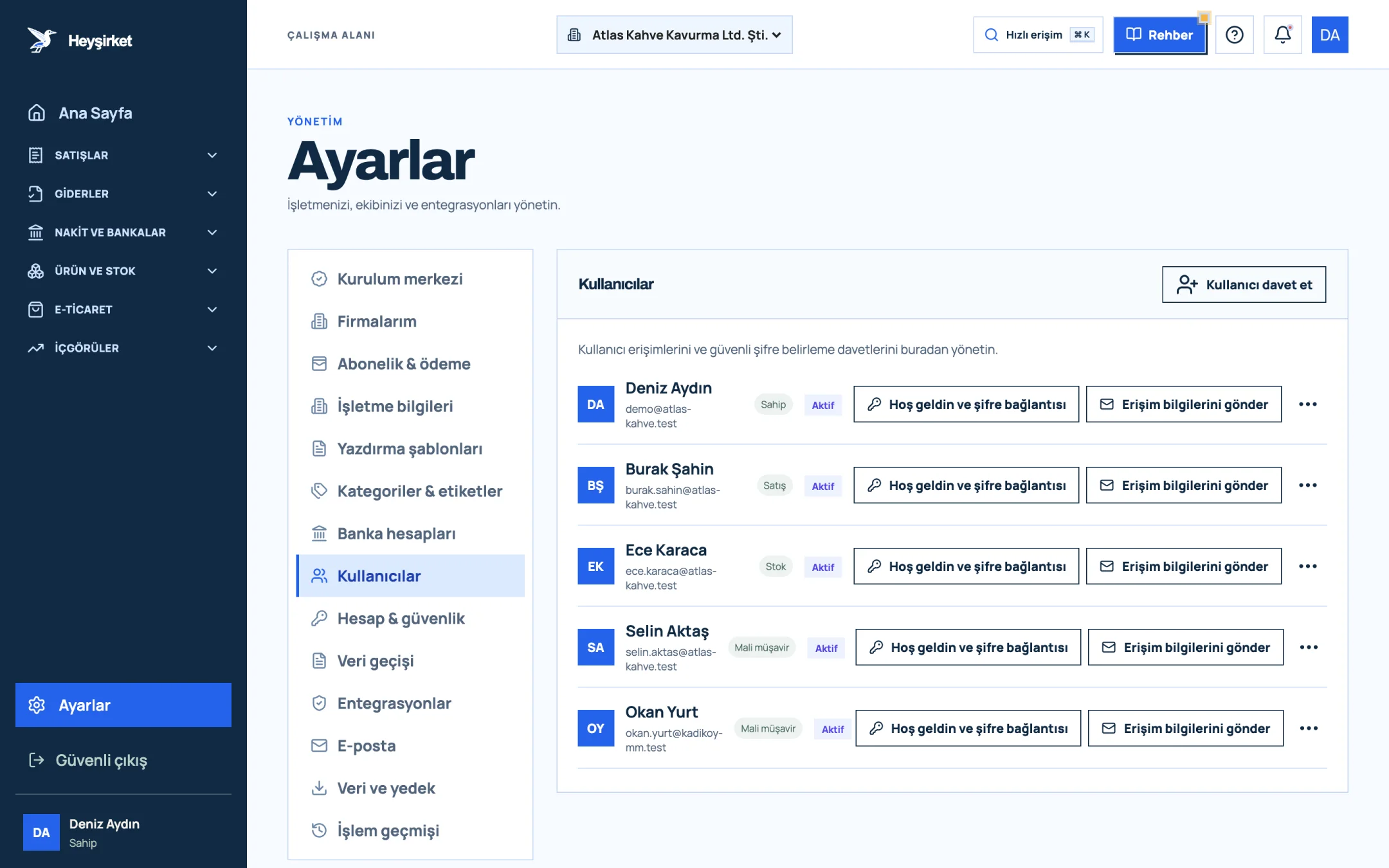
Call your accountant the same day - 1. Invite user
- 2. User role (Owner, Sales, Stock, Accountant)
- 3. Send access details
Pull sales documents period by period
On the Invoices screen, with the date filter set to All dates, export the list with Download CSV and separate out the rows for the audited period in a spreadsheet. Mark cancelled and return invoices separately.
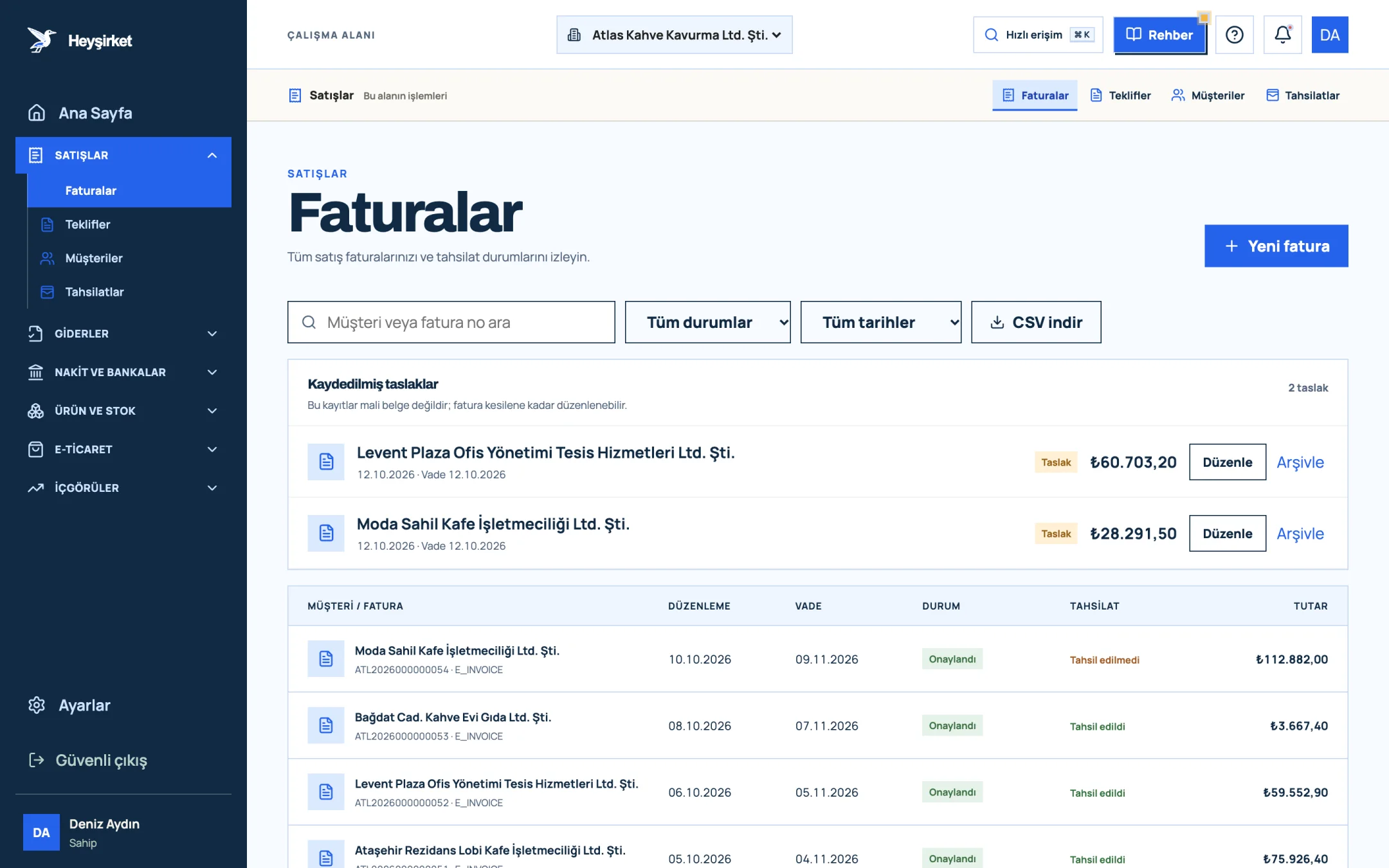
Pull sales documents period by period - 1. New invoice button
- 2. Search and filters
- 3. Collection status column
- 4. Saved invoice draft
Check the expense document archive
On the Expenses screen, find each document showing “PDF pending” in the Archive column; take the paper originals out of the folder and match them up.
Check the expense document archive - 1. Add expense button
- 2. Due date and remaining payment
- 3. Document type (Expense, Incoming e-Fatura, Receipt)
- 4. Expense document row
Verify cash and bank balances
Compare the account balances on the Cash and bank accounts screen with bank statements and a physical cash count; note any unexplained differences and discuss them with your accountant.
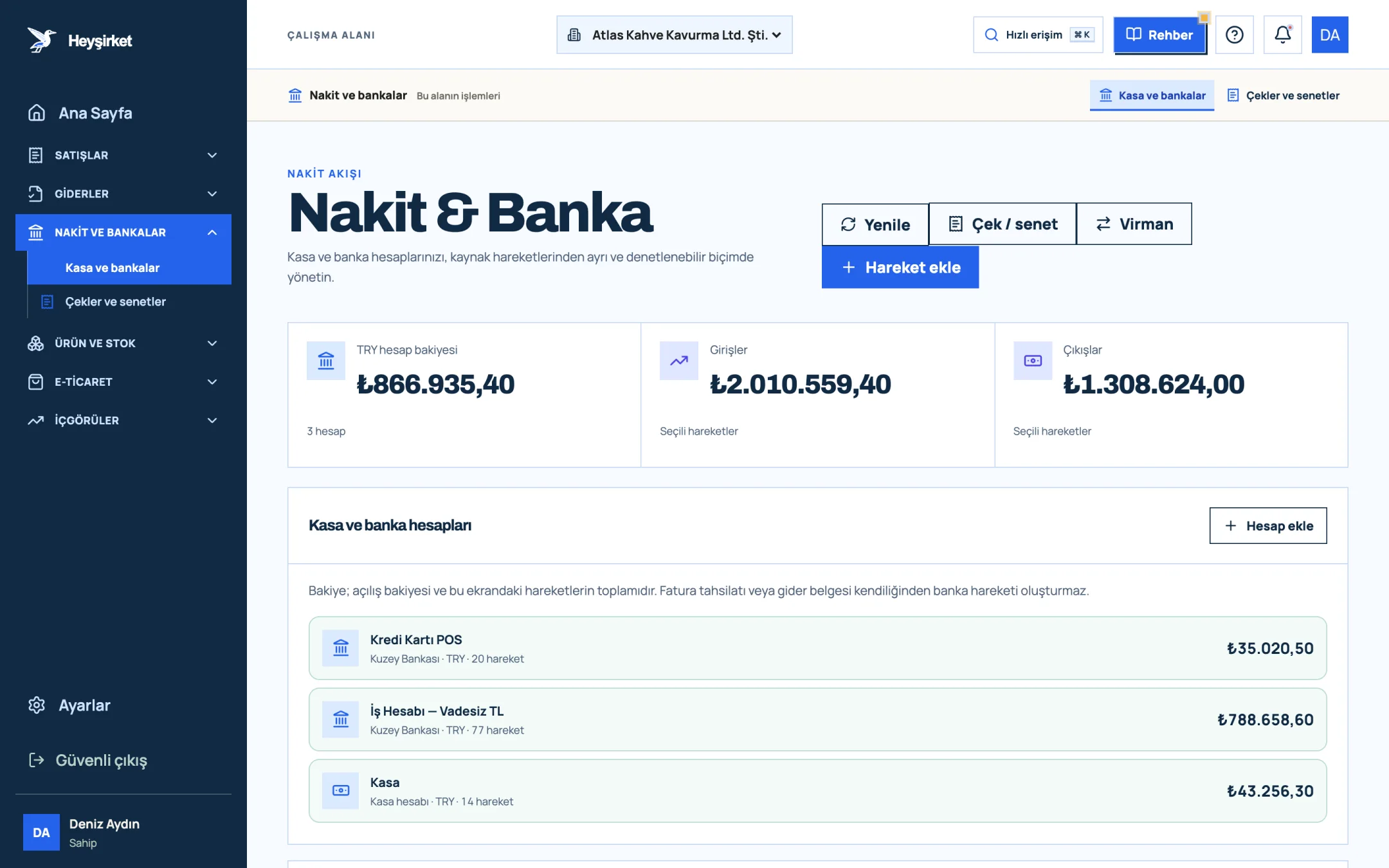
Verify cash and bank balances - 1. Add transaction button
- 2. Transfer between accounts
- 3. Total TRY balance
- 4. Cash and bank account list
Reconcile with your largest customers and suppliers
Send the statements for the accounts with the largest balances to your customers and suppliers and get confirmation; fix any mismatches before the audit.
Reconcile with your largest customers and suppliers - 1. Account statement window
- 2. Statement transactions and balance
- Provide only the documents requested, but provide everything requested, in full.
- Put verbal explanations in writing: Make sure important explanations are recorded in the official report.
- Don't sign reports without reading them: You have the right to sign with a written reservation (şerh) on any finding you disagree with.
- Make a list when handing over original documents: Record what you handed over and when with a handover report.
Part 7 · Preparation An audit preparation list you can start today
Audit preparation isn't a project that starts when the audit letter arrives; it's a small document routine repeated every month. Kept up regularly, the list below turns an audit letter into routine work rather than a panic.
Monthly and annual checks to be ready for a tax audit
- Is an invoice issued within the legal period for every sale, and are cancellation/return invoices tracked separately?
- Is every expense document business-related, recorded with the correct VAT rate, and is its original or PDF in the archive?
- For purchases from new suppliers, are the invoice, delivery note and bank payment kept together?
- Does the cash balance match a physical count every month?
- Are the amounts shareholders withdraw from and put into the company recorded?
- Is stock counted at period ends, with differences documented in a report?
- Are large current accounts reconciled at least once a year?
- Are lease, consultancy and loan agreements in a single folder and up to date?
- Are the books and documents for the last 10 years in an archive whose location you know?
- Can your accountant access your records, and is a monthly return reconciliation carried out?
- 1. Add transaction button
- 2. Transfer between accounts
- 3. Total TRY balance
- 4. Cash and bank account list
Most of these checks pile up at year end. You'll find which tasks to do in which order at year-end close in our year-end closing guide, and the monthly division of work with your accountant in working with an accountant. All filing dates are in the 2026 tax calendar article.
A business ready for an audit is a business that doesn't wait for the audit letter. A document routine closed every month answers today the question that will be asked five years from now.
Heyşirket knowledge center
How long does a tax audit take?
Under VUK Article 140, full audits are completed within one year at most and other audits within six months at most. If they can't be completed within these periods, an extension of up to six months may be granted. In practice, the duration depends on the scope of the audit and how quickly documents are submitted.
How many years back can an audit go?
A tax claim becomes time-barred if it isn't assessed and notified within five years from the start of the year following the calendar year in which it arose (VUK 114). That's why audits usually cover the last five years. Ask your accountant about special circumstances that suspend the limitation period.
What should I do when a yoklama officer arrives?
Ask to see their ID and authorisation document, answer questions accurately and briefly, and show your premises and business activity if asked. Read the yoklama report drawn up; if there's a finding you disagree with, sign it with a written reservation and keep a copy.
I use e-Fatura; do I still need to keep documents?
Yes. Electronic documents are also subject to the retention periods in the VUK and TTK and must be submitted when requested. The originals of non-electronic documents, such as paper receipts, contracts, bank receipts and stock count reports, must also be kept.
How does Heyşirket help me in an audit?
Heyşirket keeps your sales invoices, expense documents, collections and payments, cash and bank transactions and account statements in one place, and you can export lists with Download CSV. It doesn't keep statutory books (e-Defter) or file tax returns; those are your accountant's responsibility.
I noticed my mistake after the audit started. Can I make a voluntary disclosure?
No. Voluntary disclosure (pişmanlık) provisions apply to notifications made before the tax administration notices the issue and before an audit starts. For mistakes you notice after the audit has started, share them with the inspector and review options such as post-report settlement with your accountant.
Are any documents missing from your archive? Open the Expenses screen and complete the documents showing “PDF pending” in the Archive column today. Open expense documents
Author: Heyşirket Editorial Team