Sales process · 16 min read · Updated:
From quote to invoice: the B2B sales process that gets the money into your account
A sale isn't finished when the customer says “OK”; it's finished when the money lands in your account. Every step in between either protects your profit or quietly erodes it.

In short
- The B2B sales process is a chain of six links: quote, customer decision, order confirmation, delivery, invoice and collection.
- Every quote should set out the price, scope, validity period and payment terms in writing; any missing link comes back as a dispute on the invoice.
- A discount comes straight out of your gross margin: in a business working on a 30 percent margin, a 10 percent discount takes away a third of the profit.
- Payment terms are an interest-free loan you give the customer; setting a default payment term per customer automates collection tracking.
- Retyping the items of an accepted quote into the invoice by hand is the most common source of mistakes in the sales process.
Tuesday morning, Kadıköy. The founder of Atlas Kahve Kavurma is reading an email from Nişantaşı Bistro: “Let's take another 40 kilos at the price we discussed last month.” Which price? It was mentioned on the phone, nobody wrote it down, and the price of green coffee has gone up since then.
This small uncertainty sums up one of the most expensive problems in B2B sales. The product is good, the customer is happy; but because a link between the quote, the order and the invoice is broken, either profit or the customer is lost.
In this article we'll go through, one by one, the six links a sale passes through from quote to collection. At the end, a checklist is waiting that lets you find your weakest link in five minutes.
Part 1 · The big picture Why is the B2B sales process a chain?
The B2B sales process is the full set of connected steps from writing a quote to collecting the money. Each step uses the output of the one before it; if one is missing, the next step runs on guesswork.
- Quote — Price, scope, validity
- Customer decision — Accept or reject
- Order confirmation — Written approval
- Delivery — Goods or service
- Invoice — Official document
- Collection — Money in the bank
In small businesses, most of these links live in the founder's head. As the business grows, one person writes the quote, another prepares the order and a third issues the invoice. At that point, any information that isn't written down is bound to get lost.
The good news: you don't need a complex CRM to strengthen the chain. A few good habits at each link are enough. Let's start with the first link.
Part 2 · The art of the quote What does a good quote include?
A good quote is a one-page document that states, leaving no room for interpretation, who can buy what, in what quantity, at what price, on what terms and until when. When the customer reads it, they shouldn't need to ask any questions.
- Scope: Not “coffee” but “Espresso blend, 1 kg valve-sealed bag, whole bean”. For services: how many hours, how many people, where.
- Unit and quantity: Kilograms, units or hours? If you have tiered pricing, put each tier on a separate line.
- Price and VAT: State clearly whether prices exclude or include KDV (VAT). Unclear VAT is the most common invoice dispute.
- Validity date: The date until which the quote is binding.
- Payment terms: Upfront, 30 days, or with a partial advance?
- Delivery terms: Delivery time, who pays for shipping, minimum order quantity.
In Heyşirket, a quote is prepared in the window that opens with the New quote button on the Quotes screen. For items you pick from your saved products, the unit, price and VAT rate come from the product card; you write the payment and delivery terms in the Note field.
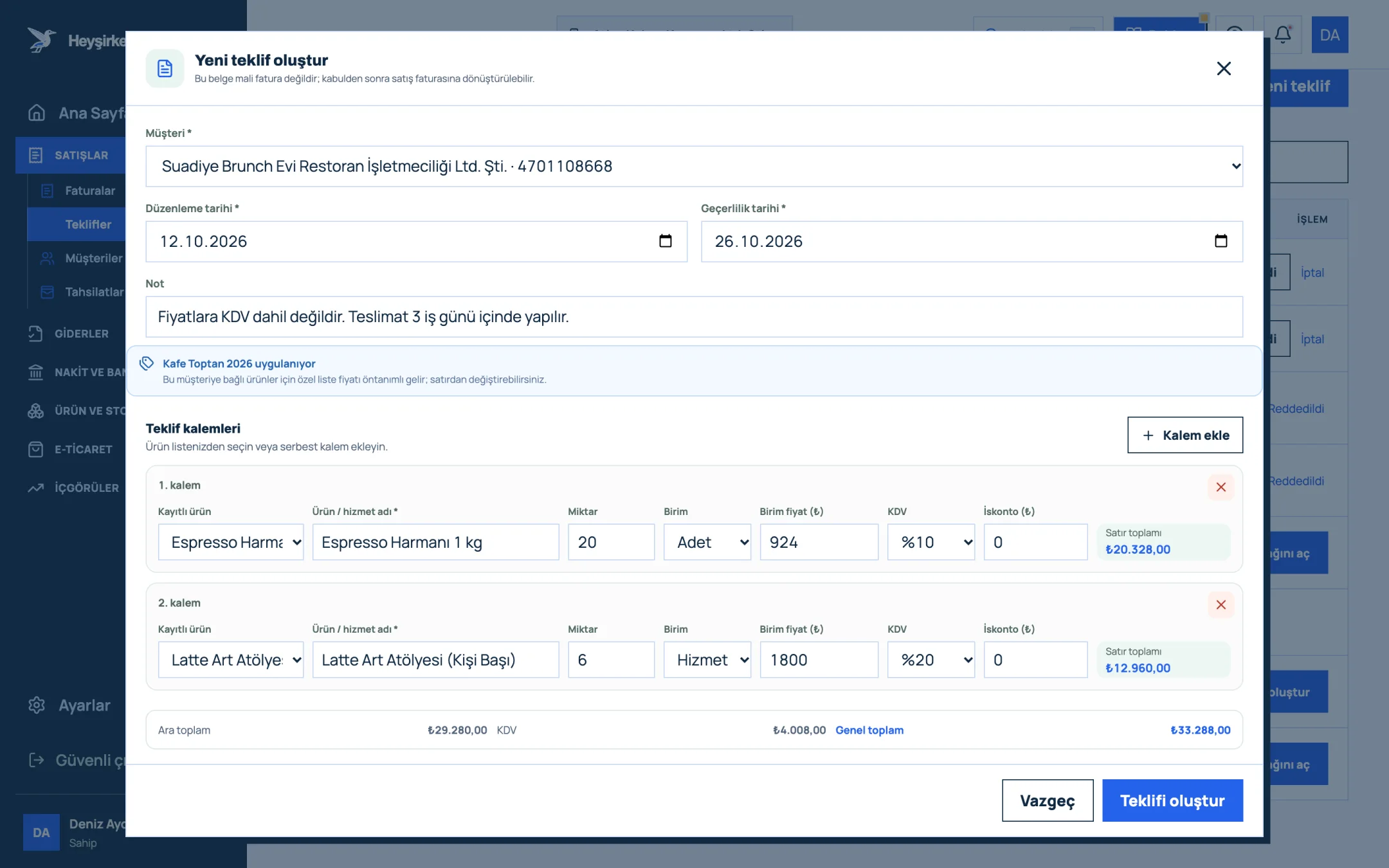
- 1. Customer and date fields
- 2. Quote line items
- 3. Add line item
- 4. Quote total
- 5. Create quote button
Part 3 · Time How long should a quote be valid for?
The validity period is the last date on which the prices and terms in the quote bind you. The right period depends on how fast your costs change: keep it short for products tied to exchange rates and commodities, and longer for services with fixed costs.
| Product / service type | Suggested period | Why? |
|---|---|---|
| Products with imported inputs (green coffee, equipment) | 7-14 days | Exchange rates and commodity prices change quickly |
| Local production, sold from stock | 14-30 days | Costs are relatively stable |
| Services such as consulting or training | 30 days | Costs are largely labour |
| Project-based work that reserves capacity | Keep it short and confirm capacity separately | Your calendar may fill up with other work |
Heyşirket sets the validity date on a new quote to 14 days ahead by default; you can change the date in the window. When the validity date of a draft or sent quote passes, it shows in the list as Expired.
An expired quote isn't a loss; it's an opportunity. It gives you a natural reason to call the customer and say “We've updated our prices, let me send you a new quote.” So how much room do you have to flex on that new quote? That's where discount discipline comes in.
Part 4 · Discount discipline How does a discount erode your profit?
A discount is a reduction from the sales price, and all of it comes straight out of your gross profit. Because your cost doesn't change, a 10 percent discount takes not 10 percent of your profit but much more.
| Sale at list price (40 kg × 900 TL, excl. VAT) | 36.000 TL |
|---|---|
| Product cost (40 kg × 630 TL) | 25.200 TL |
| Gross profit without discount (30 percent margin) | 10.800 TL |
| 10 percent discount amount | -3.600 TL |
| Gross profit with discount | 7.200 TL |
| Loss of profit | 33 percent (from 10.800 TL to 7.200 TL) |
To keep the same profit at the discounted price you'd need to sell 60 kg; that means increasing sales volume by 50 percent. The figures are an example; calculate with your own costs.
That's why a discount shouldn't be a negotiating reflex but a concession given in return for something. If the customer commits to a larger quantity, shorter payment terms or a long-term commitment, a discount makes sense; if not, it's a gift.
- Tiered discounts: Predefined steps such as 3 percent above 20 kg and 6 percent above 50 kg.
- Early payment discount: A small discount for paying upfront instead of on terms. The present value of money often covers the discount.
- Contract customer pricing: A special price list for regular customers instead of one-off discounts.
In Heyşirket, the discount is entered per line on quotes and invoices as a TL amount, and VAT is calculated on the amount remaining after the discount. If you set up a price list for regular customers, the special prices fill in automatically when you select that customer; you don't renegotiate on every quote.
Part 5 · Payment terms How do you set payment terms and due dates?
The due date is the last date by which the invoice must be paid, and in effect it's an interest-free loan you give your customer. When you make a 100.000 TL sale on 30-day terms, you're using that money to finance your customer's business for a month.
Ask three questions when setting payment terms: What's the customer's payment history? On what terms do you pay your own supplier? Do you have a cash buffer to carry these terms? If you pay your supplier in 15 days and give your customer 60 days, the 45 days in between come out of your pocket.
In Heyşirket every customer card has Default payment term (days) and Credit limit (₺) fields. When you select a customer with a default payment term on an invoice, the due date is calculated automatically; the credit limit also shows on the customer card. That way payment terms depend on company policy, not on how generous the sales rep happens to feel that day.
Part 6 · Acceptance Why does order confirmation matter?
An order confirmation is a written record that the customer has accepted your quote and on what terms they are placing the order. It can be an email reply, a signed quote or a purchase order number; what matters is that the verbal approval is put in writing.
Delivering without confirmation leaves the door open to disputes on the invoice. The only document you can put up against sentences like “That price was last month's” or “We said 20 kilos” is the quote the customer accepted.
In Heyşirket you record the customer's decision with the Accepted or Rejected buttons on the quote's row. If Send quote status updates to the customer is turned on in Settings, the status change is also emailed to the customer; the acceptance is on record for both sides.
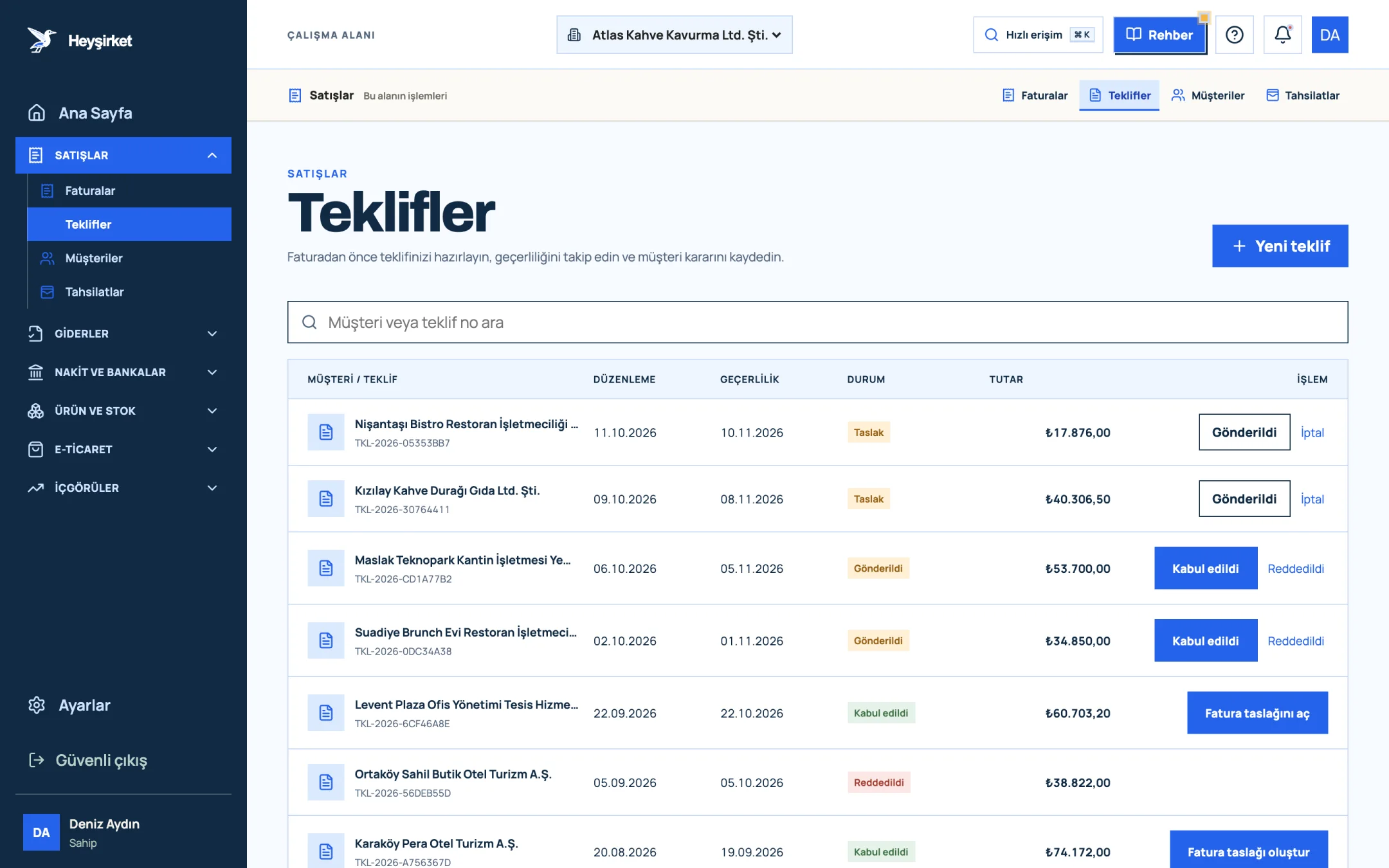
- 1. New quote button
- 2. Quote status (Accepted)
- 3. Create invoice draft
- 4. Decision buttons for a sent quote
Don't delete rejected quotes. Seeing at which price level and with which type of customer you lose deals is the most valuable data for your next pricing decision. We also cover this in our pricing strategy article.
Part 7 · The invoice How does an accepted quote turn into an invoice?
After delivery, an accepted quote becomes a sales invoice; the invoice should reflect the quote's items, prices and discounts exactly. The biggest risk at this step is retyping the items from the quote into the invoice by hand.
In Heyşirket, the Create invoice draft button on an accepted quote's row opens an invoice draft with the same customer and items. The quote number is written automatically in the invoice note, so the customer's accounting team can match the invoice to the quote in their own records straight away. Because only one draft is created per quote, the same order isn't invoiced twice.
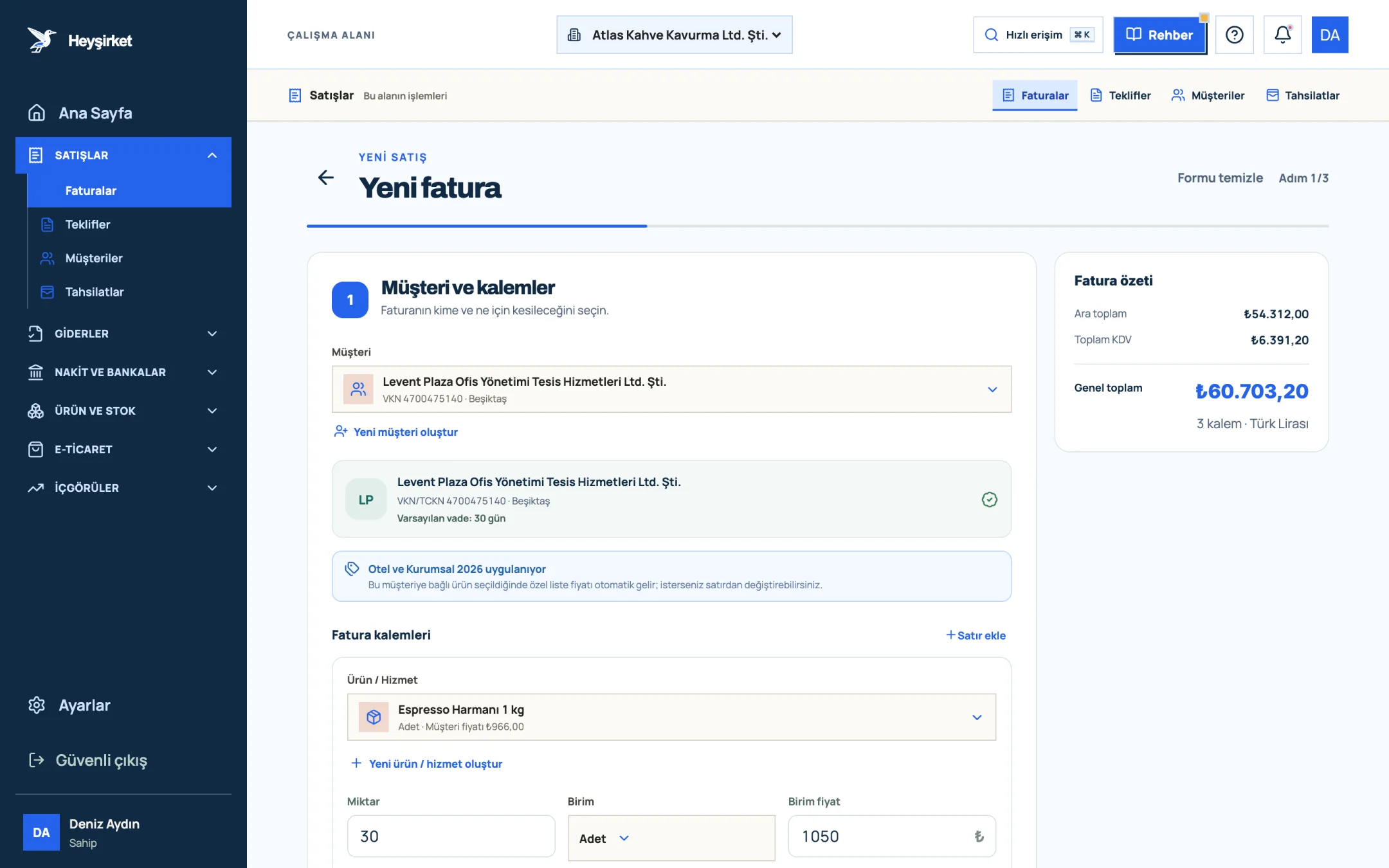
- 1. Customer carried over from the quote
- 2. Line items from the quote
- 3. Customer price list note
- 4. Invoice summary
Two checks remain on the draft. First, the due date: the draft's dates are set to the day of conversion, so adjust them to the payment terms agreed with the customer. Second, timing: the invoice must be issued within the legal period after delivery.
You'll find the steps for issuing the invoice in the how to issue an invoice guide, and whether the document will be an e-Fatura (Turkish e-invoice) or an e-Arşiv (e-archive) invoice in our article on the difference between e-Fatura and e-Arşiv. The invoice is issued; but the sale isn't over yet.
Part 8 · The money Collection: the last link in the sale
Collection means actually receiving the invoiced amount from the customer, and it's the only true measure of a sale's success. An uncollected sale is income in the books; in the bank, it's zero.
There's a principle in commercial life: under Article 21 of the Turkish Commercial Code, a person who receives an invoice and doesn't object to its content within eight days of receiving it is deemed to have accepted that content. That's why delivering the invoice quickly and in a provable way is the first step of collection.
In Heyşirket, when an invoice is issued and automatic sending is turned on in Settings, the customer receives an email with the official PDF attached. For invoices nearing or past their due date, you send a payment reminder in one click with the Send reminder button in the Invoice details window; the reminder is logged in the invoice history.
When a payment arrives, recording it against the invoice always shows accurately which invoices are still open. Details are in the how to record a customer payment guide; tactics for late receivables are in our article on speeding up collections.
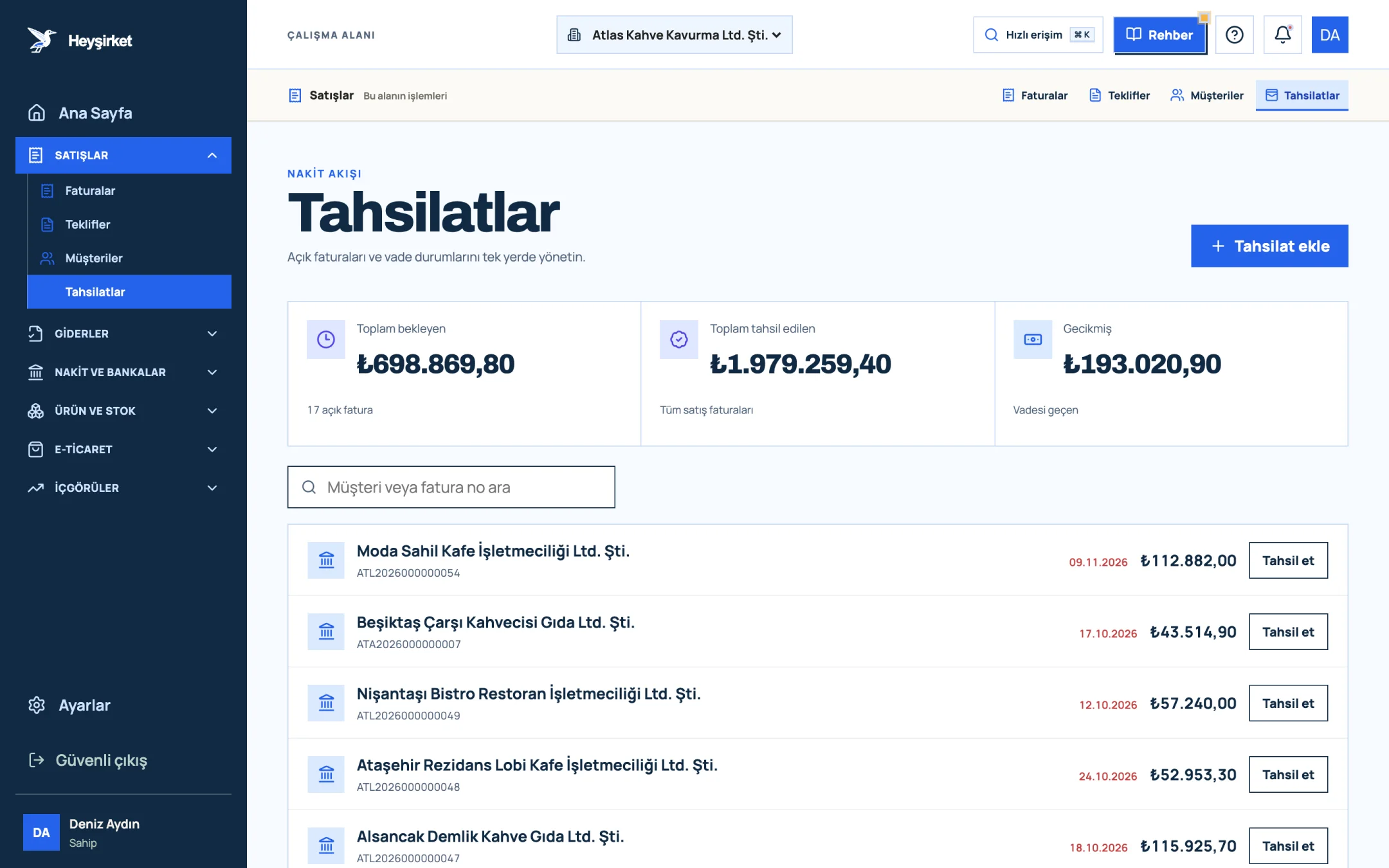
- 1. Add collection button
- 2. Total pending receivables
- 3. Total overdue receivables
- 4. Per-row Collect button
Part 9 · Measurement How do you measure the process?
Measuring the sales process means seeing in numbers how much business you lose and how long you wait at each link. Three simple ratios are enough for most SMEs.
| Indicator | How is it calculated? | What does it tell you? |
|---|---|---|
| Quote acceptance rate | Number of accepted quotes ÷ number of quotes sent | Are your prices and quote quality right for the market? |
| Quote-to-invoice time | Invoice date − quote date (average days) | How fast are your decision and delivery processes? |
| Average collection time | Payment date − invoice date (average days) | Is your payment terms policy being followed? |
For example, if you send 25 quotes a month and 10 are accepted, your acceptance rate is 40 percent. If the rate drops below 20 percent, question your pricing; if it rises above 80 percent, ask whether you might be selling too cheaply.
Part 10 · In practice Your sales process checklist
Compare the list below with your sales over the past month. Every item you can't tick shows a weak link in your chain.
Quote-to-collection checklist
- Every quote states the scope, quantity, unit, VAT treatment, validity date and payment terms in writing.
- The validity period is set according to how volatile the product's costs are.
- Discounts follow predefined rules and are given in return for something.
- Regular customers have a special price list set up.
- The customer's decision (accept or reject) is recorded on the quote.
- The invoice is generated from the accepted quote; items aren't retyped by hand.
- The invoice is issued within seven days of delivery.
- Every customer has a default payment term and credit limit set.
- Overdue invoices are reviewed weekly and reminders are sent.
- The quote acceptance rate and average collection time are calculated once a month.
Back to Tuesday morning. If the accepted quote had been in front of him when Nişantaşı Bistro's email arrived, the reply would have taken a minute: “Our quote from last month has expired; please find our new quote with current prices attached.” No uncertainty, no haggling, no lost profit.
What's the difference between a quote and a proforma invoice?
Neither is a financial document and neither creates a tax liability. A quote is a pre-sale proposal of price and terms; a proforma is usually issued as a preliminary invoice for an accepted order, for example to request an advance payment or for import procedures.
Is a quote validity period legally required?
There's no general legal period for quote validity; however, for quotes with no stated period, how long you're bound by them can become a matter of dispute. Writing a clear validity date on every quote is the safest approach.
Do I have to show the discount separately on the invoice?
When the discount is shown separately on the invoice, the VAT base is calculated on the amount after the discount and the customer can clearly see how much discount they received. In Heyşirket the discount is entered per line and appears in a separate column and on the Total discount line of the PDF.
What should I do if I need to change the price on an accepted quote?
Confirm the new price with the customer in writing. In Heyşirket, once the quote has been converted into an invoice draft you can edit the price on the draft; just make sure the change is based on the customer's approval.
When should I send a reminder for an overdue invoice?
A polite reminder a few days before the due date and a second reminder within the first week after the due date is a good start. In Heyşirket, the Send reminder button in the Invoice details window does this in one click.
Strengthen the first link in the chain Prepare your next quote in Heyşirket; when it's accepted, move to an invoice draft in one click. Create a quote
If you have any questions, you can write to info@heysirket.com or reach us on WhatsApp at 0530 681 36 16.
Author: Heyşirket Editorial Team